On this page
- 01Key takeaways
- 02What does end-to-end process outsourcing include?
- 03When does end-to-end beat splitting a process?
- 04What do you need in place first?
- 05What are the risks, and how do you manage them?
- 06What does this look like in practice?
- 07End-to-end readiness checklist
- 08Next step
- 09Sources and further reading
- 10Frequently asked questions
Key takeaways
End-to-end process outsourcing means one provider runs a whole process, from the trigger that starts it to the output that ends it, against measures you agree. It removes internal handoffs and gives one point of accountability. It works best for high-volume processes with a stable method, and needs strong measures and an exit plan.
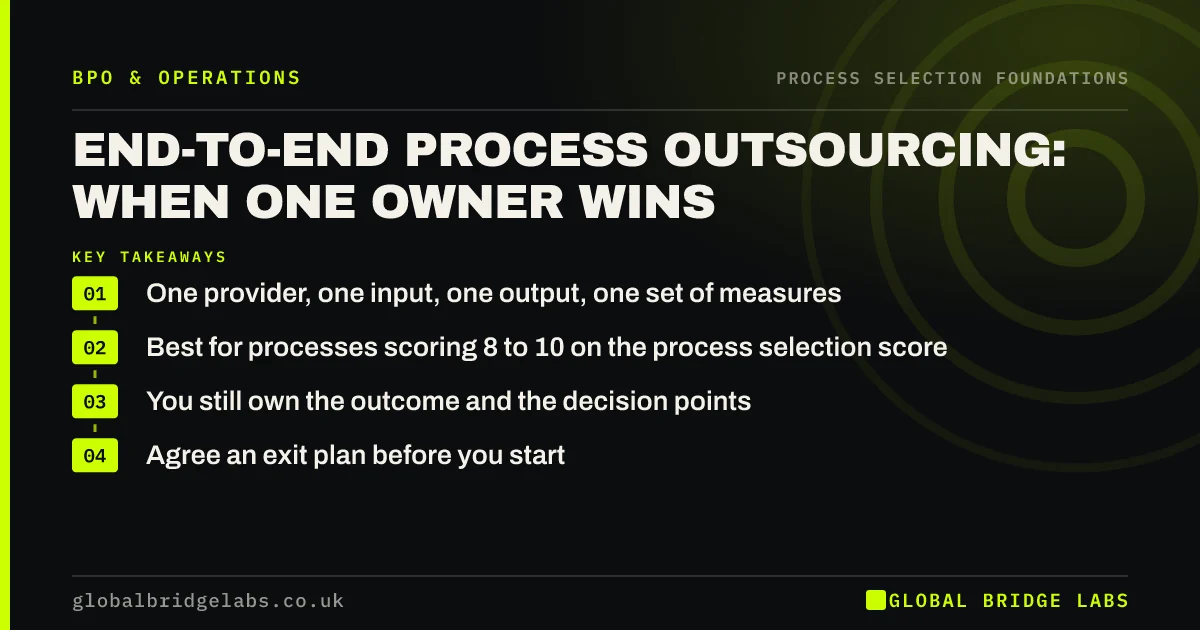
- One provider, one input, one output, one set of measures.
- Best for processes scoring 8 to 10 on the process selection score.
- You still own the outcome and the decision points.
- Agree an exit plan before you start.
Considering handing over a whole process? Message us on WhatsApp with which one.
Chat on WhatsApp →What does end-to-end process outsourcing include?
It includes every routine step between the trigger and the output: receiving the work, checking it, processing it, handling standard exceptions and reporting. For supplier invoices that means intake, coding, matching, queries to suppliers and queuing for payment. Your team keeps any approvals and handles escalations the provider cannot resolve under the agreed rules.
When does end-to-end beat splitting a process?
End-to-end wins when the process has few judgement points, steady volume and handoffs that cause delay or errors today. Every internal handoff you remove is a queue you no longer manage. Splitting wins when judgement points are frequent, because each one would bounce work back to your team and slow the provider down.
- Few judgement points: end-to-end.
- Many judgement points: split.
- Errors at handoffs today: end-to-end.
- Method still changing: neither yet.
What do you need in place first?
You need written steps, clear exception rules, measures for speed and accuracy, and access to every system the process touches. You also need a named internal owner who reviews results weekly at first. Without these, end-to-end outsourcing moves the confusion to a provider rather than removing it.
- Document your processes before you outsource
- Exception handling: the few cases that drive most cost
- BPO SLA examples you can adapt
Want a list of what to prepare for one process? Message us on WhatsApp.
Chat on WhatsApp →What are the risks, and how do you manage them?
The main risks are losing knowledge of how the process works, dependence on one provider, and slow detection of quality drift. Keep the written method current and owned by you, review a sample of output every month, and agree in the contract how the process and its data come back to you if you end the arrangement.
What does this look like in practice?
A pattern we see: a process that took three people and two spreadsheets in-house becomes one queue with one owner once it is outsourced end to end. The biggest gain is usually fewer things waiting, not faster individual steps.
End-to-end readiness checklist
Check these before handing over a whole process.
- The process scores 8 or more.
- Steps and exception rules are written.
- Speed and accuracy measures are agreed.
- System access is defined for each step.
- An internal owner reviews results weekly.
- The contract covers exit and data return.
Next step
Tell us which process you are considering for end-to-end outsourcing. We will tell you whether it is ready, what to prepare and where we would keep a decision point in-house.
Message us on WhatsApp, or book a 30-minute consultation.
Chat on WhatsApp →Sources and further reading
- The Sourcing and Consultancy Playbooks · Cabinet Office
- Contracts and liabilities between controllers and processors · Information Commissioner's Office
Frequently asked questions
What is end-to-end process outsourcing?
End-to-end process outsourcing is handing one provider responsibility for every routine step of a process, from the trigger that starts it to the output that ends it, against agreed measures. The business keeps any approvals and the escalations the provider cannot resolve under the agreed rules.
Which processes suit end-to-end outsourcing?
Processes with steady volume, a stable written method, few judgement points and measurable outputs. Supplier invoice processing, first-line customer email, data upkeep and HR admin are common examples. Processes with frequent judgement calls are usually better split between your team and the provider.
Do you lose control by outsourcing a whole process?
Not if you keep ownership of the outcome. Agree measures for speed and accuracy, review a sample of output regularly, keep approvals and escalations in-house, keep the written method current and owned by you, and write data return and exit terms into the contract before you start.
Written by

Global Bridge Labs (GBL) is a UK–Sri Lanka partner for social media, websites and BPO. Everything here comes from client delivery, not theory.