On this page
- 01Key takeaways
- 02What risks should an outsourcing register list?
- 03How do you rate each risk?
- 04Which controls work for outsourced processes?
- 05When is a risk register too much?
- 06What does this look like in practice?
- 07Risk register checklist
- 08Next step
- 09Sources and further reading
- 10Frequently asked questions
Key takeaways
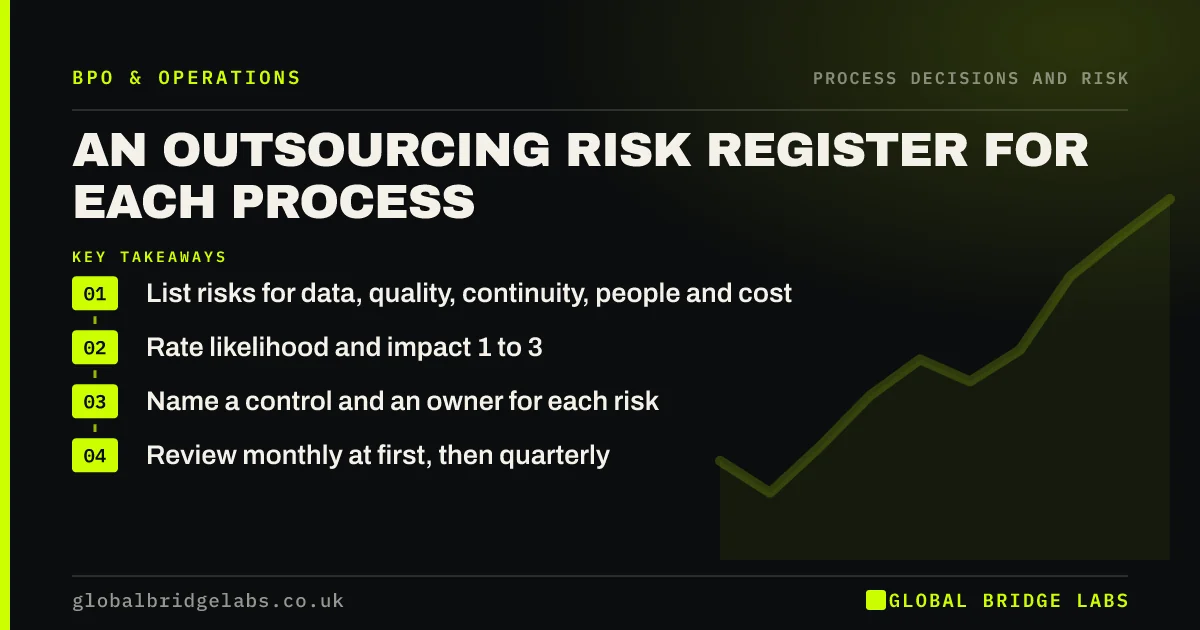
An outsourcing risk register lists, for each outsourced process, what could go wrong, how likely and serious it is, the control in place and who owns it. Keep it to one page per process. Review it before go-live, monthly for the first quarter, then quarterly. Regulated firms are expected to assess outsourcing risk as part of their oversight.
- List risks for data, quality, continuity, people and cost.
- Rate likelihood and impact 1 to 3.
- Name a control and an owner for each risk.
- Review monthly at first, then quarterly.
Want an outsourcing risk register template? Message us on WhatsApp.
Chat on WhatsApp →What risks should an outsourcing register list?
Five groups cover most processes. Data: breach, misuse, unlawful transfer. Quality: errors, drift, misunderstanding. Continuity: provider outage, staff turnover, key person loss. People: TUPE, morale, knowledge loss in your team. Cost: scope creep, price rises, exit costs.
- Data risks.
- Quality risks.
- Continuity risks.
- People risks.
- Cost risks.
How do you rate each risk?
Score likelihood and impact from 1 (low) to 3 (high) and multiply. A score of 6 or 9 needs a strong control and monthly attention. A score of 3 or 4 needs a control and quarterly review. Lower scores can be accepted and noted.
Which controls work for outsourced processes?
Processor contracts and limited access for data risks. Sampling and measures for quality. Continuity plans and back-up staff for continuity. Early communication and knowledge capture for people risks. Clear scope, change control and exit terms for cost. Each control needs an owner, or it is a hope rather than a control.
- Data security with an outsourced team
- Business continuity for outsourced operations
- Scope creep in outsourcing: how extra work erodes savings
Want controls suggested for your top risks? Message us on WhatsApp.
Chat on WhatsApp →When is a risk register too much?
For a small, low-risk process, a few lines in your process register may be enough. A separate register earns its place for critical, regulated or data-heavy processes, and for any process where a regulator or customer may ask how you manage outsourcing risk.
What does this look like in practice?
A pattern we see: risk registers are written for the contract and never opened again. Reviewing the top three risks in each monthly provider meeting keeps the register useful.
Risk register checklist
Include these for each process.
- Risks across the five groups.
- Likelihood and impact scores.
- Control for each risk.
- Owner for each control.
- Review date.
- Top three risks in each monthly review.
Next step
Tell us which process you plan to outsource. We will suggest the risks we would put on its register and the controls we would expect.
Message us on WhatsApp, or book a 30-minute consultation.
Chat on WhatsApp →Sources and further reading
- FCA Handbook SYSC 8: Outsourcing · Financial Conduct Authority
- Contracts and liabilities between controllers and processors · Information Commissioner's Office
- Small organisations guide to cyber security · National Cyber Security Centre
Frequently asked questions
What should an outsourcing risk register include?
For each outsourced process: the risks across data, quality, continuity, people and cost; a likelihood and impact score for each; the control in place; who owns that control; and the next review date. One page per process is usually enough.
How do you assess outsourcing risk?
List what could go wrong, score each risk for likelihood and impact on a simple scale such as 1 to 3, multiply the scores, and focus controls on the highest. Check the controls actually work through sampling, reports and tests.
How often should an outsourcing risk register be reviewed?
Before go-live, monthly for the first quarter, then quarterly. Review it again after any incident, change of scope or change of provider staff. Discussing the top three risks in each regular provider meeting keeps it current.
Written by

Global Bridge Labs (GBL) is a UK–Sri Lanka partner for social media, websites and BPO. Everything here comes from client delivery, not theory.