On this page
Key takeaways
Data annotation outsourcing hands the labelling of text, images or documents to a trained team so an AI model can learn from them. It suits outsourcing because the work is high volume and rule-based once the labelling guide is written. Quality depends on clear guidelines and checks for agreement between labellers. Personal data needs a processor contract and transfer safeguards.
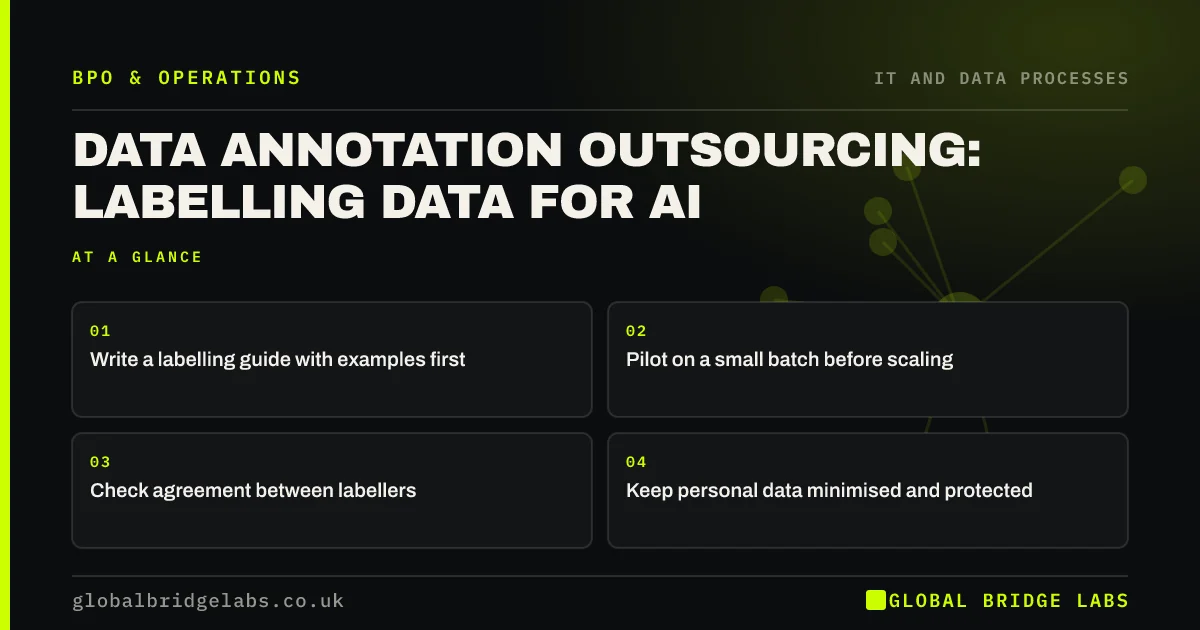
- Write a labelling guide with examples first.
- Pilot on a small batch before scaling.
- Check agreement between labellers.
- Keep personal data minimised and protected.
Planning an AI project that needs labelled data? Message us on WhatsApp.
Chat on WhatsApp →What does data annotation involve?
Annotators tag items according to a guide: classifying emails by topic, marking fields on invoices, labelling objects in images or rating whether answers are correct. The labelled data trains or tests an AI model. The work is repetitive and needs concentration, consistency and clear rules for edge cases.
When should you outsource annotation?
When volumes run into thousands of items, when your experts' time is too valuable for labelling, or when you need it done quickly. Keep the labelling guide, edge-case decisions and final quality sign-off in-house, because they define what the model learns.
- Outsource: labelling at volume, first-level checks.
- Keep: the guide, edge cases, final quality sign-off.
How do you check annotation quality?
Have a sample labelled by two people and measure how often they agree. Low agreement usually means the guide is unclear, not that labellers are careless. Review disagreements, update the guide with examples, and keep a gold set of items with known correct labels to test new annotators.
- Quality sampling: how many outsourced items to check
- Can you measure it? The test every outsourced process needs
Want a labelling guide template? Message us on WhatsApp.
Chat on WhatsApp →What data protection rules apply?
If the data includes personal information, you need a lawful basis, a processor contract and, for offshore teams, a transfer mechanism such as the IDTA. Remove or mask personal details the labellers do not need. Special category data, such as health records, needs extra care and may not be suitable for offshore annotation.
What does this look like in practice?
A pattern we see: annotation projects stall because the guide was written before anyone tried labelling. A 200-item pilot exposes the unclear cases early, when they are cheap to fix.
Data annotation checklist
Prepare these before scaling.
- Labelling guide with examples.
- Pilot batch of a few hundred items.
- Agreement check between two labellers.
- Gold set for testing.
- Personal data minimised or masked.
- Processor contract and transfer mechanism.
Next step
Tell us what data you need labelled and roughly how much. We will suggest how to pilot it and what the guide would need to cover.
Message us on WhatsApp, or book a 30-minute consultation.
Chat on WhatsApp →Sources and further reading
- International transfers of personal data · Information Commissioner's Office
- Contracts and liabilities between controllers and processors · Information Commissioner's Office
- The probability of automation in England: 2011 and 2017 · Office for National Statistics
Frequently asked questions
What is data annotation?
Data annotation is labelling data, such as text, images, audio or documents, according to set rules so it can be used to train or test an AI model. Examples include tagging emails by topic, marking fields on invoices and labelling objects in images.
Can data annotation be outsourced safely?
Yes, with a clear labelling guide, quality checks, and data protection safeguards. Minimise or mask personal data, use a processor contract, and put a transfer mechanism such as the IDTA in place for offshore teams. Keep the guide and final quality sign-off in-house.
How do you measure annotation quality?
Have a sample labelled independently by two annotators and measure how often they agree. Use a gold set of items with known correct labels to test annotators. Low agreement usually means the guide needs clearer rules and more examples.
Written by

Global Bridge Labs (GBL) is a UK–Sri Lanka partner for social media, websites and BPO. Everything here comes from client delivery, not theory.