On this page
- 01Key takeaways
- 02How do you tell key suppliers from the rest?
- 03Why do key relationships stay with the owner?
- 04Which supplier work can be outsourced?
- 05When can a key relationship be delegated?
- 06What does this look like in practice?
- 07Supplier relationship checklist
- 08Next step
- 09Sources and further reading
- 10Frequently asked questions
Key takeaways
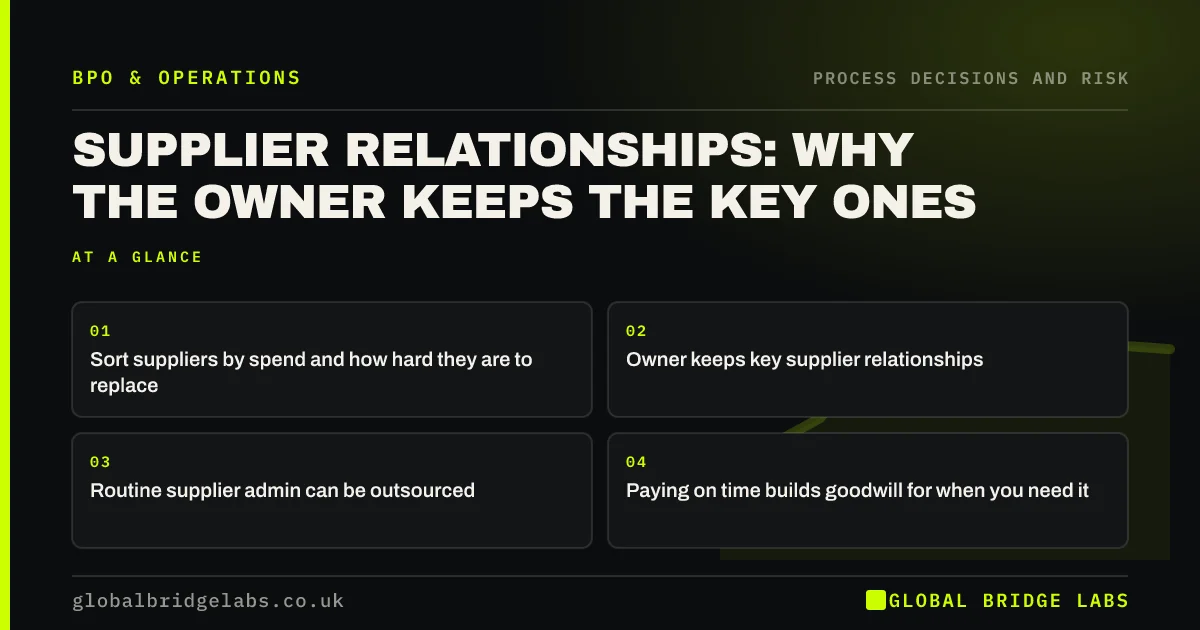
Supplier relationship management in a small business means knowing which suppliers you depend on and investing in those relationships. Key suppliers, the ones you could not replace quickly, stay with the owner or a senior person. Routine supplier admin, such as orders, chasing, records and scorecards, outsources well. Pay on time: it is the cheapest relationship investment there is.
- Sort suppliers by spend and how hard they are to replace.
- Owner keeps key supplier relationships.
- Routine supplier admin can be outsourced.
- Paying on time builds goodwill for when you need it.
Want help sorting your suppliers into key and routine? Message us on WhatsApp.
Chat on WhatsApp →How do you tell key suppliers from the rest?
Plot each supplier on two questions: how much you spend with them, and how hard they would be to replace. Suppliers that are hard to replace, whatever the spend, are key. They might be a specialist component maker, a software platform you run on, or a subcontractor with skills you cannot find elsewhere.
- High spend, hard to replace: key.
- Low spend, hard to replace: key, often overlooked.
- High spend, easy to replace: manage on price.
- Low spend, easy to replace: routine.
Why do key relationships stay with the owner?
Because they are worth most when something goes wrong: a shortage, a price rise, an urgent order. Suppliers prioritise customers they know and trust. That trust comes from senior contact, honest communication and reliable payment, which cannot be delegated to an admin team.
Which supplier work can be outsourced?
Orders, delivery chasing, invoice queries, supplier records, statement reconciliations, performance scorecards and renewal reminders. These keep the relationship running smoothly and give the owner facts for the conversations that matter.
- Supplier performance reviews: score the suppliers you rely on
- Supplier statement reconciliation: catch missing invoices
Want your supplier admin run for you? Message us on WhatsApp.
Chat on WhatsApp →When can a key relationship be delegated?
When a senior manager inside the business, not an outside provider, takes it on with authority to make commitments. The test is whether the supplier would accept that person's word in a crisis.
What does this look like in practice?
A pattern we see: when supply gets tight, suppliers allocate stock to the customers they know and who pay on time. Owners who kept those relationships warm in quiet periods get served first.
Supplier relationship checklist
Review these twice a year.
- Suppliers sorted by spend and replaceability.
- Named senior contact for each key supplier.
- Regular conversations, not just at problems.
- Payments made on agreed terms.
- Routine admin handed to a set owner.
Next step
Send us a list of your suppliers with rough annual spend. We will help you sort them and say which admin could move.
Message us on WhatsApp, or book a 30-minute consultation.
Chat on WhatsApp →Sources and further reading
Frequently asked questions
What is supplier relationship management?
Supplier relationship management is deciding which suppliers matter most to the business and managing those relationships actively, through regular contact, fair dealing and reliable payment, so they support you when supply is tight or problems arise.
Can supplier relationship management be outsourced?
Routine supplier admin can be: orders, chasing, records, reconciliations and scorecards. Relationships with key suppliers, the ones you could not replace quickly, should stay with the owner or a senior manager who can make commitments.
How do you identify key suppliers?
Look at how much you spend with each supplier and how hard they would be to replace. Any supplier that would be hard to replace quickly is key, even if spend is low, because losing them could stop the business.
Written by

Global Bridge Labs (GBL) is a UK–Sri Lanka partner for social media, websites and BPO. Everything here comes from client delivery, not theory.