On this page
- 01Key takeaways
- 02What goes in a management accounts pack?
- 03Which parts of management accounts can be outsourced?
- 04What should the owner keep?
- 05When is outsourcing management accounts the wrong move?
- 06What does this look like in practice?
- 07Management accounts checklist
- 08Next step
- 09Sources and further reading
- 10Frequently asked questions
Key takeaways
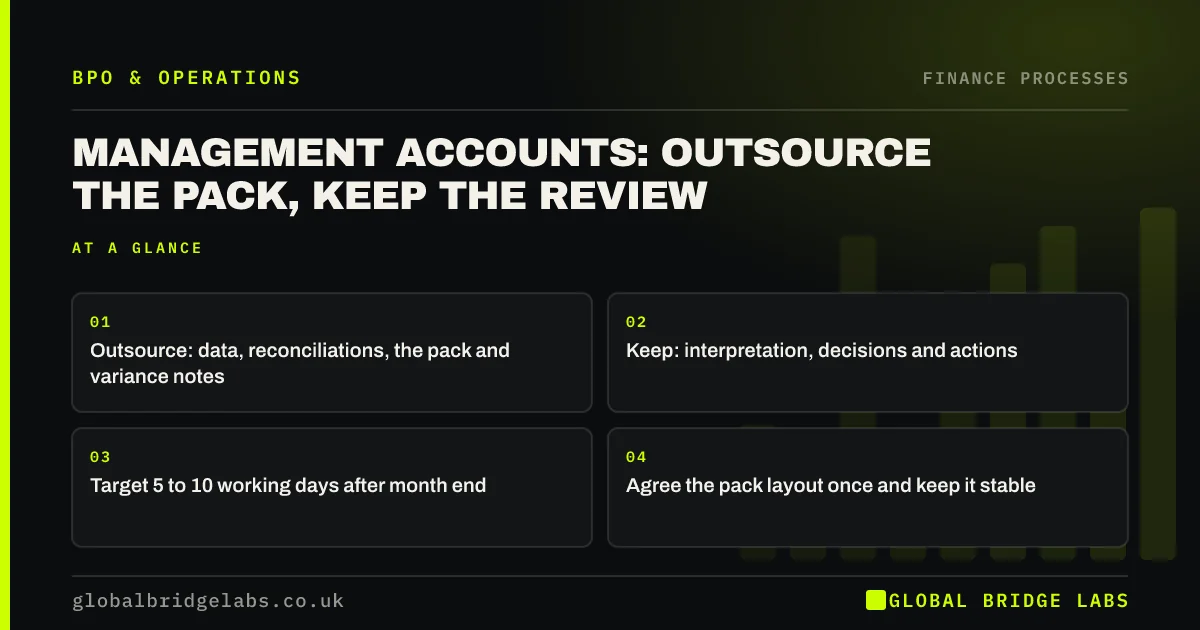
Management accounts outsourcing works well when the provider prepares the pack and the owner keeps the review. A monthly pack (profit and loss, balance sheet, cash position and key measures) can be produced by a managed team within 5 to 10 working days of month end. What it means for the business, and what to do about it, stays with you.
- Outsource: data, reconciliations, the pack and variance notes.
- Keep: interpretation, decisions and actions.
- Target 5 to 10 working days after month end.
- Agree the pack layout once and keep it stable.
Want a sample management accounts layout? Message us on WhatsApp.
Chat on WhatsApp →What goes in a management accounts pack?
A useful pack fits on four to six pages: a profit and loss against budget and last year, a balance sheet, a cash position with debtors and creditors, three to five key measures for your business, and short notes on any large variances. Anything longer tends not to be read.
Which parts of management accounts can be outsourced?
The preparation: posting and reconciling the month, routine adjustments, building the pack and drafting variance notes that explain what moved. These are rule-based once the layout and your measures are agreed. The provider should send a list of questions it could not answer from the records, which is often the most valuable page in the pack.
What should the owner keep?
The review and the decisions. Reading the pack, asking why, and deciding what to change belong to the people running the business. A provider can flag that gross margin fell two points; only you know whether that was a pricing choice or a problem. Book a fixed hour each month to review the pack with whoever prepared it.
- Cash flow forecasting: outsource the model, keep the calls
- Should you outsource pricing? Why the decision stays in-house
Want a monthly review agenda for your pack? Message us on WhatsApp.
Chat on WhatsApp →When is outsourcing management accounts the wrong move?
When nobody will read the pack, when the books are not reliable enough to report on, or when your accountant already produces it as part of an existing fee. Check what you already pay for before adding a second provider.
What does this look like in practice?
A pattern we see: owners who received no monthly numbers, or numbers six weeks late, start making decisions faster once a stable pack arrives on a fixed date. The consistency matters more than the detail.
Management accounts checklist
Agree these with the provider.
- Pack layout and page count.
- Delivery date each month.
- Three to five key measures.
- Variance threshold that triggers a note.
- Question log for unclear items.
- Monthly review meeting.
Next step
Tell us what monthly numbers you get today and when. We will suggest a pack layout and say what preparing it would involve.
Message us on WhatsApp, or book a 30-minute consultation.
Chat on WhatsApp →Sources and further reading
Frequently asked questions
Can management accounts be outsourced?
Yes. A provider can post and reconcile the month, make routine adjustments, build the pack and draft notes on variances. The owner or finance lead should keep the review, the interpretation and the decisions, because those need knowledge of the business and its plans.
How quickly should management accounts be ready?
Within 5 to 10 working days of month end is a practical target for most SMEs. Faster is possible when transactions are recorded and reconciled through the month rather than at the end. Numbers arriving after four weeks are rarely used for decisions.
What should a small business management accounts pack include?
A profit and loss against budget and last year, a balance sheet, a cash position with debtors and creditors, three to five key measures that matter for your business, and short notes explaining large variances. Four to six pages is usually enough.
Written by

Global Bridge Labs (GBL) is a UK–Sri Lanka partner for social media, websites and BPO. Everything here comes from client delivery, not theory.