On this page
- 01Key takeaways
- 02Why are customer-facing processes riskier to outsource?
- 03Which customer-facing processes move well?
- 04What should stay with your team?
- 05What controls protect the customer relationship?
- 06What does this look like in practice?
- 07Customer-facing outsourcing checklist
- 08Next step
- 09Sources and further reading
- 10Frequently asked questions
Key takeaways
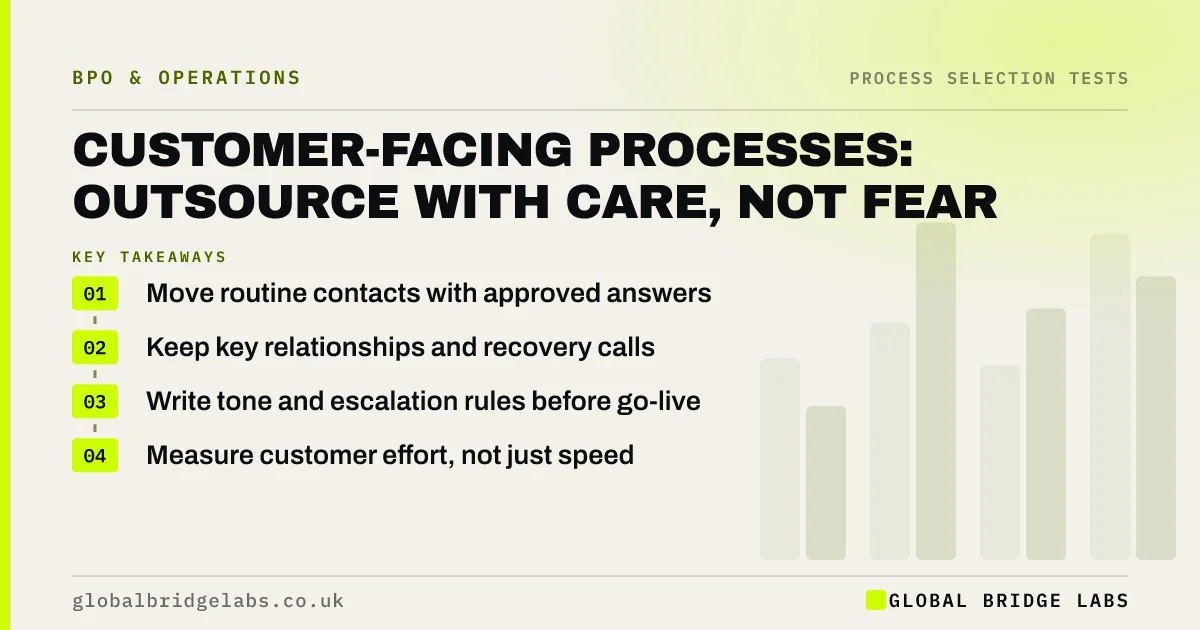
Outsourcing customer-facing processes carries more risk than back-office work, because customers notice the result. It can still improve service: faster replies, longer hours and consistent answers. Move the routine contacts with approved answers; keep the relationships, the judgement calls and the recovery of things that went wrong.
- Move routine contacts with approved answers.
- Keep key relationships and recovery calls.
- Write tone and escalation rules before go-live.
- Measure customer effort, not just speed.
Considering outsourcing customer contact? Message us on WhatsApp with what you have in mind.
Chat on WhatsApp →Why are customer-facing processes riskier to outsource?
Mistakes reach the customer directly, in your name. A back-office error can be caught by a check; a clumsy reply cannot be unsent. Customer-facing work also carries tone and judgement that are hard to write down. That is a reason to prepare more carefully, not to avoid it, because many SMEs lose more customers to slow replies than they would to a well-run outsourced team.
Which customer-facing processes move well?
High-volume, low-judgement contacts with clear answers: order and delivery queries, appointment booking, first-line email and chat, renewal reminders and survey calls. The UK Customer Satisfaction Index has long shown that ease and speed of resolution drive satisfaction, and these are exactly the contacts where a managed team with cover is fastest.
- Order and delivery queries.
- Bookings and reminders.
- First-line email and chat.
- Renewal and survey calls.
What should stay with your team?
Relationships with your most valuable customers, recovery when something has gone badly wrong, negotiations, and any contact that needs your expertise. These shape whether customers stay and recommend you. A good split routes them to your team within minutes, with the context already gathered.
Want help drawing the line for your customer contacts? Message us on WhatsApp.
Chat on WhatsApp →What controls protect the customer relationship?
Write a tone guide with examples, a knowledge base of approved answers, and escalation rules with time limits. Review a sample of contacts every week and share the findings. Measure customer effort and repeat contacts as well as response time, because fast replies that do not resolve anything make things worse.
What does this look like in practice?
A pattern we see: customers rarely notice that first-line contact has moved, but they do notice when replies get faster and evenings are covered. Complaints usually come from the handoff to the in-house team, so that link deserves the most attention.
Customer-facing outsourcing checklist
Confirm these before customers are affected.
- List contacts by volume and judgement needed.
- Write a tone guide with examples.
- Build a knowledge base of approved answers.
- Set escalation rules with time limits.
- Review a weekly sample of contacts.
- Track repeat contacts and effort.
Next step
Send us a week of customer contacts by type. We will tell you which ones a managed team could handle, which should stay, and how we would design the handoff.
Message us on WhatsApp, or book a 30-minute consultation.
Chat on WhatsApp →Sources and further reading
- UK Customer Satisfaction Index · Institute of Customer Service
- Stop trying to delight your customers (Dixon, Freeman and Toman, 2010) · Harvard Business Review
Frequently asked questions
Is it risky to outsource customer-facing processes?
It carries more risk than back-office work because customers see the result, but the risk is manageable with a tone guide, approved answers, clear escalation rules and weekly sampling. Many SMEs improve service by outsourcing routine contacts because replies get faster and hours get longer.
Which customer contacts should not be outsourced?
Contacts with your most valuable customers, recovery after serious failures, negotiations and anything needing your specialist expertise. These shape loyalty and recommendations. Route them to your team quickly, with the context already gathered by the outsourced team.
Will customers know the process is outsourced?
Usually not, if the team uses your systems, your tone and your approved answers. Some businesses choose to say they work with a support partner, and that is fine. What customers notice is speed, accuracy and whether their issue is resolved first time.
Written by

Global Bridge Labs (GBL) is a UK–Sri Lanka partner for social media, websites and BPO. Everything here comes from client delivery, not theory.