On this page
- 01Key takeaways
- 02What makes data poor quality?
- 03What rules should a data quality process have?
- 04Which data quality work can be outsourced?
- 05When is a data quality process not needed?
- 06What does this look like in practice?
- 07Data quality checklist
- 08Next step
- 09Sources and further reading
- 10Frequently asked questions
Key takeaways
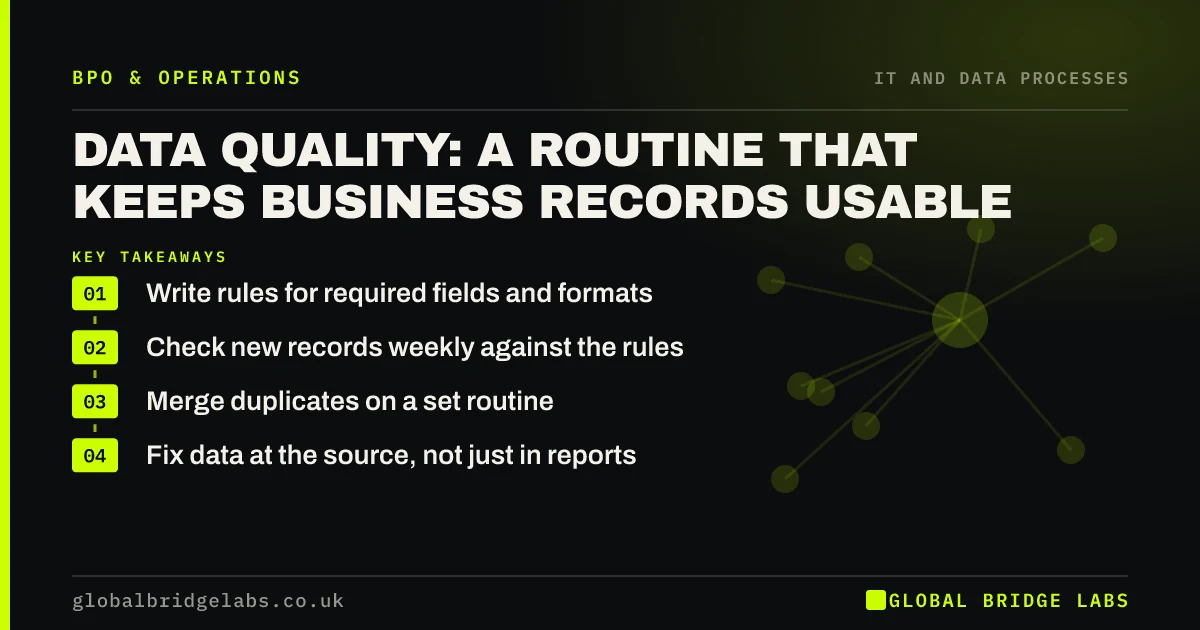
A data quality process keeps customer, supplier and product records complete, correct and free of duplicates through written rules and regular checks. One-off clean-ups decay within months; a weekly routine does not. UK GDPR also requires personal data to be accurate and kept up to date. The checks outsource well; the rules are yours.
- Write rules for required fields and formats.
- Check new records weekly against the rules.
- Merge duplicates on a set routine.
- Fix data at the source, not just in reports.
Want data quality rules written for your CRM? Message us on WhatsApp.
Chat on WhatsApp →What makes data poor quality?
Missing fields, inconsistent formats, duplicates, out-of-date details and records entered in the wrong place. Each has a cost: returned post, failed deliveries, wrong reports, and marketing sent to people who should not receive it. Most problems start at entry, when there is no rule about what a complete record looks like.
What rules should a data quality process have?
For each key record type, define required fields, allowed formats such as postcode and phone, how to spot duplicates, who can create records, and when records should be reviewed or deleted. Keep the rules on one page so they can be followed by anyone.
- Required fields per record type.
- Formats for addresses, phones and dates.
- Duplicate matching rules.
- Review and deletion periods.
Which data quality work can be outsourced?
Weekly checks of new and changed records, merging duplicates, filling gaps from reliable sources, standardising formats and producing a short quality report. The business owns the rules, decides on deletions and fixes the processes that create bad data.
Want a weekly data quality check run for you? Message us on WhatsApp.
Chat on WhatsApp →When is a data quality process not needed?
When a system has very few records and one person maintains them carefully. It becomes essential once several people enter data, records feed reports or marketing, or systems are connected, because errors then spread.
What does this look like in practice?
A pattern we see: a business pays for a big data clean-up, then the same problems return within six months because nothing changed at entry. A short weekly check against written rules keeps the gains.
Data quality checklist
Set these up once and review quarterly.
- One-page rules per record type.
- Weekly check of new records.
- Duplicate merge routine.
- Quality score tracked over time.
- Root causes fixed at entry.
- Retention and deletion rules applied.
Next step
Tell us which system holds your most important records and what goes wrong with them. We will suggest rules and a weekly check.
Message us on WhatsApp, or book a 30-minute consultation.
Chat on WhatsApp →Sources and further reading
- Principle (d): Accuracy · Information Commissioner's Office
- Lawful basis for processing personal data · Information Commissioner's Office
Frequently asked questions
How do you improve data quality in a small business?
Write simple rules for each record type, covering required fields, formats and duplicates. Check new records against the rules weekly, merge duplicates on a routine, and fix the processes that create bad data, such as forms without required fields.
Does UK GDPR require accurate data?
Yes. The accuracy principle requires personal data to be accurate and, where necessary, kept up to date, with reasonable steps taken to correct or erase inaccurate data. A regular data quality routine is a practical way to meet it.
Can data quality checks be outsourced?
Yes. Weekly checks, duplicate merging, standardising formats and filling gaps from reliable sources are routine tasks for a managed team. The business should own the rules, approve deletions and fix the sources of bad data.
Written by

Global Bridge Labs (GBL) is a UK–Sri Lanka partner for social media, websites and BPO. Everything here comes from client delivery, not theory.