On this page
- 01Key takeaways
- 02Which processes suit an offshore team?
- 03Which processes should stay onshore?
- 04What rules decide whether a process can go offshore?
- 05What does offshoring cost compared with onshore?
- 06What does this look like in practice?
- 07Offshore selection checklist
- 08Next step
- 09Sources and further reading
- 10Frequently asked questions
Key takeaways
Which processes can be offshored? Most digital, rule-based processes: finance processing, email and chat support, data work, reporting, HR admin and IT monitoring. Processes that need physical presence, UK-only data access, or a regulator's approval for offshore handling stay onshore or split. Offshore teams in Sri Lanka work four and a half to five and a half hours ahead of the UK.
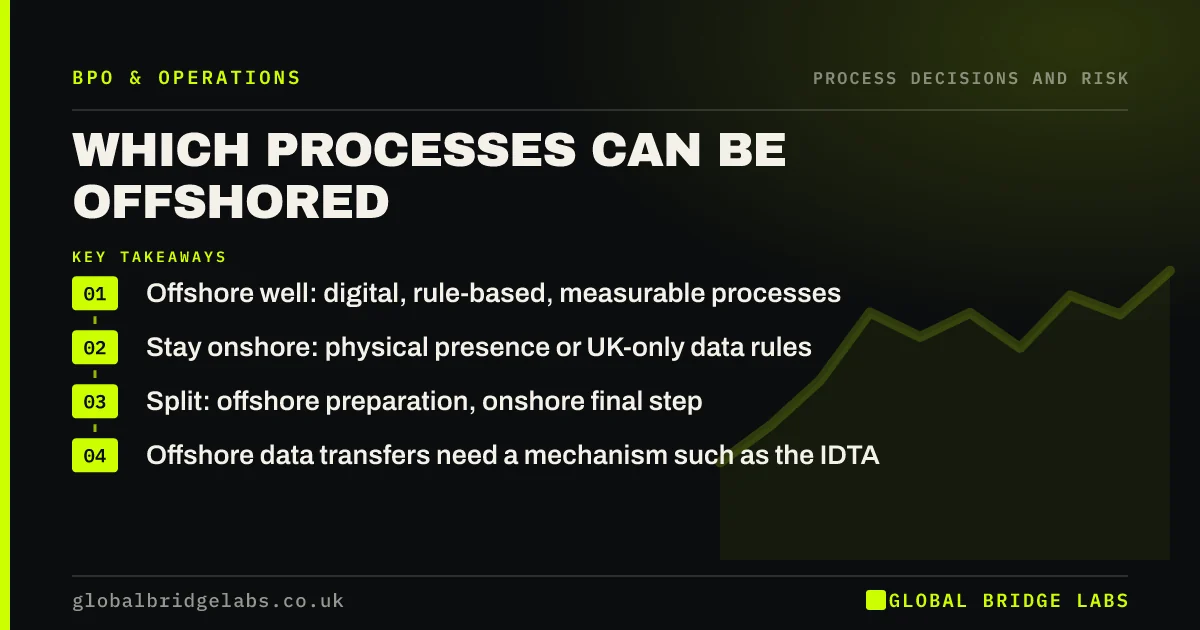
- Offshore well: digital, rule-based, measurable processes.
- Stay onshore: physical presence or UK-only data rules.
- Split: offshore preparation, onshore final step.
- Offshore data transfers need a mechanism such as the IDTA.
Want a view on which of your processes could be offshored? Message us on WhatsApp.
Chat on WhatsApp →Which processes suit an offshore team?
Processes done entirely in systems, with written rules and checkable output: supplier invoices and reconciliations, billing, email and chat support, data quality and enrichment, report refreshes, HR admin, CRM upkeep and IT monitoring. Time zones can help: work can be ready before the UK day starts.
Which processes should stay onshore?
Anything needing physical presence, such as site visits, post handling at your premises or equipment checks. Processes where a contract, regulator or public sector customer requires UK-based handling of data. And work where local knowledge or accent genuinely affects the outcome, which is rarer than people assume.
- Physical presence needed.
- UK-only data clauses in contracts.
- Regulator conditions on offshore access.
- Genuine local-knowledge requirements.
What rules decide whether a process can go offshore?
UK GDPR requires a transfer mechanism, such as the International Data Transfer Agreement, for personal data going to countries without UK adequacy, including Sri Lanka. Regulated firms must meet sector rules, such as FCA SYSC 8. Some NHS-linked and public sector work sets its own conditions. Check customer contracts for data location clauses.
Want a quick check of the rules for your processes? Message us on WhatsApp.
Chat on WhatsApp →What does offshoring cost compared with onshore?
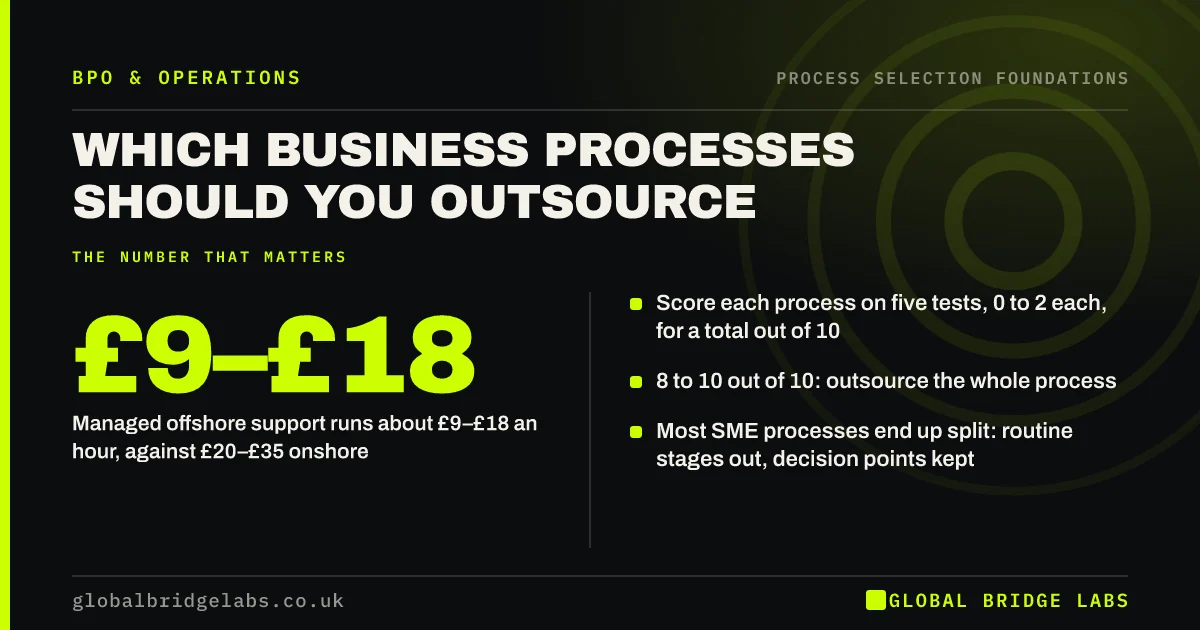
Indicative market ranges put managed offshore support at about £9–£18 an hour and onshore outsourced support at about £20–£35 an hour. The gap is real, but add management time, set-up and any extra controls. A split process, offshore preparation and onshore final step, often gives most of the saving with less risk.
What does this look like in practice?
A pattern we see: owners assume customer-facing work must stay onshore, then find that email and chat, where accent does not matter, offshore well. Phone work is decided case by case.
Offshore selection checklist
Check these for each process.
- Is it done entirely in systems?
- Is the method written and output checkable?
- Do contracts restrict data location?
- Do sector rules apply?
- Is a transfer mechanism in place?
- Do time zones help or hurt?
Next step
Send us your list of candidate processes. We will tell you which suit an offshore team, which should stay onshore and which to split.
Message us on WhatsApp, or book a 30-minute consultation.
Chat on WhatsApp →Sources and further reading
- International transfers of personal data · Information Commissioner's Office
- FCA Handbook SYSC 8: Outsourcing · Financial Conduct Authority
- Data Security and Protection Toolkit · NHS England
Frequently asked questions
Which business processes can be offshored?
Most digital, rule-based processes with checkable output: finance processing, billing, reconciliations, email and chat support, data quality and enrichment, reporting, HR admin, CRM upkeep and IT monitoring. Processes needing physical presence or UK-only data handling should stay onshore.
Can personal data be processed offshore under UK GDPR?
Yes, with a valid transfer mechanism where the destination has no UK adequacy decision. For many countries, including Sri Lanka, that means the International Data Transfer Agreement or the UK Addendum to the EU clauses, plus a transfer risk assessment and appropriate security.
Should customer-facing processes be offshored?
Written channels such as email and chat often offshore well, because accent and location rarely matter and time zones can extend cover. Phone work should be decided case by case. Keep key relationships and complex recovery with your own team.
Written by

Global Bridge Labs (GBL) is a UK–Sri Lanka partner for social media, websites and BPO. Everything here comes from client delivery, not theory.