On this page
- 01Key takeaways
- 02Why should product decisions stay in-house?
- 03Which product development work can be outsourced?
- 04How do you protect your intellectual property?
- 05When should development stay fully in-house?
- 06What does this look like in practice?
- 07Product development checklist
- 08Next step
- 09Sources and further reading
- 10Frequently asked questions
Key takeaways
Should you outsource product development? Outsource capacity, not ownership. What to build, for whom and why must stay with you, along with the knowledge of how your product works. A partner can design, build, test and document to your direction. Make sure the contract assigns intellectual property to you and that documentation stays current.
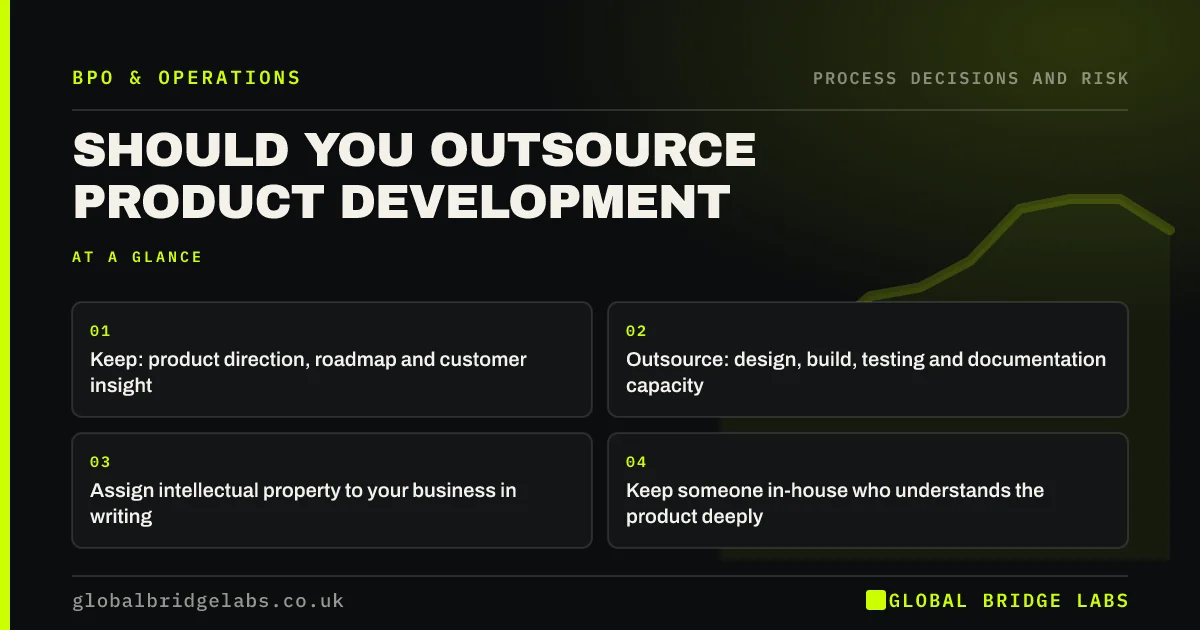
- Keep: product direction, roadmap and customer insight.
- Outsource: design, build, testing and documentation capacity.
- Assign intellectual property to your business in writing.
- Keep someone in-house who understands the product deeply.
Planning product work with a partner? Message us on WhatsApp.
Chat on WhatsApp →Why should product decisions stay in-house?
Because the product is often why customers choose you. Deciding what to build depends on customer conversations, market knowledge and strategy that live inside the business. A partner who sets your roadmap is effectively running your business, and their incentives may favour more work rather than the right work.
Which product development work can be outsourced?
Delivery capacity: user interface design to a brief, software development, testing, technical documentation and maintenance. Many SMEs cannot justify a full in-house team, and a dedicated or extended team gives them access to skills without permanent hires. The business sets priorities and accepts each release.
- Design to a brief.
- Build and test.
- Technical documentation.
- Maintenance and support.
How do you protect your intellectual property?
Make sure the contract assigns copyright and other intellectual property in the work to your business, not just a licence to use it. Keep code in repositories you own, require documentation as part of each release, and protect your brand with a registered trade mark where it matters.
Want a checklist of IP points for a development contract? Message us on WhatsApp.
Chat on WhatsApp →When should development stay fully in-house?
When the product is your core technology and changes daily based on customer feedback, an in-house team is usually faster and keeps knowledge close. A partner can still add capacity for specific projects, but the core team should be yours.
What does this look like in practice?
A pattern we see: businesses that hand over the roadmap with the build end up with features nobody asked for. Those that keep a clear owner for priorities get more value from the same development budget.
Product development checklist
Agree these before work starts.
- Named product owner in-house.
- Roadmap and priorities set by you.
- IP assigned to your business.
- Code in repositories you own.
- Documentation with every release.
- Acceptance of each release by you.
Next step
Tell us about the product you are developing and who owns it today. We will tell you where outside capacity would help and what you should keep.
Message us on WhatsApp, or book a 30-minute consultation.
Chat on WhatsApp →Sources and further reading
- Register a trade mark · GOV.UK
- The Sourcing and Consultancy Playbooks · Cabinet Office
Frequently asked questions
Is it a good idea to outsource product development?
Outsourcing delivery capacity, such as design, build, testing and documentation, can work well for SMEs. Product direction, the roadmap and customer insight should stay in-house, because they define the business. Keep a named product owner who understands the product deeply.
Who owns the code when development is outsourced?
It depends on the contract. By default, copyright often belongs to the creator, so the contract should assign intellectual property in the work to your business. Keep code in repositories you control and require documentation with every release.
How do you manage an outsourced development partner?
Set priorities yourself, agree acceptance criteria for each release, review progress regularly, keep code and documentation in systems you own, and make sure someone in your business understands how the product works so you are never dependent on one partner.
Written by

Global Bridge Labs (GBL) is a UK–Sri Lanka partner for social media, websites and BPO. Everything here comes from client delivery, not theory.