On this page
Key takeaways
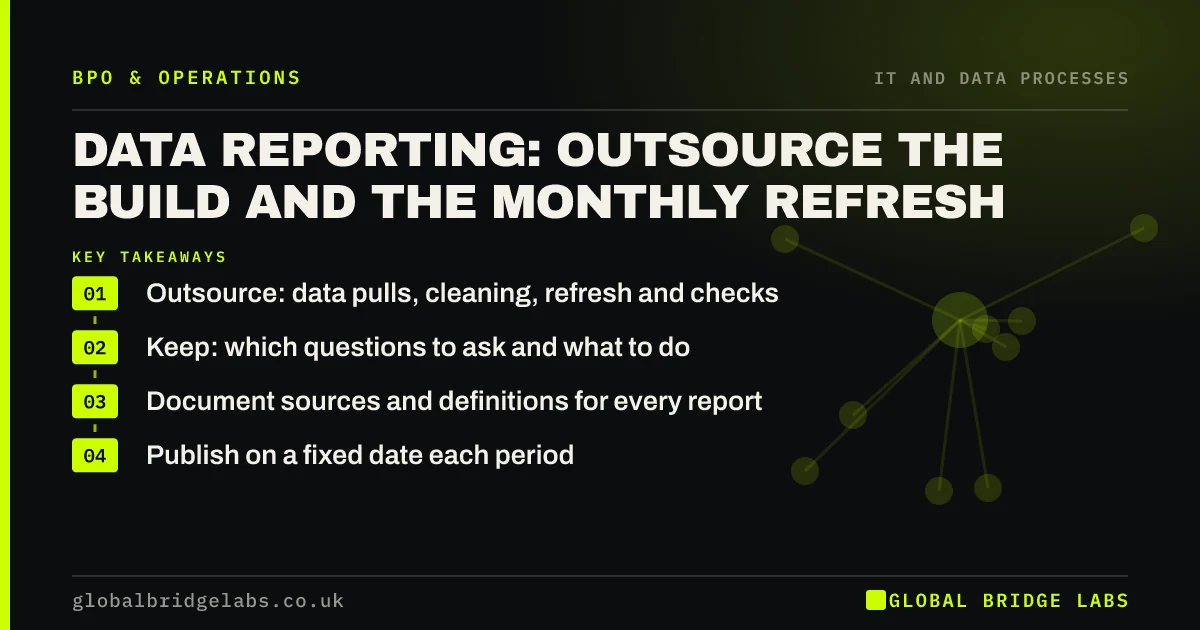
Data reporting outsourcing hands over the build and refresh of business reports: pulling data, cleaning it, updating spreadsheets or dashboards, checking totals and publishing on a set date. Managers keep the questions the reports answer and the decisions they inform. Write down each report's sources and definitions so it does not break when someone leaves.
- Outsource: data pulls, cleaning, refresh and checks.
- Keep: which questions to ask and what to do.
- Document sources and definitions for every report.
- Publish on a fixed date each period.
Want your monthly reports refreshed without the late nights? Message us on WhatsApp.
Chat on WhatsApp →Which reporting work can be outsourced?
Pulling data from systems, cleaning and combining it, refreshing spreadsheets or dashboards, reconciling totals to source systems, adding factual notes on large changes, and publishing on schedule. Building new reports to a written specification can move too.
What should managers keep?
The questions and the decisions. Which measures matter, what targets to set, why numbers moved and what to do next. A provider can say that margin fell in one product line; only the manager knows whether that was planned.
Why do business reports keep breaking?
Because they depend on one person's spreadsheet knowledge, on manual steps nobody wrote down, or on source systems that changed. Document each report: sources, steps, definitions and checks. Reconcile totals to the source every time, so errors show before the report goes out.
- List sources and refresh steps.
- Define every measure.
- Reconcile totals to source.
- Note changes to definitions.
- Key person dependency: when one person holds it all
- Running a business on spreadsheets: when it breaks
Want a report specification template? Message us on WhatsApp.
Chat on WhatsApp →When should reporting stay in-house?
When the report is small and the manager who uses it can refresh it in minutes, or when it draws on highly sensitive data that cannot be shared. Automation within your tools may also replace the need for manual refresh altogether.
What does this look like in practice?
A pattern we see: the monthly report arrives later each month because it grows a step at a time. Documenting and handing over the refresh usually brings it back to a fixed date.
Data reporting checklist
Prepare these for each report.
- Purpose and audience.
- Data sources and access.
- Measure definitions.
- Refresh steps and checks.
- Publication date.
- Owner who reviews it.
Next step
Tell us which reports take your team longest each month. We will tell you what handing over the refresh would involve.
Message us on WhatsApp, or book a 30-minute consultation.
Chat on WhatsApp →Sources and further reading
- Labour productivity · Office for National Statistics
- Principle (d): Accuracy · Information Commissioner's Office
Frequently asked questions
Can business reporting be outsourced?
Yes. Pulling and cleaning data, refreshing spreadsheets or dashboards, reconciling totals and publishing on schedule are routine tasks a managed team can run. Managers should keep the choice of measures, targets and decisions based on the reports.
Why do monthly reports take so long?
Usually because of manual steps: exporting from several systems, cleaning data by hand, copying between spreadsheets and fixing errors. Documenting the steps, automating where possible and handing the refresh to a routine owner shortens the cycle.
How do you stop reports breaking when someone leaves?
Write a short specification for each report: purpose, data sources, refresh steps, measure definitions and checks. Reconcile totals to the source each time. With that in place, anyone trained can run the report, not just the person who built it.
Written by

Global Bridge Labs (GBL) is a UK–Sri Lanka partner for social media, websites and BPO. Everything here comes from client delivery, not theory.