On this page
- 01Key takeaways
- 02Which finance processes outsource most easily?
- 03Which finance processes should be split?
- 04Which finance processes should stay in-house?
- 05What does outsourcing finance processes cost?
- 06What does this look like in practice?
- 07Finance process checklist
- 08Next step
- 09Sources and further reading
- 10Frequently asked questions
Key takeaways
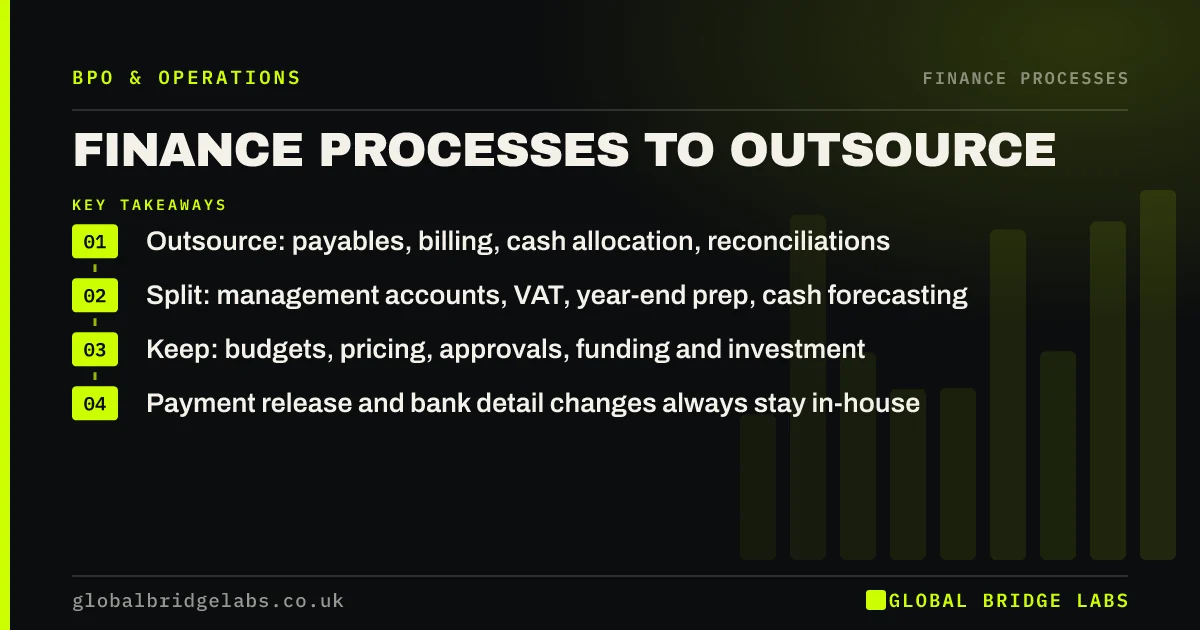
The finance processes to outsource first are the high-volume, rule-based ones: supplier invoices, billing, cash allocation, reconciliations and payroll processing. Reporting and tax preparation usually split. Budgeting, pricing, approvals and funding decisions stay in-house. The pattern is the same everywhere in finance: processing moves, decisions stay.
- Outsource: payables, billing, cash allocation, reconciliations, payroll processing.
- Split: management accounts, VAT, year-end prep, cash forecasting.
- Keep: budgets, pricing, approvals, funding and investment.
- Payment release and bank detail changes always stay in-house.
Want verdicts for your own finance processes? Message us on WhatsApp.
Chat on WhatsApp →Which finance processes outsource most easily?
Processes with steady volume, written rules and outputs that reconcile. Supplier invoice processing, recurring billing, matching receipts to invoices, bank and supplier statement reconciliations, and payroll processing all fit. They are also where small finance teams lose the most hours to routine work.
Which finance processes should be split?
Processes where routine preparation leads up to a judgement. Management accounts, VAT returns, year-end preparation and cash forecasting each have a preparation stage that moves and a review or decision stage that stays.
- Management accounts: pack out, review in.
- VAT: preparation out, approval in.
- Year end: pack out, accounts with your accountant.
- Cash forecast: updates out, assumptions in.
Which finance processes should stay in-house?
Budgeting and target setting, pricing, approval and release of payments, changes to bank details, borrowing and investment decisions, and any process where a director carries personal legal responsibility. A provider can prepare the information for each; the decision and the accountability stay with you.
- Budgeting: the process stays yours, the admin can move
- Supplier payment runs: outsource the prep, keep approval
- Should you outsource pricing? Why the decision stays in-house
Want a one-page finance process map with verdicts? Message us on WhatsApp.
Chat on WhatsApp →What does outsourcing finance processes cost?
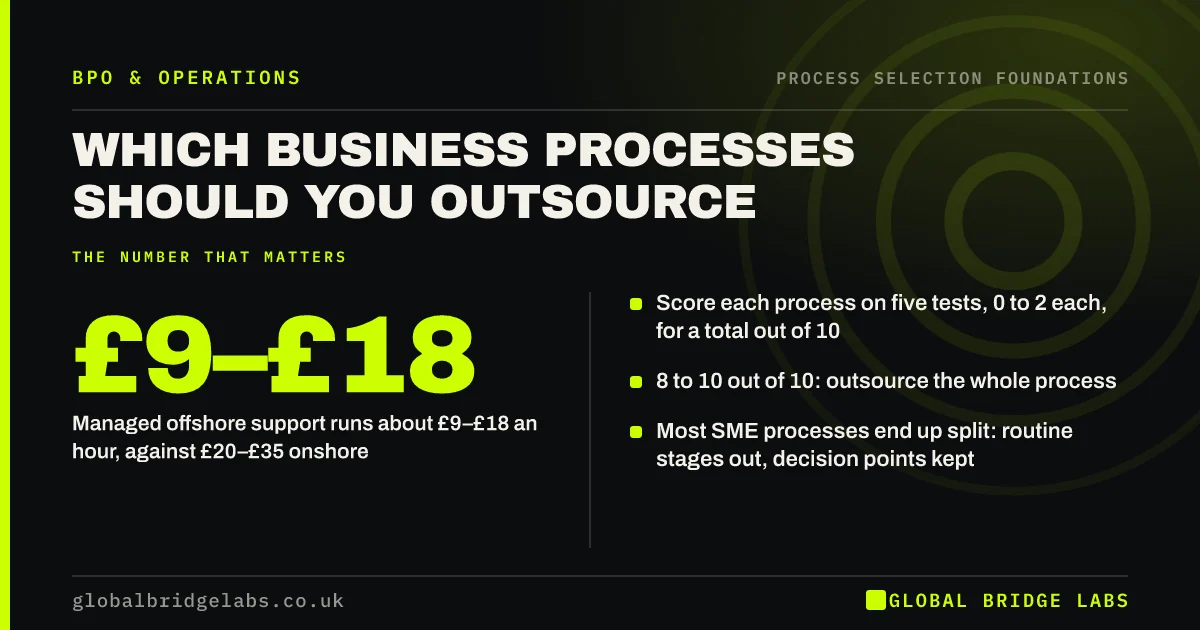
Indicative managed offshore rates run about £9–£18 an hour, against about £19.81 per worked hour for an employee on £30,000. In an illustrative example, a firm with 15 hours a week of payables, billing and reconciliations would pay roughly £135–£270 a week to a managed team, before review time. These are market ranges, not a GBL price.
What does this look like in practice?
A pattern we see: a finance manager spends half their week on processing and half on the analysis they were hired for. Moving the processing does not remove the role; it lets them do the half that matters.
Finance process checklist
Work through your finance processes in this order.
- List every finance process with weekly hours.
- Mark processing stages and decision stages.
- Score the high-hours processes.
- Move one processing stage first.
- Keep approvals and payment release in-house.
- Review after 30 days before moving the next.
Next step
Send us a list of your finance processes and who does them. We will give you a verdict for each and suggest which to move first.
Message us on WhatsApp, or book a 30-minute consultation.
Chat on WhatsApp →Sources and further reading
Frequently asked questions
Which finance processes can a small business outsource?
Supplier invoice processing, recurring billing, cash allocation, bank and supplier reconciliations and payroll processing are the most common. Management accounts, VAT preparation and year-end preparation can be outsourced in part, with the review and approval kept in-house.
Which finance processes should not be outsourced?
Budget setting, pricing decisions, approval and release of payments, changes to supplier bank details, borrowing and investment decisions, and anything where directors carry personal legal responsibility. A provider can prepare the information, but the decision should stay with the business.
Is outsourcing finance processes safe?
It is when access is limited to what each process needs, payment release and bank detail changes stay in-house, there is a processor contract covering personal data, and someone in the business reviews output regularly. Separating preparation from approval is the key control.
Written by

Global Bridge Labs (GBL) is a UK–Sri Lanka partner for social media, websites and BPO. Everything here comes from client delivery, not theory.