On this page
- 01Key takeaways
- 02What should a supplier scorecard measure?
- 03Which review work can be outsourced?
- 04What should stay with your team?
- 05When are formal supplier reviews unnecessary?
- 06What does this look like in practice?
- 07Supplier review checklist
- 08Next step
- 09Sources and further reading
- 10Frequently asked questions
Key takeaways
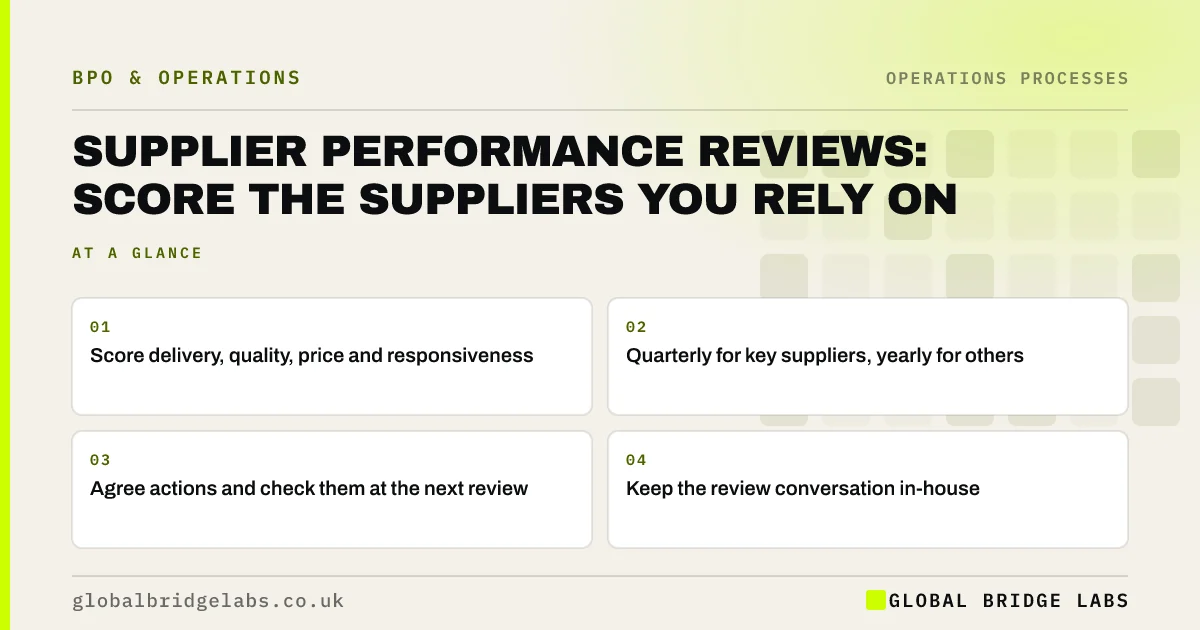
A supplier performance review scores the suppliers you depend on against a few measures, such as on-time delivery, quality, price stability and responsiveness, and agrees actions where they fall short. Review key suppliers quarterly and others yearly. Gathering the data and preparing the scorecard outsources well; the relationship conversation stays with you.
- Score delivery, quality, price and responsiveness.
- Quarterly for key suppliers, yearly for others.
- Agree actions and check them at the next review.
- Keep the review conversation in-house.
Want a supplier scorecard template? Message us on WhatsApp.
Chat on WhatsApp →What should a supplier scorecard measure?
Four or five measures you can evidence: on-time and in-full delivery, quality issues or returns, price changes against the agreed terms, invoice accuracy and how quickly problems are resolved. Score each from your own records rather than impressions.
- On-time, in-full delivery.
- Quality issues and returns.
- Price stability.
- Invoice accuracy.
- Responsiveness to problems.
Which review work can be outsourced?
Collecting delivery, quality and invoice data, calculating scores, preparing the scorecard, booking review meetings and tracking agreed actions. This is the part that makes reviews happen on time, and it uses data from processes that may already be outsourced, such as purchase order processing.
What should stay with your team?
The conversation with the supplier, decisions about improvement plans, and any decision to reduce business or switch. These depend on the relationship and on what you value beyond the numbers. For larger firms, the Modern Slavery Act also expects due diligence on supply chains.
Want your key suppliers scored before your next review? Message us on WhatsApp.
Chat on WhatsApp →When are formal supplier reviews unnecessary?
For low-value suppliers that are easy to replace, a yearly check of complaints and prices is enough. Formal reviews are worth the time for suppliers whose failure would stop your business or affect customers.
What does this look like in practice?
A pattern we see: owners feel a supplier has got worse but have no evidence to raise it. A scorecard turns a vague complaint into a specific conversation, which suppliers usually respond to.
Supplier review checklist
Prepare these for each review.
- Scorecard with evidence for each measure.
- Previous actions and their status.
- Upcoming changes on either side.
- Agreed actions with owners and dates.
- Next review date booked.
Next step
Tell us which suppliers you depend on most. We will suggest a scorecard and the data we would gather for the first review.
Message us on WhatsApp, or book a 30-minute consultation.
Chat on WhatsApp →Sources and further reading
Frequently asked questions
How do you review supplier performance?
Score each key supplier on a few evidenced measures, such as on-time delivery, quality, price stability, invoice accuracy and responsiveness. Discuss the scorecard with the supplier, agree actions with owners and dates, and check progress at the next review.
How often should suppliers be reviewed?
Quarterly for suppliers your business depends on, and annually for others. Review sooner after a serious failure. Low-value suppliers that are easy to replace may only need a yearly check of complaints and prices.
Can supplier reviews be outsourced?
The preparation can: collecting data, calculating scores, preparing the scorecard, booking meetings and tracking actions. The conversation with the supplier and decisions about improvement plans or switching should stay with your own team.
Written by

Global Bridge Labs (GBL) is a UK–Sri Lanka partner for social media, websites and BPO. Everything here comes from client delivery, not theory.