On this page
- 01Key takeaways
- 02When should linked processes move together?
- 03When should linked processes stay apart?
- 04How do you manage handoffs between processes?
- 05What about TUPE when several processes move?
- 06What does this look like in practice?
- 07Linked process checklist
- 08Next step
- 09Sources and further reading
- 10Frequently asked questions
Key takeaways
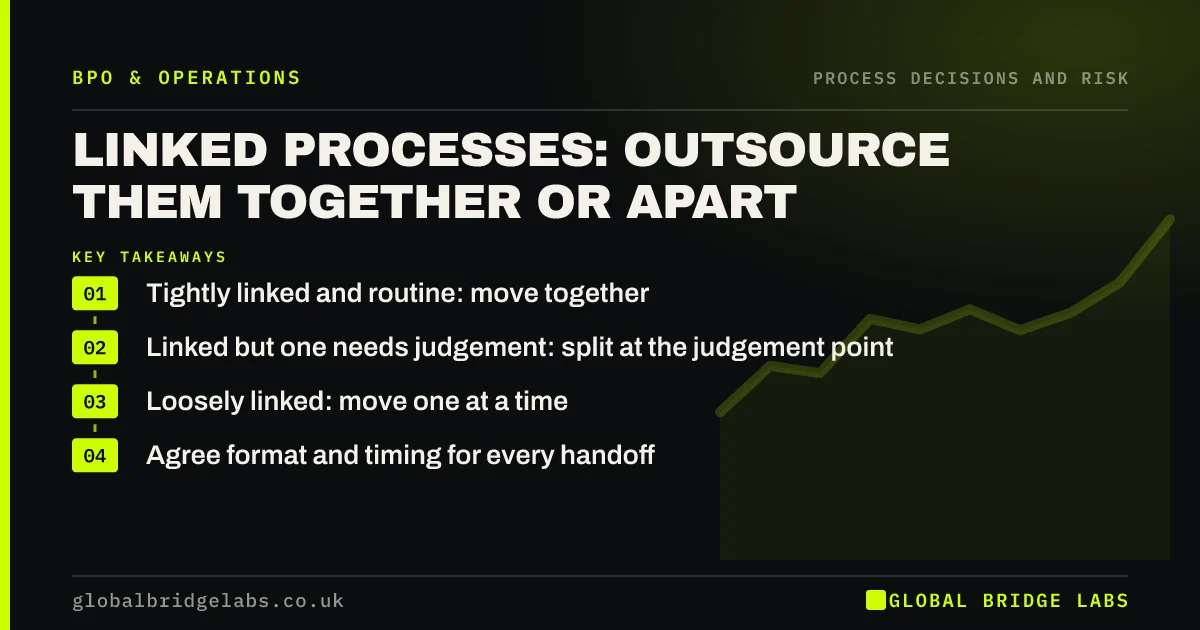
When outsourcing interdependent processes, move them together if they share data, timing and people, such as billing and cash allocation. Keep them apart if one is routine and the other needs judgement. Every link between an outsourced process and an in-house one becomes a handoff, so the question is where handoffs cost least.
- Tightly linked and routine: move together.
- Linked but one needs judgement: split at the judgement point.
- Loosely linked: move one at a time.
- Agree format and timing for every handoff.
Unsure whether to move two processes together? Message us on WhatsApp.
Chat on WhatsApp →When should linked processes move together?
When they pass work back and forth many times a day, use the same systems and data, and are both routine. Billing and cash allocation, order entry and dispatch notification, or recruitment admin and new starter set-up often fit. Moving one alone would create a busy handoff between your team and the provider.
When should linked processes stay apart?
When one process is routine and the next needs judgement, the natural split is between them. Payment run preparation and payment approval are linked, but approval stays in-house. The handoff sits at a point where work pauses anyway, so it adds little delay.
How do you manage handoffs between processes?
Map the dependencies, then agree for each handoff what passes, in what format, by when and who owns it. Measure the time work waits at each handoff. A queue that grows at one handoff is the earliest sign the split is in the wrong place.
- Map dependencies first.
- Agree format and timing per handoff.
- Name an owner on each side.
- Measure waiting time at handoffs.
- Process dependencies: map them before you hand over
- Process handoffs: why every extra handover adds cost
Want help mapping the handoffs between two processes? Message us on WhatsApp.
Chat on WhatsApp →What about TUPE when several processes move?
Moving several linked processes can make it more likely that an organised group of employees mainly did that work, which is when TUPE may apply. Check before moving a bundle of processes that was largely one team's job, and take advice where needed.
What does this look like in practice?
A pattern we see: a firm outsources billing but keeps cash allocation, and unallocated payments pile up because the two teams work on different days. Moving them together, or aligning their timetables, clears it.
Linked process checklist
Answer these for every pair of linked processes.
- How many times does work pass between them?
- Do they share systems and data?
- Is either one judgement-heavy?
- Where does work naturally pause?
- Would moving both together trigger TUPE?
Next step
Tell us which two processes you are considering. We will tell you whether we would move them together, apart or split at a decision point.
Message us on WhatsApp, or book a 30-minute consultation.
Chat on WhatsApp →Sources and further reading
- The Sourcing and Consultancy Playbooks · Cabinet Office
- Business transfers, takeovers and TUPE · GOV.UK
Frequently asked questions
Should related processes be outsourced together?
Often, yes, if they pass work back and forth frequently, share systems and data, and are both routine. Moving one alone creates a busy handoff between your team and the provider. If one process needs judgement, split at that point instead.
How do you decide where to split linked processes?
Split where work naturally pauses, such as at an approval or a decision. That keeps the handoff from adding delay. Avoid splits in the middle of a routine sequence, where work would bounce between teams several times.
Does TUPE apply when several processes are outsourced?
It can. TUPE may apply on a service provision change where an organised grouping of employees principally carried out the activities that move. Moving several linked processes that were mainly one team's work makes that more likely, so check before you proceed.
Written by

Global Bridge Labs (GBL) is a UK–Sri Lanka partner for social media, websites and BPO. Everything here comes from client delivery, not theory.