On this page
- 01Key takeaways
- 02What makes a process time-critical?
- 03Why can outsourcing help time-critical work?
- 04How do you hand over a process with a deadline?
- 05When should a time-critical process stay in-house?
- 06What does this look like in practice?
- 07Time-critical process checklist
- 08Next step
- 09Sources and further reading
- 10Frequently asked questions
Key takeaways
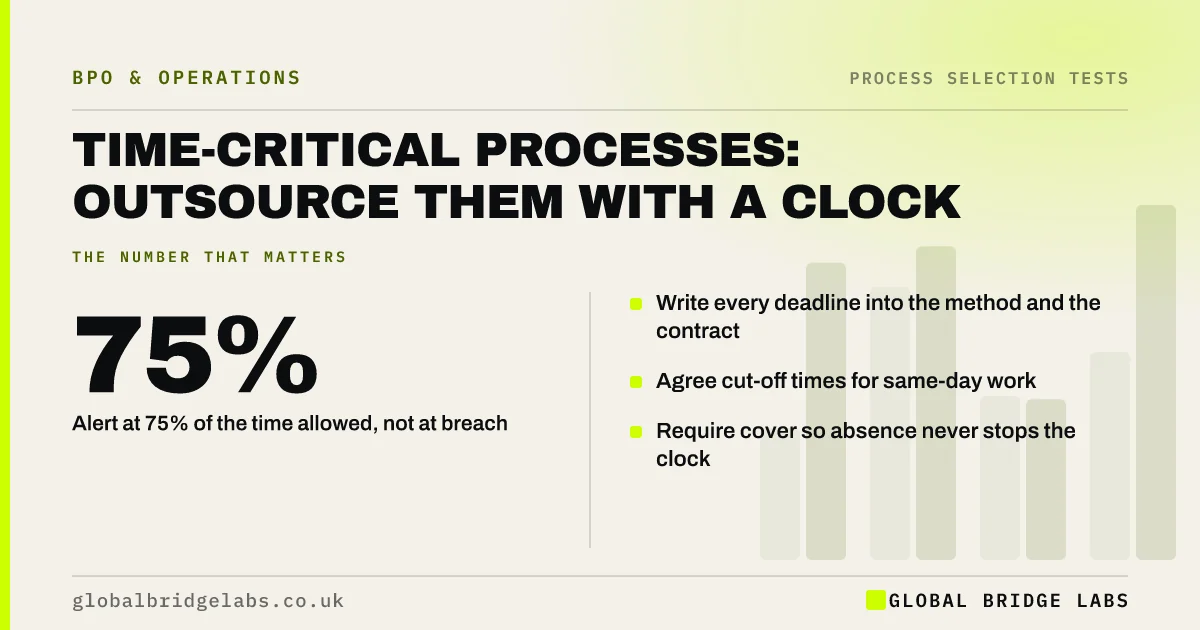
Time-critical processes outsourcing works when the clock is written into the arrangement: cut-off times, turnaround targets, cover rules and alerts when work is at risk. Deadline-driven processes, such as same-day order handling or statutory returns, often run better with a provider that has cover built in. They fail when the deadline lives only in someone's head.
- Write every deadline into the method and the contract.
- Agree cut-off times for same-day work.
- Require cover so absence never stops the clock.
- Alert at 75% of the time allowed, not at breach.
Want to check a deadline-driven process for outsourcing? Message us on WhatsApp.
Chat on WhatsApp →What makes a process time-critical?
A process is time-critical when lateness causes harm in itself, separate from errors. Statutory deadlines such as VAT returns, which are due one calendar month and seven days after the period ends, are one kind. Customer promises, such as same-day dispatch or a reply within two hours, are another. Payment terms, where late payment triggers interest or lost discounts, are a third.
Why can outsourcing help time-critical work?
In a small team, one absence can stop a deadline-driven process. A managed team plans cover, so the process does not depend on one person's holiday or illness. A provider in Sri Lanka, four and a half to five and a half hours ahead of the UK, can also have work ready before your team starts the day.
How do you hand over a process with a deadline?
Put the clock into every part of the arrangement. Agree cut-off times for work arriving, turnaround targets for each stage, the cover rule if someone is absent, and an alert when an item has used 75% of its time. Keep a calendar of fixed deadlines that both sides can see.
- Cut-off time for same-day work.
- Turnaround target for each stage.
- A named back-up for every role.
- Alerts before, not after, a breach.
- A shared deadline calendar.
- Turnaround time: what to agree with an outsourced team
- Work ageing report: find the jobs that have been waiting
Want a deadline plan for one process? Message us on WhatsApp.
Chat on WhatsApp →When should a time-critical process stay in-house?
When the deadline depends on information only you have at the last minute, such as a final pricing decision, or when the provider's working hours cannot cover the window. A split often works: the provider prepares everything in advance, and your team makes the final call within the window.
What does this look like in practice?
A pattern we see: deadlines are missed not because work is slow but because it waits unseen. An ageing alert at 75% of the allowed time catches most problems while there is still time to act.
Time-critical process checklist
Confirm these before handing over.
- List every deadline the process serves.
- Agree cut-offs and stage turnarounds.
- Name back-up cover for every role.
- Set alerts at 75% of time used.
- Share a calendar of fixed deadlines.
- Agree who makes last-minute calls.
Next step
List the deadlines your candidate process must meet and send them to us. We will tell you how we would build the clock into the handover.
Message us on WhatsApp, or book a 30-minute consultation.
Chat on WhatsApp →Sources and further reading
- Sending a VAT Return · HM Revenue & Customs
- Late commercial payments: charging interest and debt recovery · GOV.UK
Frequently asked questions
Can time-critical processes be outsourced safely?
Yes, if deadlines are written into the method and the contract, with cut-off times, stage turnaround targets, planned cover for absence and alerts before a breach. A managed team with built-in cover is often more reliable on deadlines than one person in a small in-house team.
How do you stop outsourced work missing deadlines?
Agree a cut-off time for work arriving, a turnaround target for each stage, and an alert when an item has used 75% of its allowed time. Keep a shared calendar of fixed deadlines and review an ageing report daily during the first month.
Does a time difference help or hurt deadline work?
It can help. A team four and a half to five and a half hours ahead of the UK, such as in Sri Lanka, can prepare work before your day starts and still overlap with UK hours. It hurts only if decisions are needed outside the overlap and nobody has planned for that.
Written by

Global Bridge Labs (GBL) is a UK–Sri Lanka partner for social media, websites and BPO. Everything here comes from client delivery, not theory.