On this page
- 01Key takeaways
- 02Why does caller verification matter?
- 03What questions should verification use?
- 04How should an outsourced team apply the process?
- 05When should verification be simpler?
- 06What does this look like in practice?
- 07Verification checklist
- 08Next step
- 09Sources and further reading
- 10Frequently asked questions
Key takeaways
A customer identity verification process makes sure the person on the phone or in chat is entitled to discuss an account before anyone shares or changes details. It is a rule-based process that outsourced teams follow reliably, provided the rules are written. Disclosing personal data to the wrong person can be a data breach under UK GDPR.
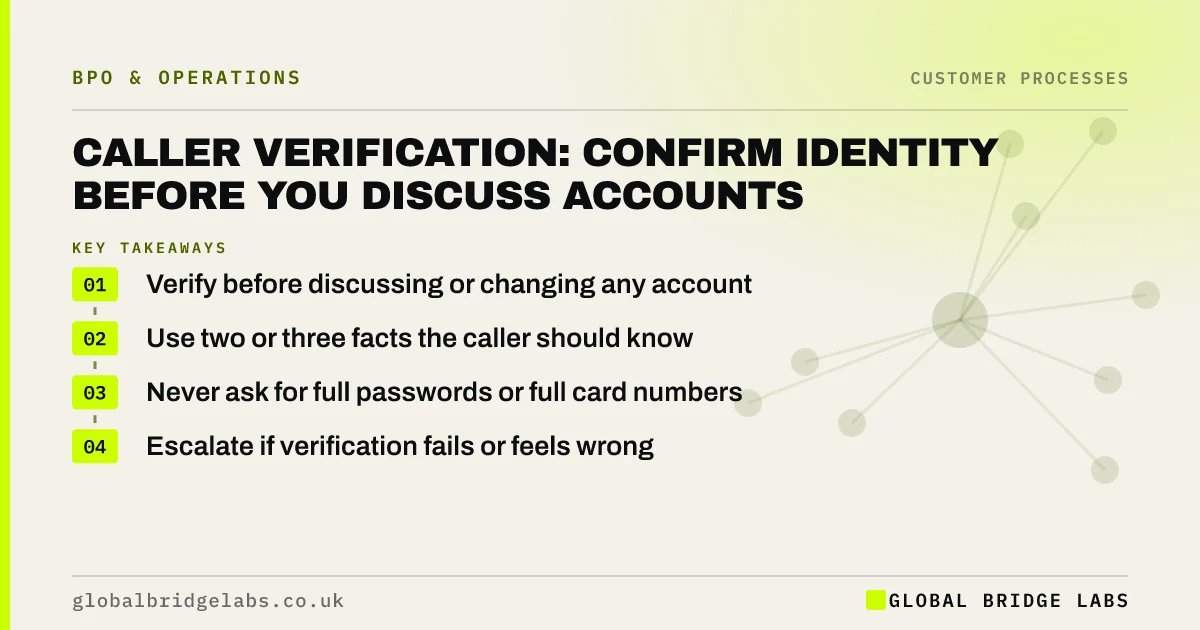
- Verify before discussing or changing any account.
- Use two or three facts the caller should know.
- Never ask for full passwords or full card numbers.
- Escalate if verification fails or feels wrong.
Want verification rules your team can follow? Message us on WhatsApp.
Chat on WhatsApp →Why does caller verification matter?
Because social engineering, someone pretending to be a customer, is a common route to fraud and data breaches. A caller who talks an agent into changing an email address or delivery address can take over an account. UK GDPR requires appropriate security for personal data, and disclosing it to the wrong person can be a reportable breach.
What questions should verification use?
Facts the genuine customer knows and an impostor is unlikely to: account number, postcode and the date or value of a recent order, for example. Ask for two or three, and never confirm a wrong answer by revealing the right one. For higher-risk changes, such as bank details or a new delivery address, add a check using a contact method already on file.
- Use two or three account facts.
- Never reveal the correct answer.
- Add an on-file check for high-risk changes.
- Never ask for full passwords or card numbers.
How should an outsourced team apply the process?
Exactly the same way every time, with no exceptions for persuasive or urgent callers. Write the questions and the actions allowed after each level of verification into the knowledge base. Sample calls to check it is followed. Agents should feel safe to refuse and escalate; urgency is a common pressure tactic.
- Internal knowledge base: answers your team can find fast
- Quality sampling: how many outsourced items to check
Want a call-sampling checklist for verification? Message us on WhatsApp.
Chat on WhatsApp →When should verification be simpler?
For general questions that do not involve account details, such as opening hours or product information, no verification is needed. Matching the level of checking to the risk keeps calls quick without leaving account changes exposed.
What does this look like in practice?
A pattern we see: verification gets skipped when a caller is pleasant and in a hurry. Clear rules that apply to everyone protect the agent as much as the customer.
Verification checklist
Put these in the knowledge base.
- Which questions verify a caller.
- What each level of verification allows.
- Extra checks for high-risk changes.
- Things never to ask for.
- What to do when verification fails.
- How often calls are sampled.
Next step
Tell us what your team checks before discussing an account today. We will suggest verification levels that fit your risks.
Message us on WhatsApp, or book a 30-minute consultation.
Chat on WhatsApp →Sources and further reading
- Advice for small organisations · Information Commissioner's Office
- Small organisations guide to cyber security · National Cyber Security Centre
Frequently asked questions
How do you verify a caller's identity?
Ask for two or three facts the genuine customer should know, such as account number, postcode and a recent order date, without revealing the right answers. For high-risk changes like bank or delivery details, add a check using a contact method already on file.
What should you never ask a caller for?
Never ask for full passwords, full card numbers or card security codes as identity checks. If payment is taken by phone, use a compliant payment process. Asking for complete secrets trains customers to share them, which helps fraudsters.
Is disclosing data to the wrong caller a data breach?
It can be. Under UK GDPR, a personal data breach includes unauthorised disclosure of personal data. Depending on the risk to the individual, it may need to be recorded, reported to the ICO within 72 hours of becoming aware, and communicated to the customer.
Written by

Global Bridge Labs (GBL) is a UK–Sri Lanka partner for social media, websites and BPO. Everything here comes from client delivery, not theory.