On this page
- 01Key takeaways
- 02What does VAT return preparation involve?
- 03Who is responsible if an outsourced VAT return is wrong?
- 04How do you set up a reliable VAT routine?
- 05When should VAT preparation stay with your accountant?
- 06What does this look like in practice?
- 07VAT preparation checklist
- 08Next step
- 09Sources and further reading
- 10Frequently asked questions
Key takeaways
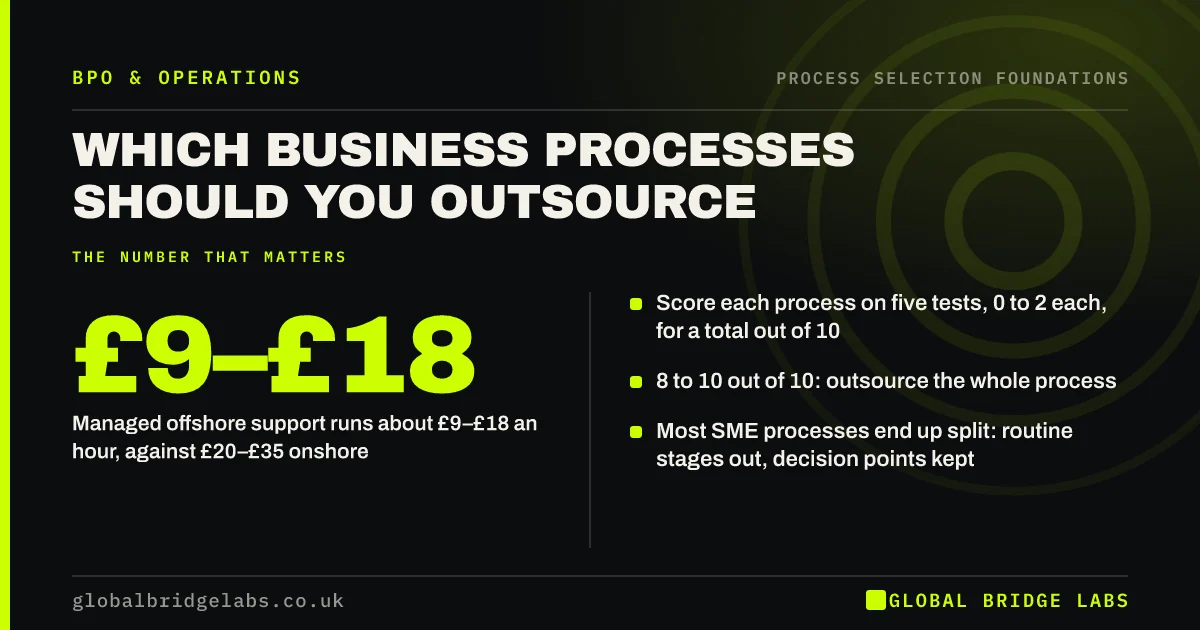
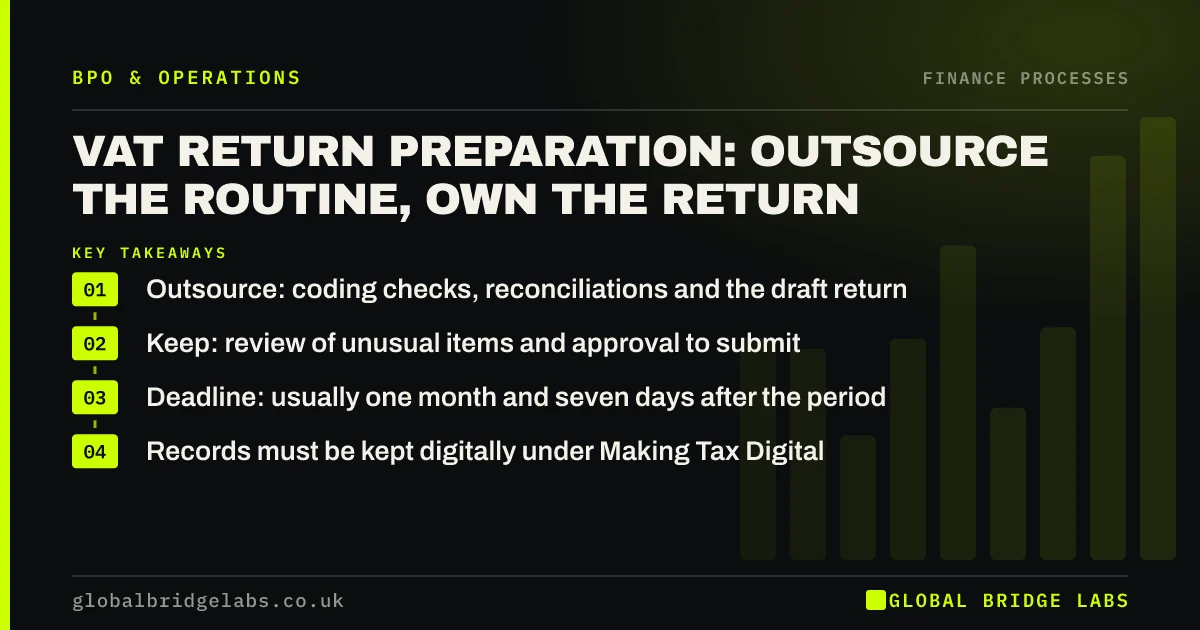
VAT return preparation outsourcing suits most VAT-registered SMEs: the coding, reconciling and draft return are rule-based. The business remains responsible for the return's accuracy, even when an agent prepares or submits it. Returns are usually due one calendar month and seven days after the period ends, and must be filed through Making Tax Digital compatible software.
- Outsource: coding checks, reconciliations and the draft return.
- Keep: review of unusual items and approval to submit.
- Deadline: usually one month and seven days after the period.
- Records must be kept digitally under Making Tax Digital.
Want a VAT preparation routine that hits the deadline? Message us on WhatsApp.
Chat on WhatsApp →What does VAT return preparation involve?
Preparation means checking that every sale and purchase in the period carries the right VAT code, reconciling the VAT control account, reviewing unusual items such as imports, reverse charge or partial exemption, and producing a draft return with supporting reports. Most of the hours go on checking codes, which is exactly the work a trained team does well.
Who is responsible if an outsourced VAT return is wrong?
The VAT-registered business. HMRC holds the taxpayer responsible for the return, whoever prepares it, although penalties can be reduced where you took reasonable care. That is why the split matters: the provider prepares and flags; a named person in the business, or your accountant, reviews the flagged items and approves submission.
How do you set up a reliable VAT routine?
Work back from the deadline. Close the period's bookkeeping in week one after quarter end, prepare and flag in week two, review in week three, and submit with a week to spare. Keep a short list of transaction types that always need review, so the provider knows what to flag.
- Week 1: close bookkeeping for the period.
- Week 2: check codes, reconcile, draft the return.
- Week 3: review flagged items and approve.
- Week 4: submit, with a week before the deadline.
- Time-critical processes: outsource them with a clock
- Cut-off times: what same-day processing really means
Want this timetable adapted to your VAT quarters? Message us on WhatsApp.
Chat on WhatsApp →When should VAT preparation stay with your accountant?
When your VAT position is complex, such as partial exemption, the capital goods scheme, margin schemes or significant cross-border trade, keep preparation with a VAT-qualified accountant. A managed team can still do the bookkeeping and code checks that feed into it.
What does this look like in practice?
A pattern we see: most VAT errors in small firms are coding errors made weeks earlier, not mistakes on the return itself. Checking codes weekly rather than quarterly removes most of the late scramble.
VAT preparation checklist
Confirm these each quarter.
- Bookkeeping closed for the period.
- VAT codes checked on every transaction.
- VAT control account reconciled.
- Unusual items flagged and reviewed.
- Approval to submit recorded.
- Return filed a week before the deadline.
Next step
Tell us your VAT quarter dates and who prepares the return today. We will tell you which steps could move and what the review step should cover.
Message us on WhatsApp, or book a 30-minute consultation.
Chat on WhatsApp →Sources and further reading
- Sending a VAT Return · HM Revenue & Customs
- Making Tax Digital for VAT · HM Revenue & Customs
- Penalty points and penalties if you submit your VAT Return late · HM Revenue & Customs
Frequently asked questions
Can I outsource my VAT return?
Yes. A provider or accountant can check VAT codes, reconcile the control account, prepare the draft return and, with your authority, submit it through Making Tax Digital software. You remain responsible for the return's accuracy, so keep a review of flagged items and an approval step.
When is a VAT return due in the UK?
For most businesses, the return and payment are due one calendar month and seven days after the end of the VAT period. Businesses on the annual accounting scheme or making payments on account have different dates, so check your own VAT account for your deadlines.
Who is liable for errors on an outsourced VAT return?
The VAT-registered business remains liable to HMRC for its return. Penalties for inaccuracies depend on the behaviour behind them and can be reduced where you took reasonable care, which is why keeping a review and approval step matters even when preparation is outsourced.
Written by

Global Bridge Labs (GBL) is a UK–Sri Lanka partner for social media, websites and BPO. Everything here comes from client delivery, not theory.