On this page
- 01Key takeaways
- 02What does business efficiency mean?
- 03Why do growing businesses become less efficient?
- 04How does outsourcing improve business efficiency?
- 05How does outsourcing make work move faster?
- 06How does outsourcing free senior time for core work?
- 07How does outsourcing improve accuracy?
- 08How does outsourcing match capacity to demand?
- 09What does the efficiency gain look like in numbers?
- 10What does outsourcing for efficiency cost?
- 11When does outsourcing make a business less efficient?
- 12How do you keep control, quality and compliance?
- 13How do you measure the efficiency gain?
- 14Which processes gain most from outsourcing?
- 15How does efficiency differ by sector?
- 16What does this look like in practice?
- 17Business efficiency checklist
- 18More guides on outsourcing and efficiency
- 19Next step
- 20Sources and further reading
- 21Frequently asked questions
Key takeaways
Outsourcing improves business efficiency when it changes how work flows, not just who does it. A managed team that works to a written process shortens waiting time, returns senior hours to core work, cuts errors, matches capacity to demand and makes performance visible. Outsourcing a process nobody has defined usually makes a business slower, not faster.
- 5 gains: flow, focus, accuracy, capacity and visibility.
- Up to 40% of productive time can be lost to task switching (APA).
- Lead time, not effort, is what most customers feel as slow service.
- Gains hold only when turnaround and errors are measured before and after.
Want to know which of the five gains apply to your business? Message us on WhatsApp with your team size and the three tasks that slow you down most.
Chat on WhatsApp →What does business efficiency mean?
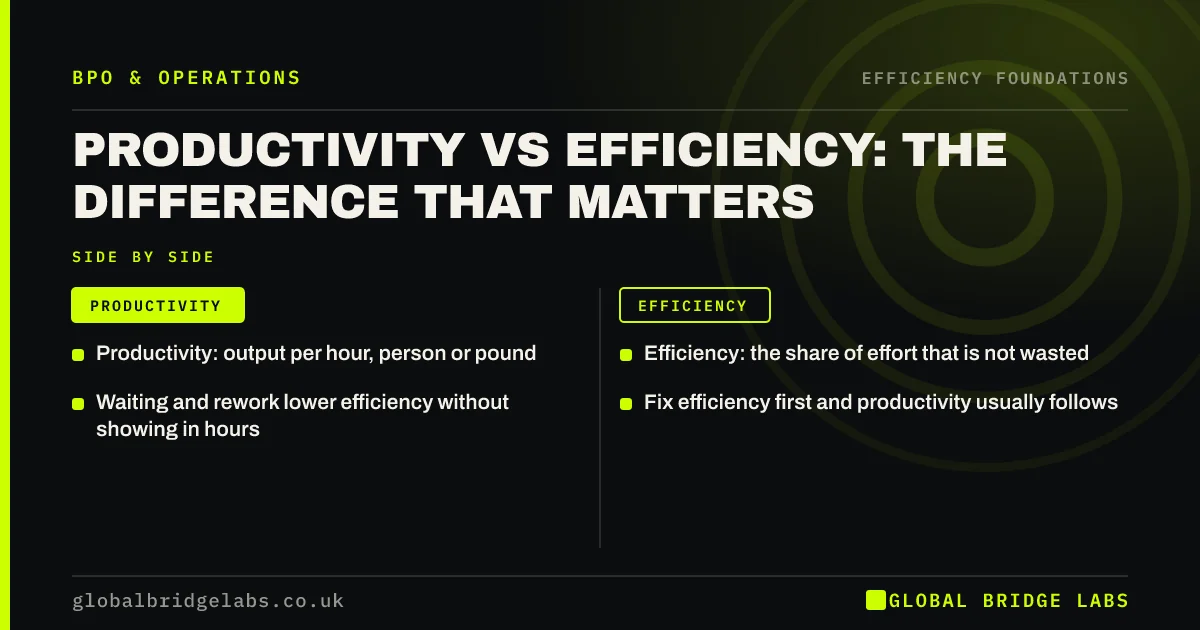
Business efficiency is the ratio of useful output to the time, money and effort used to produce it. An efficient business delivers the same quote, order, invoice or customer reply with fewer hours, less waiting and fewer corrections. It is different from being busy: a team can be fully occupied and still inefficient if work waits, loops back or lands on the wrong person.
The Office for National Statistics measures productivity at national level as output per hour worked. Inside a small business, the more useful measures are lead time (how long the customer waits), touch time (how long the work actually takes), right-first-time rate and the share of senior hours spent on the work only they can do.
Why do growing businesses become less efficient?
Growing businesses become less efficient because routine work spreads across more people without anyone redesigning it. Each new task is absorbed by whoever has a gap, so the owner answers invoices, a fee earner books appointments and three people handle customer email three different ways. Work waits in personal inboxes, and nobody can see the queue.
Interruptions compound the problem. The American Psychological Association summarises research showing that switching between tasks can cost as much as 40% of someone's productive time. A senior person who checks the shared inbox twenty times a day is paying that tax on their most valuable hours.
- Routine work lands on whoever is free, not whoever is best placed.
- Methods drift: the same task is done several ways.
- Queues are invisible, so work waits without anyone noticing.
- Senior people are interrupted by low-value requests all day.
How does outsourcing improve business efficiency?
Outsourcing improves business efficiency through five gains: faster flow of work, more senior focus on core tasks, higher accuracy, capacity that matches demand, and visibility of performance. We call these the five efficiency gains. Each can be measured, and a provider that cannot show progress on at least three of them is moving work, not improving it.
The gains come from the handover itself as much as from the provider. Writing a process down so another team can run it forces decisions about steps, standards and exceptions that most small businesses have never made.
- Flow: work waits less because a dedicated team works the queue every day.
- Focus: senior people stop doing routine tasks and get uninterrupted time back.
- Accuracy: one written method and regular checks mean fewer corrections.
- Capacity: hours flex with volume instead of being fixed at headcount.
- Visibility: turnaround, volumes and errors are reported every week.
How does outsourcing make work move faster?
Outsourcing makes work move faster by cutting waiting time, which is usually most of the lead time. A quote that takes three days to send often needs under an hour of actual work. The rest is time sitting in an inbox until someone is free. A team whose job is to work that queue every day removes most of the wait.
Process cycle efficiency, touch time divided by lead time, is often below 10% in office processes. Raising it does not require anyone to work faster. It requires work to stop waiting.
- Lead time vs cycle time: what your customers actually feel
- Process cycle efficiency: how much of the wait is work?
- Little's law: why more work in progress slows delivery
- Work queue management: stop jobs waiting in the back office
- Turnaround time: what to agree with an outsourced team
- Quote turnaround time: how fast should you send a quote?
- Approval bottlenecks: when sign-off holds up the work
- Backlog clearance: catch up with an outsourced team
How does outsourcing free senior time for core work?
Outsourcing frees senior time by moving the interruptions, not just the tasks. When bookings, inbox triage, invoicing and data entry sit with a dedicated team, owners and specialists get long, unbroken blocks for selling, delivering and planning. The value of an hour returned to a fee earner or owner is usually several times the cost of the hour outsourced.
The freed time only becomes an efficiency gain if it is planned. Decide before the handover what the returned hours will be used for, and protect them in the diary.
- Outsourcing to focus on your core business: what changes
- Deep work for business owners: protect the hours that matter
- Time freed by outsourcing: how to spend it well
- How to increase billable hours without longer days
- Maker vs manager schedule: plan the owner's week
- The 80/20 rule in business: find the work that matters
- Outsourced diary management: is it worth it for owners?
- Too many meetings? Cut the time a small team loses
How does outsourcing improve accuracy?
Outsourcing improves accuracy because a handed-over process has to be written down, checked and measured. One documented method replaces several informal ones, checklists catch the common slips, and a provider's quality checks sample work before customers see it. Fewer corrections means less rework, and rework is the most expensive kind of inefficiency because the work is paid for twice.
- Should you fix a process before you outsource it?
- Work instructions vs SOPs: which one does your team need?
- Acceptance criteria: define done for outsourced work
- Checklists that reduce errors in routine business work
- Mistake-proofing admin processes: design errors out
- Process maturity: is your process ready to hand over?
- How to brief an outsourced team so work comes back right
- Right first time rate: the quality number that cuts cost
How does outsourcing match capacity to demand?
Outsourcing matches capacity to demand because you buy hours or output to fit the workload rather than whole employees. An in-house role sized for the busiest week sits idle in quieter ones, and a role sized for the average falls behind at peaks. A managed team can be sized to the average and flexed when volumes rise, so queues stay short without paying for idle time.
- How many customer service agents do you need?
- Agent occupancy: how busy a support team should be
- Takt time for service teams: pace work to demand
- Support ticket backlog: how to clear it and keep it clear
- Overflow outsourcing: hand off only work above your limit
- How outsourcing helps small businesses scale without hiring
What does the efficiency gain look like in numbers?
In an illustrative 14-person professional services firm, the owner and two senior staff spend about 18 hours a week on routine admin: scheduling, chasing documents, raising invoices and answering general email. Client quotes take three working days to go out, although each needs about 45 minutes of work. These are example figures to show the mechanism, not a benchmark.
After the routine work is documented and handed to a managed team working UK hours, quotes are drafted the same day for senior review, so lead time falls from three days to under one. The senior team gets about 15 of the 18 hours back after allowing three hours a week for review and questions. If even half of those hours become billable at an illustrative £90 an hour, that is about £675 a week of extra capacity.
- Before: 18 senior hours a week on admin, 3-day quote lead time.
- After: 3 hours a week of review, quotes out within 1 working day.
- Net: about 15 senior hours a week returned to client work.
- Illustrative value: about £675 a week if half become billable at £90.
- How to measure the time outsourcing saves you
- Outsourcing efficiency KPIs: prove the work got faster
- Run a time audit to find what to outsource
Want this worked through with your own hours and turnaround times? Send them on WhatsApp and we will discuss your requirements.
Chat on WhatsApp →What does outsourcing for efficiency cost?
As indicative UK market ranges, a managed offshore team costs £9–£18 per hour and an onshore provider £20–£35 per hour, depending on skills, hours and volume. These are not GBL prices. For comparison, a UK employee on £30,000 costs about £19.81 per worked hour once employer National Insurance, pension and holiday are included, before recruitment, equipment and management time.
The efficiency case rarely rests on the rate alone. The bigger number is usually the value of senior hours returned and the revenue protected by faster turnaround. Price the provider, your own review time and the setup effort together.
When does outsourcing make a business less efficient?
Outsourcing makes a business less efficient when it adds handovers without removing waits. The common causes are handing over an undefined process, routing every decision back to one busy person, splitting one task across too many parties, and judging the provider on hours rather than outcomes. Each one creates a new queue in place of the old one.
- The process changes every week and nobody has written it down.
- Volumes are a few hours a week, too small to justify the handover.
- Every exception still needs the owner's approval.
- The work is your product, your sales relationship or your expertise.
How do you keep control, quality and compliance?
Control holds when four things exist: a written process, a named internal process owner, a weekly scorecard and sampling of real work. Under UK GDPR your business remains the controller of personal data a provider handles, so you need a written processor contract, and a transfer to a country without UK adequacy regulations needs a safeguard such as the International Data Transfer Agreement (IDTA).
If existing employees' work moves to a provider, the Transfer of Undertakings (Protection of Employment) regulations, known as TUPE, may apply, so take advice before any role changes. Give the provider only the system access each task needs.
How do you measure the efficiency gain?
Measure the same five things before the handover and again 30, 60 and 90 days after: lead time, touch time, right-first-time rate, backlog age and senior hours spent on the work. Use the same definitions each time. A gain in speed that comes with more errors is not a gain, so read the numbers together.
- Throughput: how much work your team really finishes
- Work ageing report: find the jobs that have been waiting
- Outsourcing performance report: what a good one shows
- Post-implementation review: did outsourcing work?
- Leading vs lagging indicators in operations
- Control charts for small businesses: spot real change
- Work sampling: measure where office time goes, quickly
- Time and motion study for office work: a modern version
Which processes gain most from outsourcing?
The processes that gain most are high-volume, rule-based and time-sensitive: customer email and calls, order and booking administration, invoicing and supplier payments, document handling and lead follow-up. They have clear queues, so faster flow shows up quickly, and they interrupt senior people when kept in-house.
- Customer service: triage, replies, call answering and follow-up.
- Back office: purchase-to-pay, order-to-cash, documents and onboarding admin.
- Revenue support: lead qualification, routing, bids and sales admin.
- Tools: automation, dashboards and knowledge bases run alongside the team.
- Support ticket triage: route each query to the right place
- Customer service workflow: from first message to closed
- Purchase-to-pay process: faster, cleaner supplier payments
- Order-to-cash process: shorten the road from sale to cash
- Lead qualification process: spend sales time on real buyers
- Sales support outsourcing: more selling time for your team
- Workflow automation for small businesses: where to start
- Human in the loop: pairing AI tools with an outsourced team
How does efficiency differ by sector?
The mechanism is the same in every sector, but the queue that matters differs. In e-commerce it is order to dispatch, in trades it is call to booked job, in accountancy and law it is fee-earner time, in clinics it is the patient admin around appointments, in restaurants it is the admin behind service, and in logistics it is booking and proof-of-delivery paperwork.
- How to improve e-commerce operational efficiency
- How to run a more efficient trades business
- How to improve efficiency in an accountancy practice
- How to improve efficiency in a small law firm
- How to improve efficiency in a private clinic
- Restaurant efficiency: faster admin, smoother service
- How to improve office efficiency in a logistics firm
What does this look like in practice?
A pattern we see in UK firms with 10 to 30 staff: the owner believes the problem is workload, so the first instinct is to hire. A two-week log shows the work itself is modest but it waits in four inboxes and loops back for corrections. Once one process is written down and run daily by a managed team, the queue shortens first, then the corrections fall, then the senior hours come back.
Across our client work, owners have got 31 hours a week back once routine work was documented and run by a managed team.
Business efficiency checklist
Work through these steps before you hand anything over.
- List the ten routine tasks that interrupt senior people most.
- Log lead time and touch time for each over two weeks.
- Score them on the five efficiency gains.
- Write the top process down, including exceptions.
- Remove steps and approvals that add nothing.
- Name an internal process owner.
- Pilot one process for 60 to 90 days with a weekly scorecard.
- Compare lead time, errors and senior hours with the baseline.
More guides on outsourcing and efficiency
These guides cover the tools, roles and measures that keep an outsourced process efficient once it is running.
- Batching admin tasks: when it helps and when it slows you
- Response time vs resolution time: which one to improve
- Service level in call answering: what 80/20 really means
- Call abandonment rate: what it is and how to lower it
- After-call work: the hidden half of every customer contact
- Shared inbox vs helpdesk: which does a small team need?
- Expense claims processing: stop chasing receipts
- Supplier onboarding: set up new suppliers right first time
- Going paperless in a small business: what really saves time
- Bank reconciliation outsourcing: daily, not month-end
- Recruitment admin outsourcing: hire faster with less effort
- New starter admin: get employees productive from day one
- Document processing outsourcing: from paper pile to data
- Order to dispatch time: how fast should orders leave?
- Marketing operations for small businesses: less chaos
- Creative brief template: get marketing work right first time
- Website change requests: how fast should updates happen?
- Bid and tender admin support: respond to more tenders
- Contract admin: stop renewals and obligations slipping
- Lead routing: get every enquiry to the right person fast
- Customer feedback loop: turn complaints into fewer contacts
- Outsourced research support: faster answers for busy teams
- Task management for outsourced teams: one list, no chasing
- Video SOPs: train an outsourced team with screen recordings
- Single source of truth: one place for each business fact
- Operations dashboard: the few numbers a small firm needs
- Internal knowledge base: answers your team can find fast
- File naming conventions for small business teams
- Time tracking for outsourced teams: useful or intrusive?
Next step
Send us your team size, the three tasks that slow you down most and roughly how long customers wait for each. In a 30-minute call we will score them on the five efficiency gains with you, say plainly which should stay in-house, and outline what a managed team would change for the rest.
Message us on WhatsApp for an efficiency review, or book a 30-minute consultation.
Chat on WhatsApp →Sources and further reading
- Multitasking: switching costs · American Psychological Association
- Labour productivity · Office for National Statistics
- Rates and thresholds for employers 2026 to 2027 · HM Revenue & Customs
- Contracts and liabilities between controllers and processors · Information Commissioner's Office
- International transfers of personal data · Information Commissioner's Office
- Business transfers, takeovers and TUPE · GOV.UK
Frequently asked questions
How does outsourcing improve business efficiency?
Outsourcing improves efficiency by shortening the time work waits, moving routine interruptions away from senior people, replacing informal methods with one checked process, matching capacity to demand and reporting performance every week. The gain shows up as shorter lead times, fewer corrections and more senior hours spent on core work.
Does outsourcing always increase efficiency?
No. Outsourcing an undefined or constantly changing process usually adds handovers and questions, which makes work slower. Efficiency improves when the process is written down, a named person owns it in-house, the provider works the queue daily, and turnaround and accuracy are measured before and after.
Which business processes should you outsource for efficiency?
Start with high-volume, rule-based and time-sensitive work that interrupts senior people: customer email and calls, bookings, invoicing, supplier payments, document handling and lead follow-up. These have clear queues, so the effect of daily, dedicated handling on lead time is quick to see and easy to measure.
How long does it take for outsourcing to improve efficiency?
Most businesses see the first change in lead time within the first month, once the provider is working the queue daily. Accuracy and senior time usually take 60 to 90 days, because the process needs a few rounds of feedback before exceptions are handled without escalation.
Is outsourcing for efficiency different from outsourcing to cut costs?
Yes. Cost-led outsourcing judges success on the price per hour. Efficiency-led outsourcing judges it on lead time, accuracy and senior hours returned, which often matter more to revenue. The best results come when the brief names both, with efficiency measures written into the weekly scorecard.
Written by

Global Bridge Labs (GBL) is a UK–Sri Lanka partner for social media, websites and BPO. Everything here comes from client delivery, not theory.