
On this page
- 01Key takeaways
- 02What is right first time?
- 03How do you calculate it?
- 04What does a poor rate cost?
- 05How do you raise the rate?
- 06Is 100% the right goal?
- 07How should you use it with a provider?
- 08What does this look like in practice?
- 09Right first time checklist
- 10Next step
- 11Sources and further reading
- 12Frequently asked questions
Key takeaways
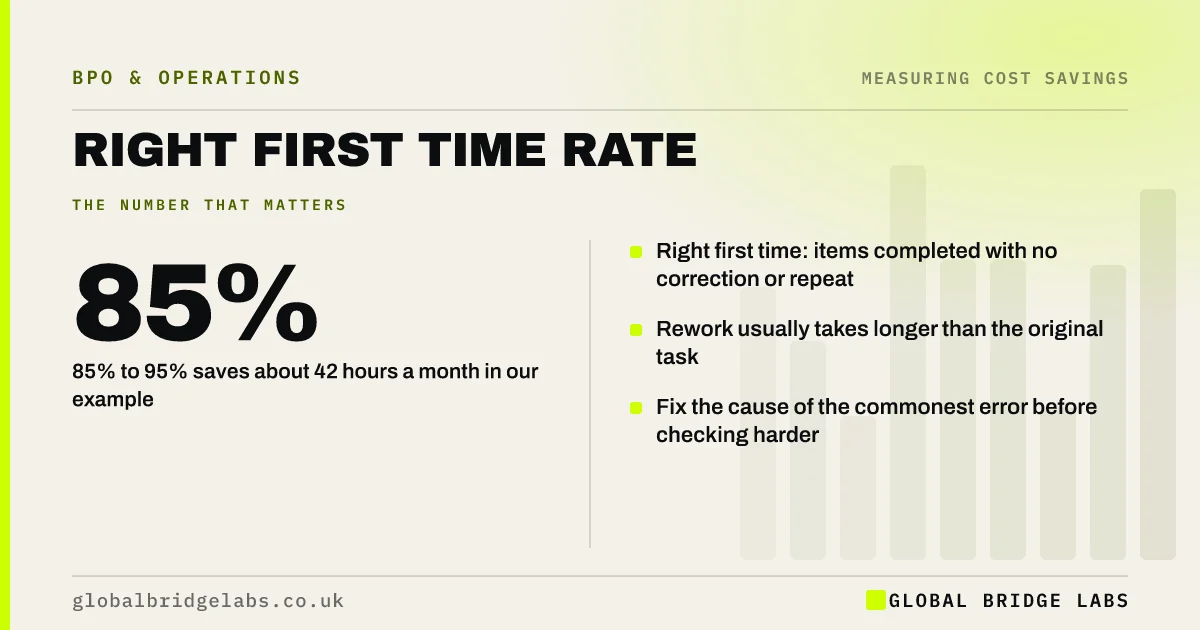
Right first time rate is the share of items completed correctly with no correction, query or repeat. It is the clearest link between quality and cost, because every item that fails is paid for at least twice. In our example, raising the rate from 85% to 95% on 1,000 items a month saves about 42 hours.
- Right first time: items completed with no correction or repeat.
- 85% to 95% saves about 42 hours a month in our example.
- Rework usually takes longer than the original task.
- Fix the cause of the commonest error before checking harder.
Want your right first time rate measured? Message us on WhatsApp with the process and monthly volume.
Chat on WhatsApp →What is right first time?
Right first time (RFT) is a quality measure showing the percentage of work completed correctly at the first attempt, without needing to be fixed, redone or queried. It applies to any repeatable output: invoices, orders, data records, customer replies, reports.
How do you calculate it?
Divide the number of items completed with no correction by the total completed, and multiply by 100. The hard part is counting corrections honestly. Include anything queried by a customer, returned by a colleague or changed after it was sent.
- 1. Define what counts as an error for this process.
- 2. Count items completed in the period.
- 3. Count items that needed any correction.
- 4. Subtract, divide by the total, multiply by 100.
What does a poor rate cost?
A poor rate costs the time to find, fix and re-send each failed item, which is normally longer than doing it once. In an illustrative process handling 1,000 items a month, each takes 6 minutes and each correction takes 25. At 85% right first time, 150 corrections use 62.5 hours a month. At 95%, 50 corrections use about 21.
The difference is roughly 42 hours a month, about £830 at a loaded £19.81 per worked hour, or close to £10,000 a year. That excludes the cost of errors nobody caught.
- 85% RFT: 150 corrections, 62.5 hours a month.
- 95% RFT: 50 corrections, about 21 hours a month.
- Saving: about 42 hours a month.
- Admin errors costing money? When accuracy says outsource
- Work out your cost per task before you outsource
Want the cost of rework calculated for your process? Send us the numbers on WhatsApp.
Chat on WhatsApp →How do you raise the rate?
Raise the rate by removing the cause of the most frequent error, then the next. Log each failure with a reason. A few reasons will account for most failures, and they are usually about unclear input or an ambiguous step, not carelessness.
- Log every correction with a reason code.
- Rank reasons and fix the top one at source.
- Add required fields and validation at entry.
- Write the standard method and train to it.
- Sample work weekly and feed back within a day.
Is 100% the right goal?
Not always. The last few points are expensive, and for low-risk work the cost of preventing every error can exceed the cost of fixing the few that remain. Set the goal by consequence. A payment, a medical record or a legal document warrants near-perfect accuracy. An internal note does not.
How should you use it with a provider?
With a provider, agree the definition of an error in writing, set a target rate in the service level agreement, and sample the output yourself for the first few months. Ask for the reason-code log each week. A provider that reports its own errors openly is more valuable than one reporting a perfect score.
What does this look like in practice?
A pattern we see when error logging starts: the team expects a long list of different mistakes and finds that one field on one form accounts for a large share of them. The field is ambiguous, and people guess. Rewording it does more than any amount of double-checking.
Right first time checklist
Put these in place for each key process.
- An error is defined in writing.
- Corrections are logged with a reason.
- The rate is calculated monthly.
- The top reason has an owner.
- Input validation is in place.
- Work is sampled weekly.
- The target reflects the consequence of error.
Next step
Tell us which process generates the most corrections. We will help you set up an error log and work out what a better right first time rate would be worth.
Message us on WhatsApp to cut rework in one process, or book a 30-minute consultation.
Chat on WhatsApp →Sources and further reading
- Labour productivity · Office for National Statistics
- UK Customer Satisfaction Index · Institute of Customer Service
Frequently asked questions
How do you calculate right first time rate?
Divide the number of items completed without any correction by the total number completed, then multiply by 100. If 1,000 invoices are raised and 150 need correcting, the right first time rate is 85%. Count every query, reissue and amendment as a correction.
What is a good right first time rate?
It depends on the process and the consequence of error. High-risk work such as payments should be close to 100%. Routine admin can tolerate a little less. The more useful question is whether your own rate is improving month on month.
What is the difference between right first time and first contact resolution?
Right first time measures whether a piece of work was completed correctly at the first attempt. First contact resolution measures whether a customer's query was solved in one contact. The first applies to any process output. The second is specific to customer service.
Why does rework cost more than the original task?
Rework includes finding the error, working out what went wrong, correcting it, re-sending it and often apologising or explaining. It interrupts other work and may involve a second person. The original task had none of that overhead.
Written by

Global Bridge Labs (GBL) is a UK–Sri Lanka partner for social media, websites and BPO. Everything here comes from client delivery, not theory.


