
On this page
- 01Key takeaways
- 02Flow: does work move without waiting?
- 03Focus: are senior people freed for core work?
- 04Accuracy: is work right first time?
- 05Capacity: does capacity match demand?
- 06Visibility: can you see performance?
- 07How do you read your score?
- 08How does this differ from the scorecard?
- 09When is a checklist not enough?
- 10What does this look like in practice?
- 11Next step
- 12Sources and further reading
- 13Frequently asked questions
Key takeaways
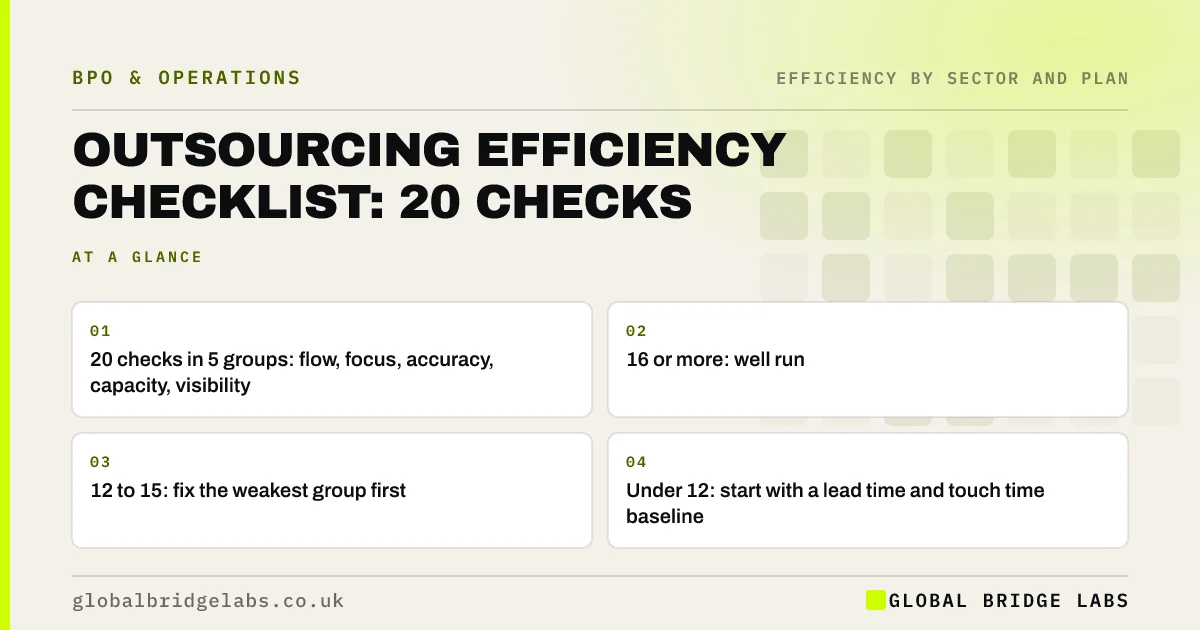
This outsourcing efficiency checklist has 20 yes or no checks in five groups of four: flow, focus, accuracy, capacity and visibility. Use it before a handover to check readiness, or on a running arrangement to find what is slowing it down. A score of 16 or more means it is well run, 12 to 15 means fix the weakest group, and under 12 means start with a baseline.
- 20 checks in 5 groups: flow, focus, accuracy, capacity, visibility.
- 16 or more: well run.
- 12 to 15: fix the weakest group first.
- Under 12: start with a lead time and touch time baseline.
Want to go through the checklist with us? Message us on WhatsApp.
Chat on WhatsApp →Flow: does work move without waiting?
Flow checks whether work moves from request to result without sitting in queues.
- 1. All requests of each type arrive in one place.
- 2. A named owner works the queue every day.
- 3. Turnaround targets are set by task type.
- 4. The oldest open item is under the agreed age limit.
Focus: are senior people freed for core work?
Focus checks whether the arrangement actually returns senior time.
- 5. Approval limits let routine items finish without you.
- 6. Decisions are batched into one daily slot.
- 7. Senior time on the process is logged and falling.
- 8. Freed hours are planned for named core work.
Accuracy: is work right first time?
Accuracy checks whether quality is defined, built in and measured.
- 9. The process and top exceptions are written down.
- 10. Acceptance criteria exist for each task type.
- 11. A checklist or system rule covers common errors.
- 12. Work is sampled weekly and right-first-time is reported.
Capacity: does capacity match demand?
Capacity checks whether the team is sized and flexed to the work.
- 13. Daily or hourly demand is known.
- 14. Capacity is sized to peaks, not only the average.
- 15. A trigger brings in extra cover before backlogs build.
- 16. Holiday and absence cover is agreed.
Visibility: can you see performance?
Visibility checks whether you know how the process is performing without chasing.
- 17. A baseline was recorded before the handover.
- 18. A one-page report arrives every week.
- 19. A named internal process owner reads it.
- 20. A review is held at day 90 and each quarter.
How do you read your score?
Count your yes answers. 16 or more means the arrangement is well run, so look for one improvement a quarter. 12 to 15 means one group is holding you back, so fix the group with the fewest yes answers first. Under 12 means start with a two-week baseline of lead time and touch time, then work through flow and accuracy.
In an illustrative example, a business scores 13: flow 4, focus 2, accuracy 3, capacity 2, visibility 2. Focus and capacity tie as weakest. Setting approval limits and a daily decision slot lifts focus first, because it also shortens the queue. Example scores only.
- The efficiency gain scorecard: where outsourcing helps
- A 90-day plan to improve efficiency through outsourcing
Want a second opinion on your score? Send us your answers on WhatsApp.
Chat on WhatsApp →How does this differ from the scorecard?
The efficiency gain scorecard rates a process before you decide what to hand over, showing where the biggest gain is. This checklist tests how well a handover or running arrangement is set up. Use the scorecard to choose and the checklist to run.
When is a checklist not enough?
A checklist is not enough when the process itself is the wrong one to outsource, or when the provider is not a good fit. It also cannot replace talking to the people doing the work. Use it to structure the conversation, not to end it.
What does this look like in practice?
A pattern we see: a running arrangement feels slow and nobody can say why. The checklist shows strong flow and accuracy but a weak focus group, because every exception still goes to the owner. Fixing those four checks is enough to change how the arrangement feels.
Next step
Run through the 20 checks and send us your answers. We will tell you which group to fix first and what would move your score fastest.
Message us on WhatsApp with your checklist score, or book a 30-minute consultation.
Chat on WhatsApp →Sources and further reading
- The Sourcing and Consultancy Playbooks · Cabinet Office
- Contracts and liabilities between controllers and processors · Information Commissioner's Office
Frequently asked questions
What should an outsourcing efficiency checklist include?
Checks on flow, focus, accuracy, capacity and visibility: one intake point and daily queue owner, approval limits and decision slots, written processes and acceptance criteria, capacity sized to peaks, and a baseline, weekly report, process owner and regular reviews.
How do you use the 20-check list?
Answer each check yes or no and count the yes answers. 16 or more means well run; 12 to 15 means fix the group with the fewest yes answers; under 12 means start with a two-week baseline of lead time and touch time.
When should you use the checklist?
Use it before a handover to check readiness, 30 days in to catch set-up gaps, and each quarter on a running arrangement. Scores change as volumes, staff and systems change, so a quarterly check keeps the arrangement efficient.
Written by

Global Bridge Labs (GBL) is a UK–Sri Lanka partner for social media, websites and BPO. Everything here comes from client delivery, not theory.


