
On this page
- 01Key takeaways
- 02What should the report contain?
- 03How often should it come?
- 04How should trends be shown?
- 05What does a good report look like?
- 06How do you use the report?
- 07When does a report become noise?
- 08What does this look like in practice?
- 09Report checklist
- 10Next step
- 11Sources and further reading
- 12Frequently asked questions
Key takeaways
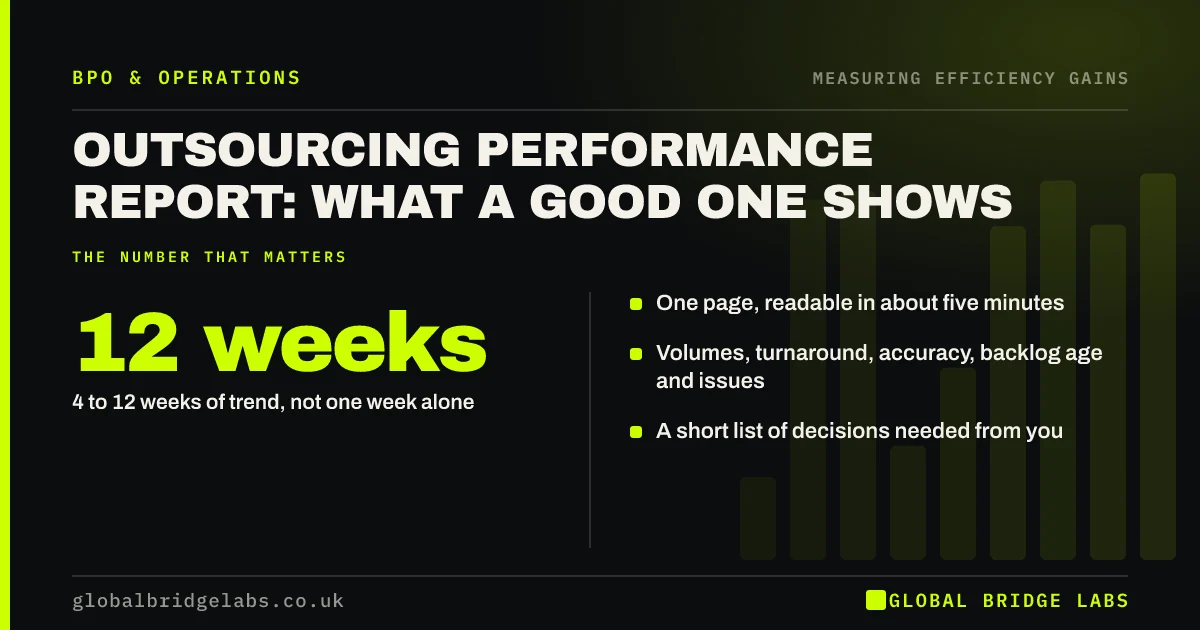
A good outsourcing performance report fits on one page and shows volumes, turnaround against target, accuracy, backlog age, issues and decisions needed, with a few weeks of trend. It should take you five minutes to read and tell you whether to act. If you still have to chase for updates, the report is not doing its job.
- One page, readable in about five minutes.
- Volumes, turnaround, accuracy, backlog age and issues.
- 4 to 12 weeks of trend, not one week alone.
- A short list of decisions needed from you.
Want a report template for your provider? Message us on WhatsApp.
Chat on WhatsApp →What should the report contain?
The report should answer four questions: how much work came in and went out, how fast it was done, how accurate it was, and what needs your attention. Everything else is optional.
- Volumes in and completed, by task type.
- Share within turnaround target.
- Right-first-time rate from sampling.
- Oldest open item and backlog size.
- Issues, causes and actions taken.
- Decisions needed from you.
How often should it come?
Weekly suits most small-business processes, with a monthly summary and a longer quarterly review. Daily reporting is useful only during a handover or a peak. Agree the day and time so the report arrives before your weekly review slot.
How should trends be shown?
Show each number for the last 4 to 12 weeks, so a single bad week is seen in context and a slow drift is spotted early. A simple table or line chart is enough. Mark the target on each line so movement against it is obvious.
What does a good report look like?
In an illustrative weekly report for an outsourced order desk: 1,240 orders processed against 1,260 received; 94% within the four-hour target; 98.5% right first time on a sample of 100; oldest open order 26 hours, caused by a stock query; two decisions needed, both on refunds above the agreed limit. One page, five minutes. Example figures.
- Order processing outsourcing for manufacturers and brands
- Escalation paths for outsourced teams: fast, not chaotic
Want your current provider report reviewed? Send it to us on WhatsApp.
Chat on WhatsApp →How do you use the report?
Read it in a fixed weekly slot, answer the decisions needed the same day, and pick one number to discuss when it moves. Ask for the cause and the action, not just the figure. Over time, the report should replace most ad hoc check-ins.
When does a report become noise?
A report becomes noise when it runs to many pages, lists activity rather than results, or never leads to a decision. If nobody reads it, cut it back to the four questions and ask for a shorter version.
What does this look like in practice?
A pattern we see: a provider sends a long monthly spreadsheet, and the client checks in by email several times a week instead. Switching to a one-page weekly report with decisions needed at the top ends the check-ins.
Report checklist
Ask your provider for these.
- One page.
- Volumes, turnaround, accuracy and backlog.
- Trend over several weeks.
- Issues with causes and actions.
- Decisions needed, at the top.
Next step
Send us the report you receive today, or tell us what you would like to know each week. We will suggest a one-page format that gives you the answers.
Message us on WhatsApp about reporting, or book a 30-minute consultation.
Chat on WhatsApp →Sources and further reading
- The Sourcing and Consultancy Playbooks · Cabinet Office
- UK Customer Satisfaction Index · Institute of Customer Service
Frequently asked questions
What should an outsourcing performance report include?
Volumes received and completed, the share within turnaround target, right-first-time rate, backlog size and oldest open item, issues with causes and actions, and any decisions needed from you. Show several weeks of trend, on one page.
How often should an outsourcing provider report?
Weekly suits most small-business processes, with a monthly summary and a quarterly review. Daily reporting is useful during a handover or peak period. Agree the timing so the report arrives before your weekly review.
What if the provider's report does not match my experience?
Check the definitions first, such as when the turnaround clock starts and how accuracy is sampled. Then check a sample of items yourself. Agree written definitions so both sides measure the same thing in the same way.
Written by

Global Bridge Labs (GBL) is a UK–Sri Lanka partner for social media, websites and BPO. Everything here comes from client delivery, not theory.


