
On this page
- 01Key takeaways
- 02What is deep work?
- 03Why do business owners get so little of it?
- 04How do you create deep work time?
- 05What does the gain look like?
- 06Which tasks should move so the blocks hold?
- 07When is deep work not realistic?
- 08What does this look like in practice?
- 09Deep work checklist
- 10Next step
- 11Sources and further reading
- 12Frequently asked questions
Key takeaways
Deep work for business owners means long, uninterrupted blocks spent on demanding work such as strategy, pricing, key proposals and hiring decisions. Most owners get almost none, because routine requests break the day into short pieces. Two protected blocks of 90 minutes or more a week, with routine work handled elsewhere, are a realistic start.
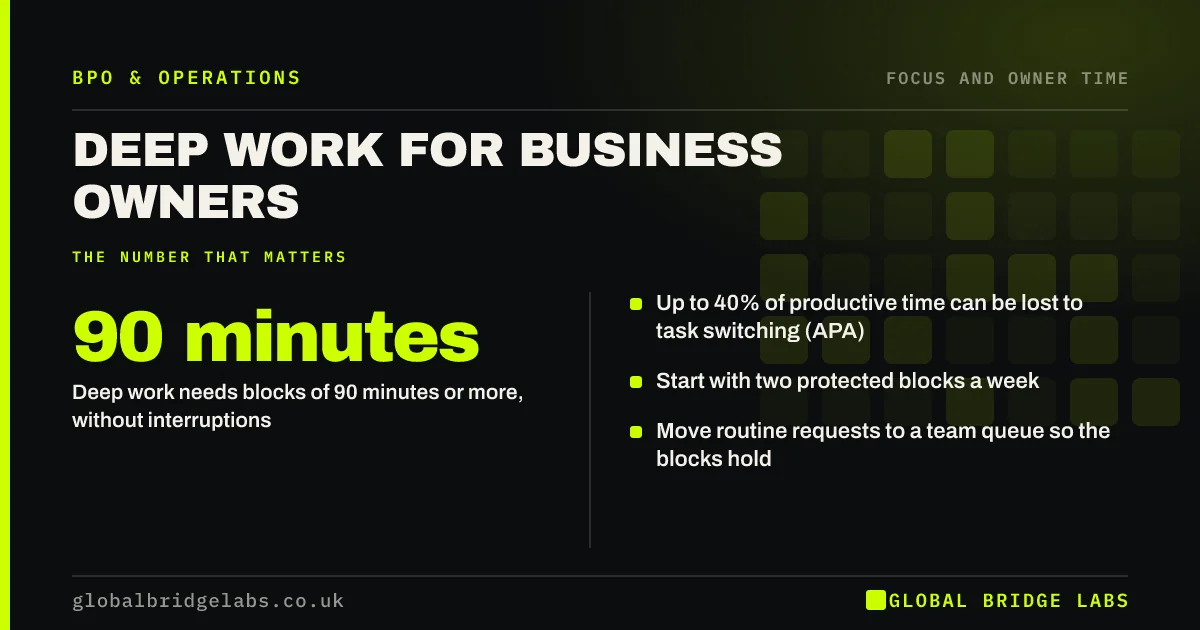
- Deep work needs blocks of 90 minutes or more, without interruptions.
- Up to 40% of productive time can be lost to task switching (APA).
- Start with two protected blocks a week.
- Move routine requests to a team queue so the blocks hold.
Want help finding deep work time in your week? Message us on WhatsApp.
Chat on WhatsApp →What is deep work?
Deep work is focused, uninterrupted time on cognitively demanding tasks. The term was popularised by Cal Newport in his 2016 book of the same name. Its opposite, shallow work, is the routine, easily interrupted work such as email, scheduling and admin. Both are needed, but only deep work moves a business forward.
Why do business owners get so little of it?
Owners get little deep work because they are the default answer to every question. Customers, staff and suppliers all route to them, and each request takes a few minutes. The American Psychological Association notes that switching between tasks can cost as much as 40% of productive time, so an owner interrupted every 15 minutes rarely reaches full concentration.
How do you create deep work time?
Create deep work time by scheduling it first and removing what breaks it. Book two or three blocks a week, ideally in the morning. During them, turn off notifications and route routine requests to someone else. Batch decisions into one daily slot so questions have a home that is not your inbox.
- 1. Book two 90-minute blocks a week in the diary.
- 2. Name one task for each block in advance.
- 3. Route routine requests to a team or deputy.
- 4. Hold one daily slot for decisions and approvals.
- 5. Review after four weeks and extend if it works.
What does the gain look like?
In an illustrative week, an owner has 45 working hours but no block longer than 30 minutes. After routine email and scheduling move to a managed team, two 2-hour blocks a week become possible. That is 4 hours a month of focused time per block, used for pricing, partnerships and key proposals. Example figures; the point is the shape of the week.
Want to see what your week could look like? Send us your diary pattern on WhatsApp.
Chat on WhatsApp →Which tasks should move so the blocks hold?
Move the tasks that arrive unpredictably and need a quick answer but not your judgement: general enquiries, booking changes, supplier chasing, document requests and routine customer replies. These are the interruptions that break blocks. Keep the decisions only you can make, batched into a daily slot.
When is deep work not realistic?
Deep work is hard in roles that are genuinely on call, such as a sole trader answering emergency call-outs or a duty manager in service hours. Even then, a short protected block before or after the busy period helps, and call answering cover can make it possible.
What does this look like in practice?
A pattern we see: an owner tries to block focus time and gives up after a week because the phone and inbox keep pulling them back. Putting a team in front of the inbox and phone for those hours, with an agreed list of what truly needs the owner, makes the blocks stick.
Deep work checklist
Set these up before your first block.
- Choose two blocks a week and book them.
- Pick the task for each block.
- Agree who handles requests during blocks.
- Write what counts as an emergency.
- Turn off notifications during the block.
Next step
Tell us what usually interrupts you. We will help you work out which requests a team could handle so your focus blocks hold.
Message us on WhatsApp to protect your focus time, or book a 30-minute consultation.
Chat on WhatsApp →Sources and further reading
- Multitasking: switching costs · American Psychological Association
- Work-related stress and how to manage it · Health and Safety Executive
Frequently asked questions
What is deep work?
Deep work is focused, uninterrupted time on demanding tasks, such as strategy, pricing or complex proposals. The term was popularised by Cal Newport in 2016. It contrasts with shallow work like email and admin, which is easily interrupted and rarely moves a business forward.
How much deep work should a business owner do?
Start with two blocks of about 90 minutes a week and build from there. The exact amount matters less than consistency. Owners who protect even a few hours a week for strategic work usually make better decisions and make them sooner.
How do I stop interruptions as a business owner?
Give interruptions somewhere else to go. Route routine requests to a team or deputy, define what counts as an emergency, and batch decisions into one daily slot. Then turn off notifications during focus blocks. Without an alternative route, requests will keep finding you.
Written by

Global Bridge Labs (GBL) is a UK–Sri Lanka partner for social media, websites and BPO. Everything here comes from client delivery, not theory.


