
On this page
- 01Key takeaways
- 02What is an escalation process?
- 03What should be escalated?
- 04What does a three-level path look like?
- 05How do you stop escalations slowing work?
- 06How does escalation work for customer service?
- 07When should the team not escalate?
- 08What does this look like in practice?
- 09Escalation checklist
- 10Next step
- 11Sources and further reading
- 12Frequently asked questions
Key takeaways
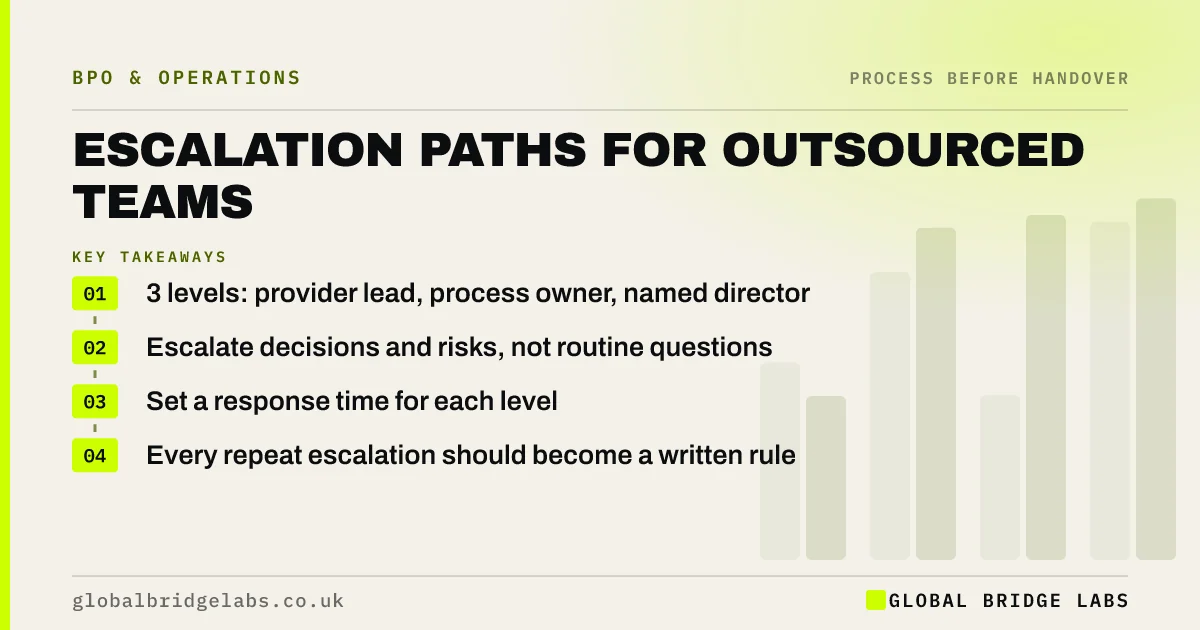
An escalation process for outsourcing sets what the team should pass up, to whom and how fast. A simple three-level path works for most small businesses: the provider's team leader for process questions, your process owner for business decisions, and a named director for urgent or high-risk issues. Most items should never need escalating.
- 3 levels: provider lead, process owner, named director.
- Escalate decisions and risks, not routine questions.
- Set a response time for each level.
- Every repeat escalation should become a written rule.
Want an escalation path drafted for your handover? Message us on WhatsApp.
Chat on WhatsApp →What is an escalation process?
An escalation process is a written route for issues the person doing the work cannot or should not resolve alone. It names who to contact, how, and how quickly they should respond. In outsourcing, it is the bridge between the provider's team and your business, and it decides whether exceptions are handled in minutes or days.
What should be escalated?
Escalate items that need a business decision, carry risk or fall outside the written process. Routine questions about how to do a task should go to the provider's team leader and the documents, not to you.
- Decisions above an agreed limit, such as refunds over £100.
- Complaints that mention legal action or regulators.
- Suspected fraud or bank detail changes.
- Personal data requests or breaches.
- Anything not covered by the process.
What does a three-level path look like?
In an illustrative path, level 1 is the provider's team leader, responding within one working hour on process questions. Level 2 is your process owner, who clears a daily decision list and answers urgent items within two working hours. Level 3 is a named director for urgent or high-risk issues, reachable by phone. Example response times only.
- The process owner: who keeps an outsourced process healthy
- Turnaround time: what to agree with an outsourced team
Want response times set for your own path? Send us your team structure on WhatsApp.
Chat on WhatsApp →How do you stop escalations slowing work?
Stop escalations slowing work by batching non-urgent ones into a daily list, setting response times for each level, and turning every repeated escalation into a written rule. Track the count weekly. A falling number means the process is maturing. A rising number means rules are missing.
How does escalation work for customer service?
For customer service, escalation usually follows tiers: the first tier answers routine queries, the second handles complex or technical ones, and a named person in your business handles complaints, goodwill decisions and anything reputational. Tell customers what will happen next and when.
When should the team not escalate?
The team should not escalate items the written process covers, items within its approval limits, or questions it can answer from the knowledge base. Escalating those is a sign the documents or limits are unclear, so fix them rather than answering each time.
What does this look like in practice?
A pattern we see: early in a handover, the team escalates everything to the owner by email, and the owner answers late at night. Introducing a daily decision list, a team leader for process questions and written limits cuts escalations sharply within a month.
Escalation checklist
Agree these before the handover.
- List what must be escalated.
- Name a contact and deputy at each level.
- Set a response time for each level.
- Agree how urgent items are flagged.
- Count escalations weekly.
Next step
Tell us what you plan to outsource and who makes decisions today. We will help you draft a three-level escalation path with sensible response times.
Message us on WhatsApp to set up escalation, or book a 30-minute consultation.
Chat on WhatsApp →Sources and further reading
- Contracts and liabilities between controllers and processors · Information Commissioner's Office
- Small Business Guide: response and recovery · National Cyber Security Centre
Frequently asked questions
What is an escalation process?
An escalation process is a written route for issues that the person doing the work cannot or should not resolve alone. It names who to contact at each level, how to contact them and how quickly they should respond, so exceptions are handled quickly.
What should an outsourced team escalate?
Decisions above agreed limits, serious complaints, suspected fraud, bank detail changes, personal data issues and anything not covered by the written process. Routine how-to questions should go to the provider's team leader and the documents instead.
How do you reduce escalations?
Turn every repeated escalation into a written rule or a new approval limit, keep a searchable knowledge base, and count escalations weekly. A falling count shows the process is maturing; a rising one shows rules are missing.
Written by

Global Bridge Labs (GBL) is a UK–Sri Lanka partner for social media, websites and BPO. Everything here comes from client delivery, not theory.


