
On this page
- 01Key takeaways
- 02Why are expenses so time-consuming?
- 03What should an expense policy include?
- 04How do you make processing faster?
- 05What does the gain look like in numbers?
- 06What records do you need to keep?
- 07When is outsourcing expenses not worth it?
- 08What does this look like in practice?
- 09Expense claims checklist
- 10Next step
- 11Sources and further reading
- 12Frequently asked questions
Key takeaways
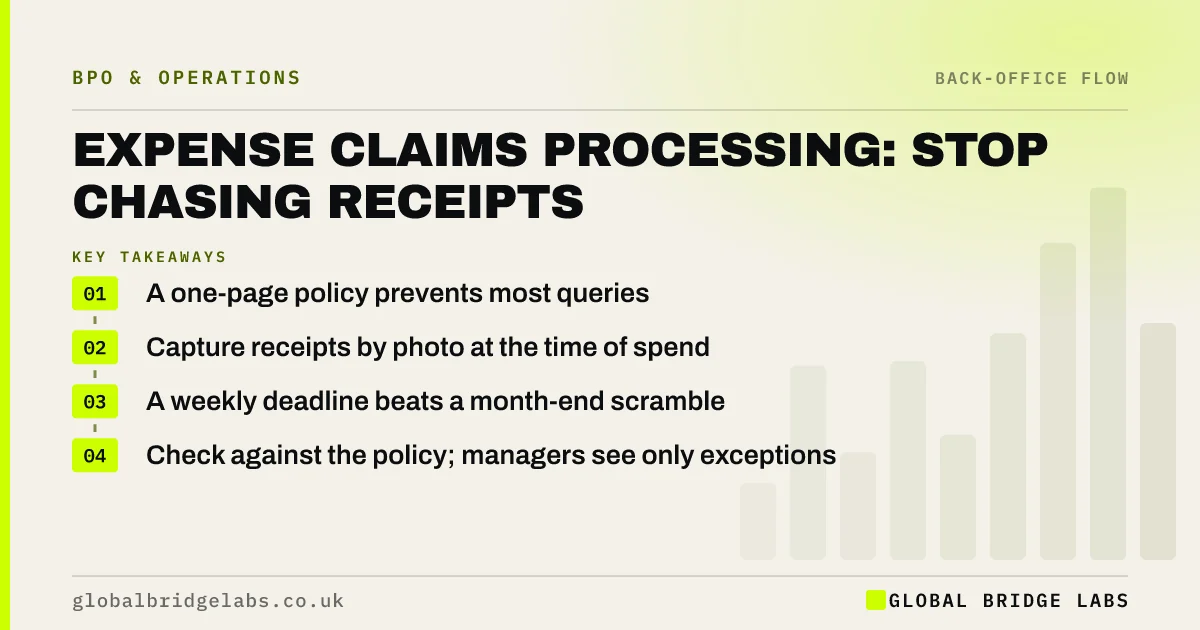
Expense claims processing is slow when receipts arrive late, policies are unclear and every claim waits for one approver. A one-page policy, photographing receipts at the time of spend, a weekly submission deadline and approval limits make it routine. A managed team can check claims against the policy so managers only see exceptions.
- A one-page policy prevents most queries.
- Capture receipts by photo at the time of spend.
- A weekly deadline beats a month-end scramble.
- Check against the policy; managers see only exceptions.
Want a simpler expense routine for your team? Message us on WhatsApp.
Chat on WhatsApp →Why are expenses so time-consuming?
Expenses are time-consuming because the work arrives in a burst, often at month-end, with missing receipts and unclear categories. Someone has to chase, check and code each item, and an approver has to sign off. Each step waits for the one before, so a few claims can take days.
What should an expense policy include?
A good policy fits on one page: what can be claimed, limits for common items such as meals and travel, how to claim mileage using HMRC approved rates, what receipt is needed, the submission deadline and who approves what. The clearer the policy, the fewer queries and rejections.
- What can and cannot be claimed.
- Limits for meals, hotels and travel.
- How mileage is claimed.
- Receipt and VAT receipt requirements.
- Submission deadline and approval limits.
How do you make processing faster?
Make it faster by capturing receipts at the time of spend in an expenses app or accounting tool, setting a weekly rather than monthly deadline, checking claims against the policy as they arrive and sending only exceptions to managers. Pay approved claims on a fixed weekly cycle so staff know when to expect money.
What does the gain look like in numbers?
In an illustrative firm with 25 claimants, month-end expense processing takes the office manager about two days, mostly chasing receipts. Moving to photo capture, a weekly deadline and a managed team checking against the policy cuts it to under an hour a week of approvals. Example figures only.
- Month-end close: how to finish faster with less effort
- How to reduce back-office costs in a UK small business
Want your expense workload estimated? Send us claimant numbers on WhatsApp.
Chat on WhatsApp →What records do you need to keep?
Keep receipts and claim records as part of your business records. Limited companies must keep accounting records for six years from the end of the financial year they relate to. Digital copies are generally acceptable if they are clear and complete. Ask your accountant about any sector-specific rules.
When is outsourcing expenses not worth it?
It is not worth it for a handful of claims a month, where a simple app and the owner's quick review are enough. It pays off when there are many claimants, frequent travel or several entities, and the in-house check is falling behind.
What does this look like in practice?
A pattern we see: staff submit three months of receipts at once, the office manager spends days on them and payments go out late, which leads to more late submissions. A weekly deadline and fast, predictable payment break the cycle.
Expense claims checklist
Put these in place.
- One-page policy shared with all staff.
- Receipts captured by photo at the time.
- Weekly submission deadline.
- Claims checked against policy as they arrive.
- Approval limits for managers.
- Fixed weekly payment day.
Next step
Tell us how many people claim expenses and how claims are handled now. We will suggest a simpler routine and whether a managed team would help.
Message us on WhatsApp about expenses, or book a 30-minute consultation.
Chat on WhatsApp →Sources and further reading
Frequently asked questions
How do you process expense claims efficiently?
Use a one-page policy, capture receipts by photo at the time of spend, set a weekly submission deadline, check claims against the policy as they arrive and send only exceptions for approval. Pay approved claims on a fixed weekly day.
How long should a business keep expense receipts?
Limited companies must keep accounting records, including expense receipts, for six years from the end of the financial year they relate to. Clear digital copies are generally acceptable. Check with your accountant for any rules specific to your business.
Can expense processing be outsourced?
Yes. A managed team can check claims against your policy, code them, chase missing receipts and prepare approved claims for payment. Your managers then review exceptions only. It pays off when there are many claimants or frequent travel.
Written by

Global Bridge Labs (GBL) is a UK–Sri Lanka partner for social media, websites and BPO. Everything here comes from client delivery, not theory.


