
On this page
- 01Key takeaways
- 02What should a brief include?
- 03Why does purpose matter so much?
- 04What are the common gaps?
- 05How do you check the brief was understood?
- 06How does briefing change for creative or digital work?
- 07When is a full brief unnecessary?
- 08What does this look like in practice?
- 09Briefing checklist
- 10Next step
- 11Sources and further reading
- 12Frequently asked questions
Key takeaways
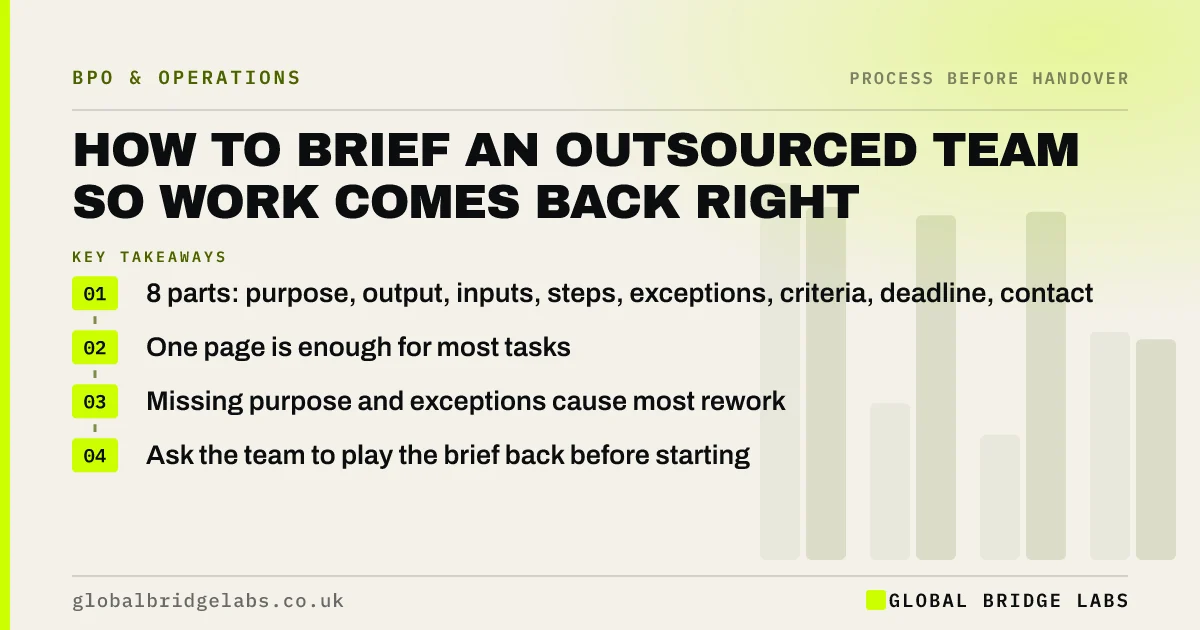
To brief an outsourced team so work comes back right, give them eight things on one page: the purpose, the output, the inputs, the steps, the exceptions, the acceptance criteria, the deadline and who to ask. Most rework comes from a missing purpose or missing exceptions, because the team fills the gap with a reasonable guess that is not yours.
- 8 parts: purpose, output, inputs, steps, exceptions, criteria, deadline, contact.
- One page is enough for most tasks.
- Missing purpose and exceptions cause most rework.
- Ask the team to play the brief back before starting.
Want a brief template adapted for your work? Message us on WhatsApp.
Chat on WhatsApp →What should a brief include?
A brief for outsourced work should answer every question the team would otherwise ask. Eight headings cover almost every case, whether the work is a one-off project or an ongoing process.
- Purpose: why this matters and who uses the result.
- Output: exactly what you want back, in what format.
- Inputs: where the information and files are.
- Steps: the method, or a link to the SOP.
- Exceptions: what to do in the common unusual cases.
- Criteria: how you will judge it done.
- Deadline: when, and the target turnaround if ongoing.
- Contact: who to ask, and how fast they will answer.
Why does purpose matter so much?
Purpose matters because it lets the team make sensible choices you did not foresee. If they know a customer list is for a renewal campaign, they will flag expired contacts. If they only know to tidy the list, they may delete them. A one-sentence purpose often prevents more errors than a page of steps.
What are the common gaps?
The common gaps are unstated standards, missing exceptions, unclear format, and no named contact. Each produces either a question that waits for you or a guess that comes back wrong. In an illustrative handover, a brief without exceptions produced 18 questions in week one; adding the top ten exceptions cut that to four. Example figures only.
- Escalation paths for outsourced teams: fast, not chaotic
- Work instructions vs SOPs: which one does your team need?
Want a second pair of eyes on your brief before you send it? Share it on WhatsApp.
Chat on WhatsApp →How do you check the brief was understood?
Ask the team to play the brief back in their own words, and to complete a small sample first. Review the sample against your criteria and adjust the brief, not just the work. For ongoing processes, the first two weeks are the real test, so book a short review at the end of each.
How does briefing change for creative or digital work?
For creative or digital work, such as social posts or website updates, add audience, tone and examples of what good looks like. These are harder to put into criteria, so examples carry more weight. The same eight headings still apply.
When is a full brief unnecessary?
A full brief is unnecessary for repeat tasks the team already does to a written SOP. A short note with the inputs and deadline is enough. Write a full brief for new work, changed work and anything with consequences if it goes wrong.
What does this look like in practice?
A pattern we see: a client sends a task by email with one line of instruction and gets back something technically correct but not what they needed. A one-page brief with purpose and examples gets it right first time, and the team keeps the brief as the template for next time.
Briefing checklist
Check your brief against these.
- Purpose stated in one sentence.
- Output and format described exactly.
- Inputs and access listed.
- Top exceptions covered.
- Acceptance criteria included.
- Deadline and contact named.
Next step
Send us a task you want to hand over. We will help you turn it into a one-page brief the team can work from without questions.
Message us on WhatsApp for a brief template, or book a 30-minute consultation.
Chat on WhatsApp →Sources and further reading
- The Sourcing and Consultancy Playbooks · Cabinet Office
- Contracts and liabilities between controllers and processors · Information Commissioner's Office
Frequently asked questions
What should be in a brief for an outsourced team?
Eight things: the purpose, the exact output, the inputs and where to find them, the steps or SOP, the common exceptions, the acceptance criteria, the deadline and a named contact. One page is enough for most tasks.
Why does outsourced work come back wrong?
Usually because the brief left something out, most often the purpose or the exceptions. The team then fills the gap with a reasonable guess. Adding a one-sentence purpose and the common exceptions prevents most rework.
How do you know a provider has understood a brief?
Ask them to explain it back in their own words and to complete a small sample first. Check the sample against your acceptance criteria and adjust the brief where it was unclear, before the full volume starts.
Written by

Global Bridge Labs (GBL) is a UK–Sri Lanka partner for social media, websites and BPO. Everything here comes from client delivery, not theory.


