
On this page
- 01Key takeaways
- 02Mistake 1: handing over an undefined process
- 03Mistake 2: keeping every decision with one person
- 04Mistake 3: sending work through every channel
- 05Mistake 4: skipping the baseline
- 06Mistakes 5 to 8: the quieter ones
- 07What does a mistake cost in numbers?
- 08When is the problem really the provider?
- 09What does this look like in practice?
- 10Mistake-avoidance checklist
- 11Next step
- 12Sources and further reading
- 13Frequently asked questions
Key takeaways
Outsourcing makes a business less efficient when it adds handovers without removing waits. The common mistakes are handing over an undefined process, keeping every decision with one person, sending work through several channels, skipping the baseline, judging on hours not outcomes and giving no one ownership. Each is avoidable with a few hours of preparation.
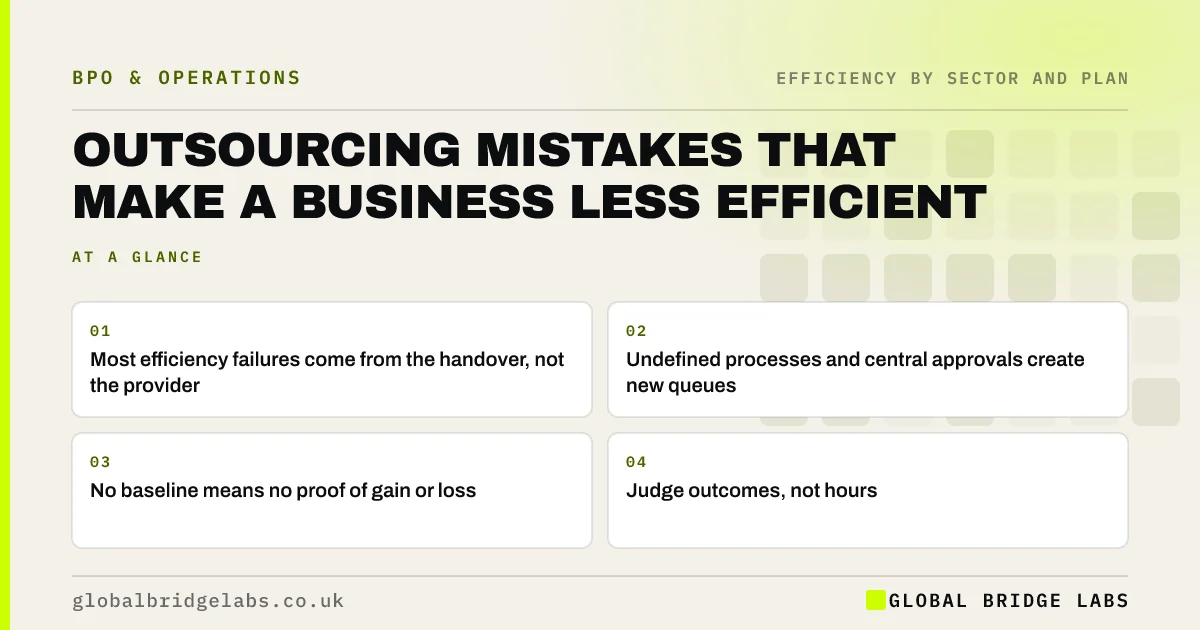
- Most efficiency failures come from the handover, not the provider.
- Undefined processes and central approvals create new queues.
- No baseline means no proof of gain or loss.
- Judge outcomes, not hours.
Worried an outsourcing arrangement is slowing you down? Message us on WhatsApp.
Chat on WhatsApp →Mistake 1: handing over an undefined process
If the steps, exceptions and definition of done are not written down, the provider learns by asking. Each question waits for you, and lead time rises. Spend a few hours writing the process and the top ten exceptions before the handover.
Mistake 2: keeping every decision with one person
If every exception needs the owner's approval, the owner becomes the bottleneck the outsourcing was meant to remove. Set written approval limits, a deputy and a daily decision slot.
Mistake 3: sending work through every channel
Requests by email, chat, phone and meetings get lost or done twice. Use one intake point and one task list, and agree that nothing outside it is worked.
Mistake 4: skipping the baseline
Without measuring lead time, accuracy and senior hours before the handover, nobody can show whether things improved. Problems get blamed on the provider and gains go unnoticed. Two weeks of measurement fixes this.
Mistakes 5 to 8: the quieter ones
Four further mistakes are less obvious but just as costly, and each adds waiting or rework.
- 5. Judging on hours billed rather than turnaround and accuracy.
- 6. No named process owner on your side.
- 7. Access arriving weeks after the start date.
- 8. Judging the arrangement in week two instead of day 90.
What does a mistake cost in numbers?
In an illustrative handover where every refund above £20 needs the owner's approval, about 30 refunds a week wait an average of two days for a decision. Customers chase, creating around 25 extra contacts a week. Raising the limit to £100 with weekly sampling removes most of the waits and the chasing. Example figures only.
Want a quick check of your arrangement for these mistakes? Send us an outline on WhatsApp.
Chat on WhatsApp →When is the problem really the provider?
Sometimes it is. Signs include missed turnaround with no clear cause, rising errors after the process is defined, high staff turnover on your account and reports that never show actions. Raise it with evidence, agree a fix and a date, and be ready to change provider if it does not improve.
What does this look like in practice?
A pattern we see: a business concludes outsourcing does not work after a difficult first month. A review shows four of these eight mistakes, all on the client side. Fixing them with the same provider produces the gains that were expected in the first place.
Mistake-avoidance checklist
Check these before and during a handover.
- Process and exceptions written down.
- Approval limits and a deputy set.
- One intake point and task list.
- Baseline KPIs recorded.
- Named process owner.
- Access ready on day one.
Next step
Tell us how your outsourcing is set up, or how you plan to set it up. We will point out which of these mistakes are likely and how to avoid them.
Message us on WhatsApp for a set-up check, or book a 30-minute consultation.
Chat on WhatsApp →Sources and further reading
- The Sourcing and Consultancy Playbooks · Cabinet Office
- Contracts and liabilities between controllers and processors · Information Commissioner's Office
Frequently asked questions
Why does outsourcing sometimes make things slower?
Usually because handovers are added without removing waits: an undefined process generates questions, decisions still wait for one person, and requests arrive through several channels. Most of these causes sit on the client side and can be fixed with preparation.
What is the most common outsourcing mistake?
Handing over a process that has never been written down. Without steps, exceptions and a definition of done, the provider has to ask about everything, and each question becomes a wait. A few hours of documentation prevents most of it.
How do you know if the provider is the problem?
Look for missed targets with no clear cause, rising errors once the process is defined, high turnover on your account and reports without actions. Raise it with evidence and agree a fix. If nothing improves, consider changing provider.
Written by

Global Bridge Labs (GBL) is a UK–Sri Lanka partner for social media, websites and BPO. Everything here comes from client delivery, not theory.


