
On this page
- 01Key takeaways
- 02What is supplier onboarding?
- 03What should you collect?
- 04How do you verify bank details safely?
- 05How much due diligence is enough?
- 06What does the gain look like in numbers?
- 07When is a formal process overkill?
- 08What does this look like in practice?
- 09Supplier onboarding checklist
- 10Next step
- 11Sources and further reading
- 12Frequently asked questions
Key takeaways
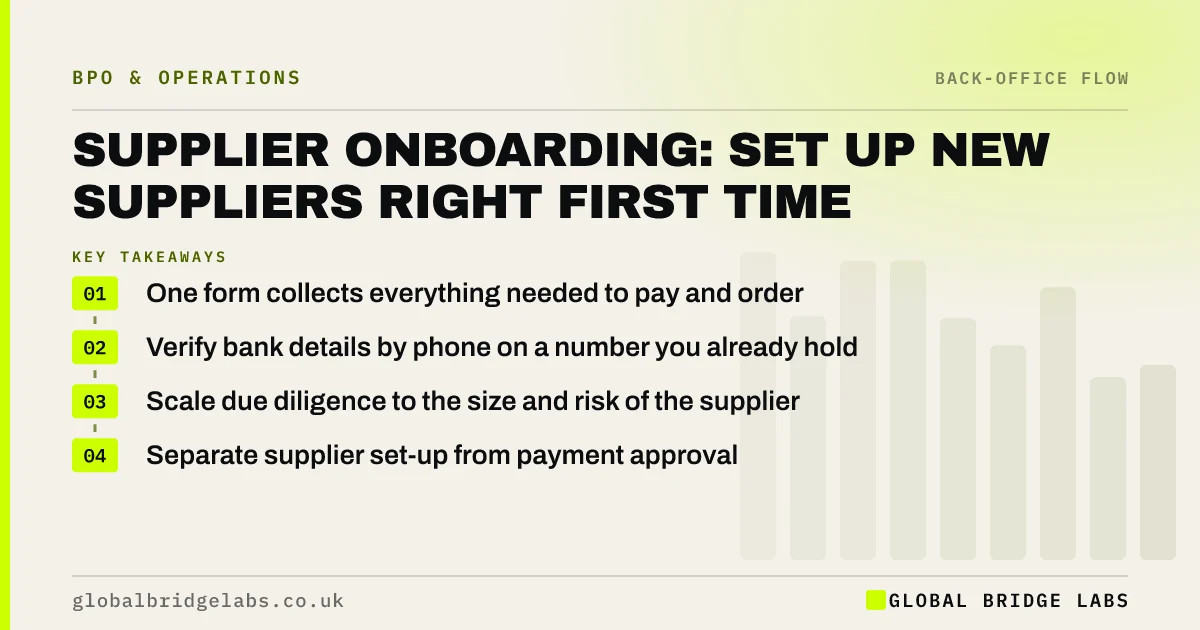
A supplier onboarding process collects the right details once, verifies them and sets the supplier up so the first invoice can be paid without corrections. Use one form, verify bank details by phone, check basic due diligence for the size of the relationship, and separate the person who sets up suppliers from the person who approves payments.
- One form collects everything needed to pay and order.
- Verify bank details by phone on a number you already hold.
- Scale due diligence to the size and risk of the supplier.
- Separate supplier set-up from payment approval.
Want a supplier set-up form and checklist? Message us on WhatsApp.
Chat on WhatsApp →What is supplier onboarding?
Supplier onboarding is the process of gathering a new supplier's details, checking them and setting them up in your systems so you can order from and pay them. Done well, it takes one pass. Done badly, it produces invoices that bounce, payments to the wrong account and repeated emails asking for the same information.
What should you collect?
Collect everything in one form so nothing is chased later. The basics cover legal identity, payment and contact details.
- Legal name, trading name and company number.
- VAT number, if registered.
- Bank details on headed paper or a bank letter.
- Remittance and accounts contact.
- Payment terms agreed.
- Insurance or certificates where relevant.
How do you verify bank details safely?
Verify bank details by calling the supplier on a number from their website or an earlier contract, never one in the email that sent the details. Confirm the account name and number. Apply the same check to any later change of bank details, which is a common route for invoice fraud. A small test payment adds another check for large suppliers.
How much due diligence is enough?
Scale it to the risk. For a one-off small purchase, the form and a Companies House check are enough. For a supplier handling personal data on your behalf, you need a written processor contract under UK GDPR. For larger or sensitive supply chains, consider insurance, accreditation and modern slavery checks.
What does the gain look like in numbers?
In an illustrative firm, new suppliers are set up from emails, and about one in four needs a correction before the first payment, each taking around 30 minutes and a delay of several days. A single form and a set-up checklist worked by a managed team cut corrections to about one in twenty. Example figures only.
- Right first time rate: the quality number that cuts cost
- Mistake-proofing admin processes: design errors out
Want to see how many of your supplier set-ups need fixing? Send us a rough count on WhatsApp.
Chat on WhatsApp →When is a formal process overkill?
A formal process is overkill for a business adding one or two suppliers a year. Keep the bank detail verification rule, though. That single step prevents the most expensive mistake.
What does this look like in practice?
A pattern we see: supplier details live in old email threads, so every first invoice triggers a search. Moving set-up to one form and one team, with bank verification as a fixed step, removes the search and the risk at the same time.
Supplier onboarding checklist
Use these for each new supplier.
- Send the set-up form.
- Check company details.
- Verify bank details by phone.
- Agree terms in writing.
- Set up by one person, approved by another.
- Store the form with the supplier record.
Next step
Tell us how you set up suppliers today. We will help you build a one-form process and a checklist a managed team can work to.
Message us on WhatsApp about supplier set-up, or book a 30-minute consultation.
Chat on WhatsApp →Sources and further reading
- Contracts and liabilities between controllers and processors · Information Commissioner's Office
- Slavery and human trafficking in supply chains: guidance for businesses · Home Office
Frequently asked questions
What information do you need from a new supplier?
Legal and trading name, company number, VAT number if registered, bank details on headed paper or a bank letter, an accounts contact and agreed payment terms. Add insurance or certificates where the work needs them, and a processor contract if they handle personal data for you.
How do you verify supplier bank details?
Phone the supplier on a number you already hold or find independently, not one from the email that sent the details, and confirm the account name and number. Repeat the check for any later change. Some businesses also make a small test payment.
Who should set up new suppliers?
Someone other than the person who approves payments. Separating the two duties makes invoice fraud much harder. In a small business that might mean a managed team sets suppliers up and the owner or finance lead approves payments.
Written by

Global Bridge Labs (GBL) is a UK–Sri Lanka partner for social media, websites and BPO. Everything here comes from client delivery, not theory.


