
On this page
- 01Key takeaways
- 02What is the difference?
- 03What are examples for a small business?
- 04How do you choose leading indicators?
- 05What does using them look like?
- 06How do they fit outsourcing reports?
- 07When do leading indicators mislead?
- 08What does this look like in practice?
- 09Indicator checklist
- 10Next step
- 11Sources and further reading
- 12Frequently asked questions
Key takeaways
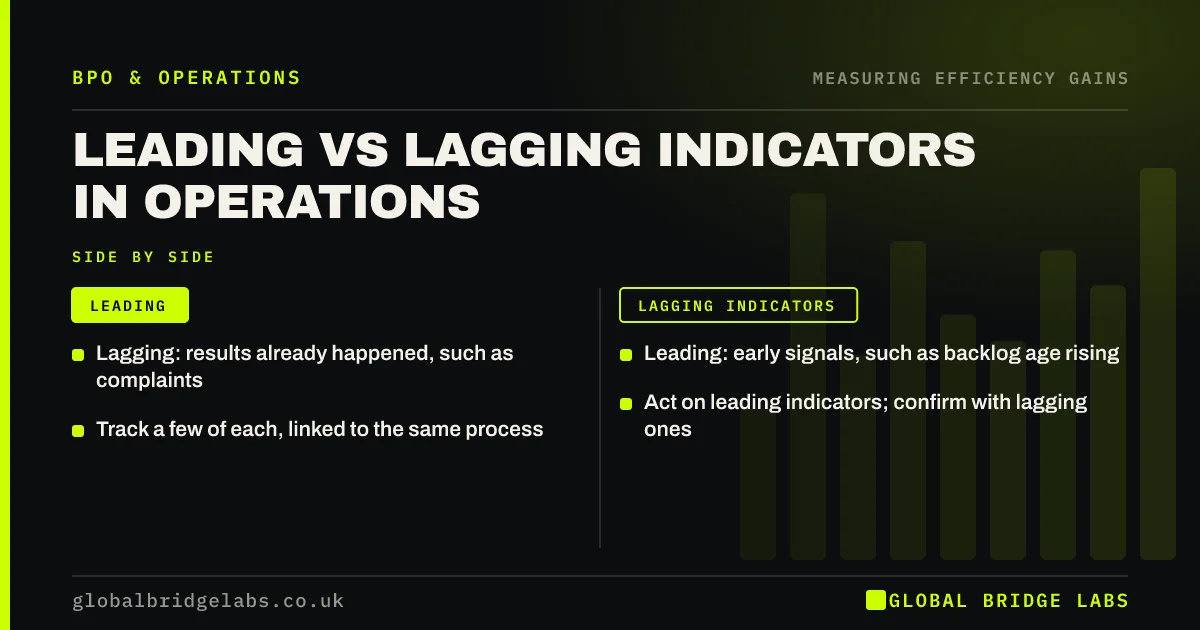
Lagging indicators show results that have already happened, such as complaints, refunds or late deliveries. Leading indicators move earlier and predict them, such as backlog age, arrivals exceeding completions or rising rework. An efficient operation tracks a few of each and acts on the leading ones, so problems are fixed before customers feel them.
- Lagging: results already happened, such as complaints.
- Leading: early signals, such as backlog age rising.
- Track a few of each, linked to the same process.
- Act on leading indicators; confirm with lagging ones.
Want to find the early warning signs for your operations? Message us on WhatsApp.
Chat on WhatsApp →What is the difference?
A lagging indicator measures an outcome after the fact. A leading indicator measures something that tends to change before the outcome does. In operations, customer complaints are lagging. The age of the oldest open ticket, which usually rises before complaints do, is leading.
What are examples for a small business?
Pair each lagging indicator you care about with one or two leading indicators from the same process.
- Complaints (lagging): backlog age and first response time (leading).
- Late deliveries (lagging): held orders and dispatch cut-off misses (leading).
- Debtor days (lagging): days from completion to invoice (leading).
- Staff turnover (lagging): overtime and absence (leading).
- Lost enquiries (lagging): call abandonment and lead response time (leading).
How do you choose leading indicators?
Look at a past problem and ask what changed in the weeks before it. If backlog grew for three weeks before complaints spiked, backlog is a leading indicator. Choose indicators you can measure weekly and that the team can influence directly.
What does using them look like?
In an illustrative business, complaints rose sharply in two recent Decembers. Looking back, arrivals exceeded completions for three weeks each time before complaints followed. Setting a trigger, extra cover when arrivals exceed completions for two weeks running, lets the business act in November instead. Example figures only.
Want triggers set for your busy periods? Send us last year's figures on WhatsApp.
Chat on WhatsApp →How do they fit outsourcing reports?
Ask a provider to report leading indicators weekly, such as arrivals, completions, backlog age and rework, with lagging indicators monthly. Agree triggers in advance, so both sides know when to add capacity or escalate.
When do leading indicators mislead?
They mislead when the link to the outcome is weak, or when people start managing the indicator instead of the work, for example closing tickets early to reduce backlog age. Check regularly that the leading indicator still predicts the result.
What does this look like in practice?
A pattern we see: a business only looks at monthly complaints and refunds, so problems are visible a month after they start. Adding two weekly leading indicators gives a few weeks' warning, which is usually enough to fix the cause.
Indicator checklist
Use these to set up your indicators.
- List the outcomes you care about.
- Pair each with a leading indicator.
- Measure leading indicators weekly.
- Set a trigger for action.
- Check the link still holds each quarter.
Next step
Tell us the outcomes you most want to protect. We will help you find leading indicators and sensible triggers for each.
Message us on WhatsApp about indicators, or book a 30-minute consultation.
Chat on WhatsApp →Sources and further reading
- Labour productivity · Office for National Statistics
- UK Customer Satisfaction Index · Institute of Customer Service
Frequently asked questions
What is the difference between leading and lagging indicators?
Lagging indicators measure outcomes that have already happened, such as complaints or late deliveries. Leading indicators measure things that tend to change first, such as backlog age or rising rework, and so give early warning of the outcome.
What are examples of leading indicators in operations?
Backlog age, arrivals exceeding completions, first response time, rework rate, held orders, days from job completion to invoice, overtime and absence. Each tends to move before a related outcome such as complaints, late deliveries or staff turnover.
How many indicators should a small business track?
A few of each is enough, linked to the outcomes that matter most. Six to eight numbers on a weekly dashboard, with leading indicators reviewed weekly and lagging ones monthly, covers most small businesses.
Written by

Global Bridge Labs (GBL) is a UK–Sri Lanka partner for social media, websites and BPO. Everything here comes from client delivery, not theory.


