
On this page
- 01Key takeaways
- 02What is the maker vs manager schedule?
- 03Why do owners struggle with it?
- 04How do you split the week?
- 05What does it look like in a real week?
- 06What needs to move for maker time to hold?
- 07When does the split not work?
- 08What does this look like in practice?
- 09Weekly schedule checklist
- 10Next step
- 11Sources and further reading
- 12Frequently asked questions
Key takeaways
The maker vs manager schedule idea says focused work needs half-day blocks, while management runs in one-hour slots. One meeting in the middle of a maker's afternoon can wreck it. Owners do both kinds of work, so the fix is to split the week: manager days or mornings for meetings and decisions, maker blocks for deep work, with routine interruptions handled elsewhere.
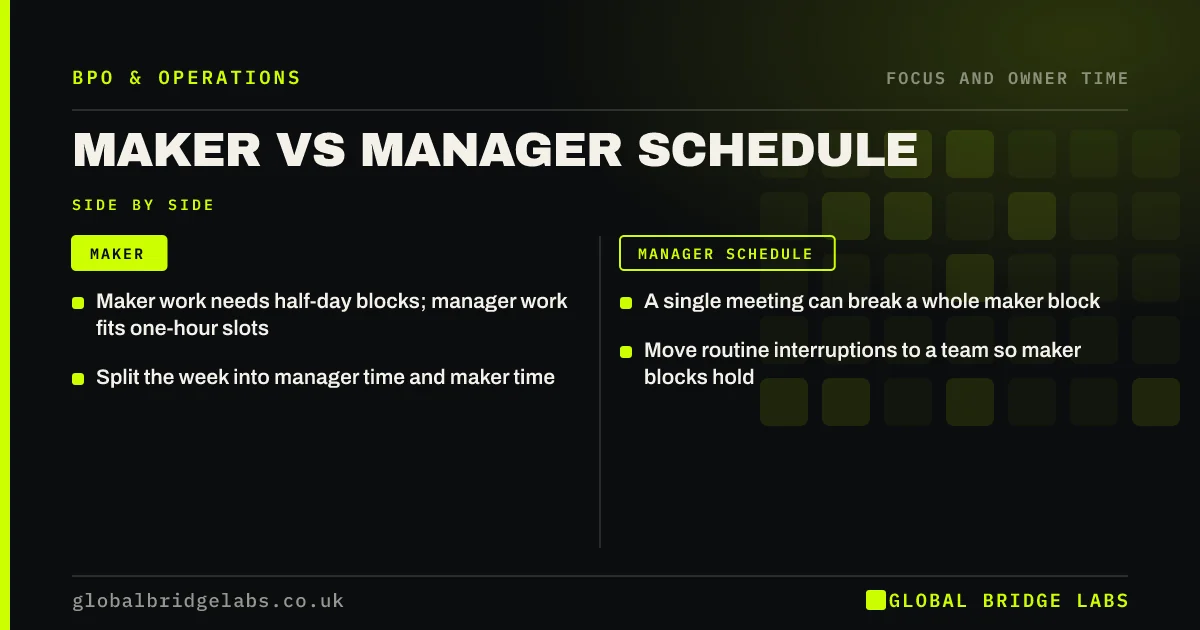
- Maker work needs half-day blocks; manager work fits one-hour slots.
- A single meeting can break a whole maker block.
- Split the week into manager time and maker time.
- Move routine interruptions to a team so maker blocks hold.
Want help splitting your week? Message us on WhatsApp with your current pattern.
Chat on WhatsApp →What is the maker vs manager schedule?
The idea comes from a 2009 essay by Paul Graham. A manager's day is divided into one-hour slots, and a meeting is just one more slot. A maker's day, for writing, designing, analysing or building, needs long stretches, and a meeting in the middle splits it into pieces too small for real work. Both are valid; they just do not mix well.
Why do owners struggle with it?
Owners are both makers and managers. They write proposals, design offers and plan, but they also hold meetings, approve things and answer questions. When the manager side fills every gap, maker work slips to evenings and weekends. The American Psychological Association notes that task switching can cost as much as 40% of productive time.
How do you split the week?
Split the week by grouping all meetings, calls and approvals into set days or half-days, and protecting the rest for maker work. A common pattern is meetings on Monday and Thursday, with Tuesday and Wednesday mornings as maker blocks. Give routine requests a daily slot so they do not leak into maker time.
- 1. List your maker tasks and manager tasks.
- 2. Choose two manager days or half-days.
- 3. Protect two or three maker blocks of 3 hours or more.
- 4. Set one daily slot for routine decisions.
- 5. Ask your diary manager or team to enforce it.
What does it look like in a real week?
In an illustrative week, an owner moves internal meetings to Monday afternoon and client calls to Thursday, keeps Tuesday and Wednesday mornings free for proposals and pricing, and reviews a daily decision list at 4pm. The number of meetings barely changes. What changes is that maker work gets two 3-hour blocks instead of none. Example only.
- Too many meetings? Cut the time a small team loses
- The 80/20 rule in business: find the work that matters
Want a week like this sketched around your commitments? Send us your diary on WhatsApp.
Chat on WhatsApp →What needs to move for maker time to hold?
Maker time holds only if routine interruptions have somewhere else to go. Customer email, booking changes, supplier questions and document requests should go to a team or deputy during maker blocks, with clear rules on what counts as urgent. Without that, the phone wins every time.
When does the split not work?
The split is hard when customers expect you personally at any time, such as an on-call trade or a hands-on service. Shorter maker blocks, at the start or end of the day, and call answering cover during them can still help. Review after a month and adjust rather than giving up.
What does this look like in practice?
A pattern we see: an owner blocks Wednesday for strategy and loses it every week to small requests. Asking the team to hold all non-urgent questions to Thursday's decision slot, and having someone answer the inbox on Wednesday, is what finally makes the block stick.
Weekly schedule checklist
Set these up for next week.
- Pick your manager days or half-days.
- Book maker blocks of 3 hours or more.
- Set a daily decision slot.
- Agree who handles requests in maker time.
- Review after four weeks.
Next step
Tell us what typically fills your week. We will help you find maker time and work out which interruptions a team could take on.
Message us on WhatsApp to plan your week, or book a 30-minute consultation.
Chat on WhatsApp →Sources and further reading
- Multitasking: switching costs · American Psychological Association
- Maximum weekly working hours · GOV.UK
Frequently asked questions
What is the maker vs manager schedule?
It is an idea from Paul Graham's 2009 essay. Managers work in one-hour slots, so meetings fit easily. Makers need half-day blocks for focused work, so a meeting in the middle breaks the block. People who do both should separate the two kinds of time.
How should a business owner plan their week?
Group meetings, calls and approvals into set days or half-days, and protect two or three long blocks for focused work such as proposals, pricing and planning. Give routine requests a daily slot and route them to a team or deputy during focus blocks.
Do meeting-free days work for small businesses?
They can, if someone else handles routine requests that day and urgent matters are clearly defined. Start with one meeting-free morning a week rather than a full day, then extend it once the team and customers have adjusted.
Written by

Global Bridge Labs (GBL) is a UK–Sri Lanka partner for social media, websites and BPO. Everything here comes from client delivery, not theory.


