
On this page
- 01Key takeaways
- 02What is takt time?
- 03How do you calculate takt time?
- 04What does it look like in numbers?
- 05How does takt time help with outsourcing?
- 06What are the limits of takt time in an office?
- 07When is takt time not worth calculating?
- 08What does this look like in practice?
- 09Takt time checklist
- 10Next step
- 11Sources and further reading
- 12Frequently asked questions
Key takeaways
Takt time is the pace at which you need to finish work to keep up with demand: available working time divided by the number of items customers ask for. If your cycle time per item is longer than takt time, a queue builds. In service and admin teams it is a quick way to see how much capacity a process needs.
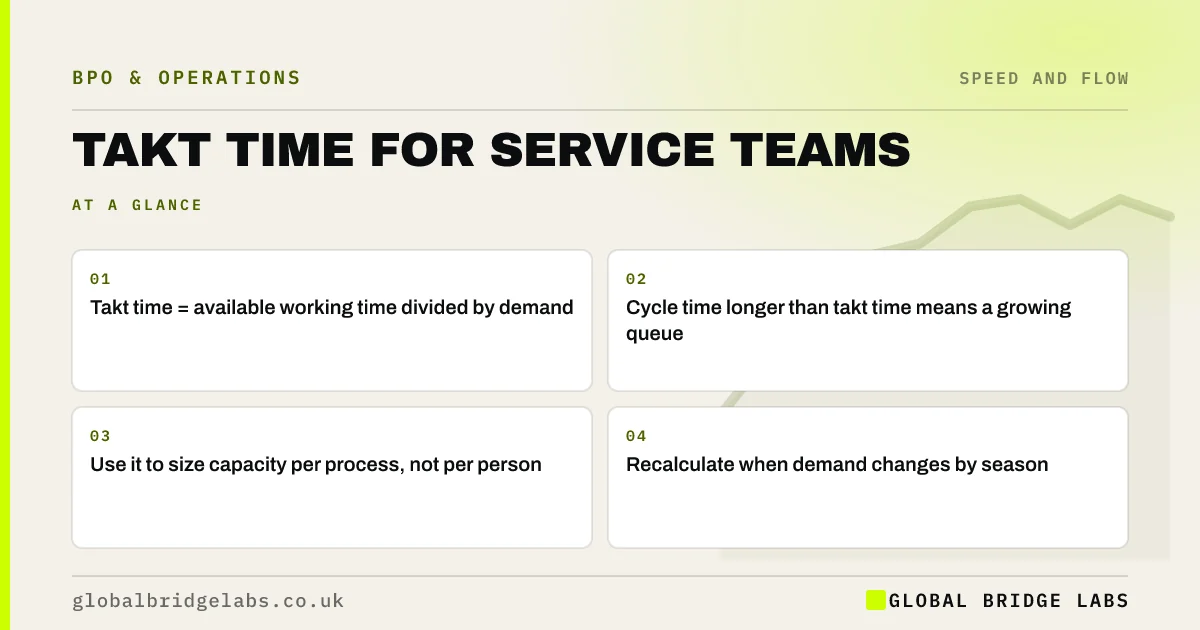
- Takt time = available working time divided by demand.
- Cycle time longer than takt time means a growing queue.
- Use it to size capacity per process, not per person.
- Recalculate when demand changes by season.
Want takt time worked out for one of your processes? Message us on WhatsApp.
Chat on WhatsApp →What is takt time?
Takt time is the rate at which a process must complete items to meet customer demand. The word comes from the German for beat or pulse and was used in lean manufacturing to pace production lines. In an office it might be one invoice every six minutes, or one customer email every four minutes.
How do you calculate takt time?
Divide available working time by demand for the same period. If the team has 7 hours a day for a process and receives 70 items a day, takt time is 6 minutes. Compare it with cycle time per item. If each item takes one person 9 minutes, one person cannot keep up and you need 1.5 people's worth of capacity.
- 1. Measure available working minutes per day.
- 2. Count items received per day.
- 3. Divide minutes by items for takt time.
- 4. Divide cycle time by takt time for people needed.
What does it look like in numbers?
In an illustrative e-commerce business, 240 order queries arrive on a typical day and the team has 420 working minutes, so takt time is about 1.75 minutes. Each query takes about 5 minutes, so the process needs roughly three people working only on queries. With two, a queue of about 80 builds every day. Example figures to show the method.
Want to check if your team is sized to demand? Send us your daily volumes on WhatsApp.
Chat on WhatsApp →How does takt time help with outsourcing?
Takt time tells you how much capacity to buy and when. If demand doubles in December, takt time halves and you need twice the capacity for that month. A managed team can flex to match, so the queue stays short without carrying extra staff for the rest of the year.
What are the limits of takt time in an office?
Office work varies more than a production line. Items differ in size and arrive unevenly through the day. Use takt time for broad sizing, then add a buffer for peaks and complex items. For contact centres, staffing models that account for random arrivals give a more accurate answer.
When is takt time not worth calculating?
It is not worth calculating for low-volume or one-off work, or for expert work where each item is unique. It earns its place in high-volume, repeatable processes, such as order queries, invoices, bookings and data entry.
What does this look like in practice?
A pattern we see: a team is told to work faster to clear a growing queue. Takt time shows the problem is capacity, not effort: demand has risen and cycle time is reasonable. Adding flexible capacity for the busy hours clears the queue without pushing people harder.
Takt time checklist
Use these steps for any high-volume process.
- Count daily demand for two typical weeks.
- Measure available minutes per day.
- Calculate takt time.
- Time ten items for cycle time.
- Compare and size capacity with a buffer.
Next step
Send us daily volumes and rough time per item for one process. We will calculate takt time with you and say how much capacity it needs through the year.
Message us on WhatsApp with your volumes, or book a 30-minute consultation.
Chat on WhatsApp →Sources and further reading
- Labour productivity · Office for National Statistics
- Maximum weekly working hours · GOV.UK
Frequently asked questions
What is the formula for takt time?
Takt time equals available working time divided by customer demand in the same period. If a team has 420 minutes a day and receives 140 items, takt time is 3 minutes per item. Finishing items more slowly than that builds a queue.
What is the difference between takt time and cycle time?
Takt time is the pace demand requires. Cycle time is the pace the process actually achieves per item. If cycle time is longer than takt time, the process cannot keep up and needs more capacity or a simpler method.
Can takt time be used in service businesses?
Yes, for high-volume, repeatable work such as order queries, bookings and invoices. Because office demand varies more than factory demand, use it for broad capacity sizing and add a buffer for peaks and complex items.
Written by

Global Bridge Labs (GBL) is a UK–Sri Lanka partner for social media, websites and BPO. Everything here comes from client delivery, not theory.


