
On this page
- 01Key takeaways
- 02What is agent occupancy?
- 03How do you calculate it?
- 04Why is very high occupancy a problem?
- 05Why do small teams need more slack?
- 06What does it look like in numbers?
- 07What should you do when occupancy is low?
- 08What does this look like in practice?
- 09Occupancy checklist
- 10Next step
- 11Sources and further reading
- 12Frequently asked questions
Key takeaways
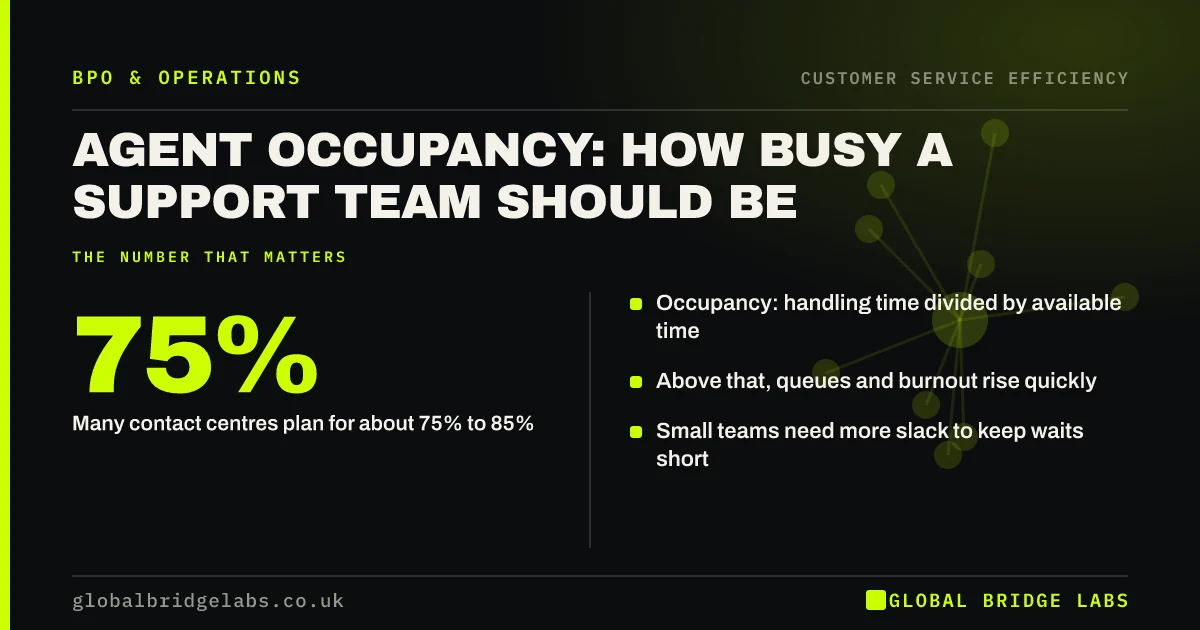
Agent occupancy is the share of time agents are available that they spend actually handling contacts. Too low means you are paying for idle time. Too high means queues, burnout and no time to recover between difficult contacts. Many contact centres plan for roughly 75% to 85%. A small team rarely reaches the high end without long waits.
- Occupancy: handling time divided by available time.
- Many contact centres plan for about 75% to 85%.
- Above that, queues and burnout rise quickly.
- Small teams need more slack to keep waits short.
Want to check whether your team is over or under-loaded? Message us on WhatsApp.
Chat on WhatsApp →What is agent occupancy?
Agent occupancy measures how much of an agent's available time is spent on contacts, including talk, hold and after-call work, as opposed to waiting for the next one. It is different from utilisation, which compares handling time with all paid time, including breaks and training.
How do you calculate it?
Divide total handling time by total available time in the same period and multiply by 100. If an agent is logged in and available for 6 hours and handles contacts for 4.8 hours, occupancy is 80%. Calculate by hour as well as by day, because peaks and quiet periods average out.
Why is very high occupancy a problem?
Very high occupancy means there is no spare agent when the next contact arrives, so queues build. It also leaves no recovery time after difficult calls, which raises stress and errors. The Health and Safety Executive lists demands, control and support among its Management Standards for work-related stress. Constant back-to-back contacts affect all three.
Why do small teams need more slack?
Small teams need more slack because random arrivals hit them harder. With two agents, a cluster of three calls creates a queue at once. With twenty, it is absorbed. That is why the same service level needs lower occupancy in a small team. Pooling contacts with a larger provider team is one way to run at a higher occupancy without longer waits.
What does it look like in numbers?
In an illustrative two-person team, occupancy averages 60% but hits 95% from 9am to 11am, when most calls go unanswered. Moving one agent's admin tasks out of that window and adding overflow cover brings peak occupancy to about 80% and the daily average to 65%. Example figures to show why the hourly view matters.
- Overflow outsourcing: hand off only work above your limit
- Call abandonment rate: what it is and how to lower it
Want your occupancy worked out by hour? Send us your contact data on WhatsApp.
Chat on WhatsApp →What should you do when occupancy is low?
When occupancy is low, use quiet periods for planned work such as follow-ups, quality checks and knowledge base updates, rather than cutting staff straight away. If it stays low across the week, staffing is too high for demand, and flexible or shared cover may suit better than fixed roles.
What does this look like in practice?
A pattern we see: an owner sees average occupancy of 55% and concludes the team is overstaffed, while customers complain about waits. The hourly view shows the team is overloaded for three hours and idle for five. Rearranging tasks around the peaks solves both problems.
Occupancy checklist
Use these to read and act on occupancy.
- Calculate occupancy by hour.
- Compare peaks with service level.
- Move admin out of peak hours.
- Use quiet time for planned work.
- Add flexible cover where peaks run hot.
Next step
Tell us how many contacts your team handles by hour and how many people are on. We will show you where occupancy is too high or too low.
Message us on WhatsApp to review occupancy, or book a 30-minute consultation.
Chat on WhatsApp →Sources and further reading
- What are the Management Standards for work-related stress? · Health and Safety Executive
- Maximum weekly working hours · GOV.UK
Frequently asked questions
What is agent occupancy?
Agent occupancy is the share of an agent's available time spent handling contacts, including talk, hold and after-call work. It is calculated as handling time divided by available time. It shows how busy agents are while logged in and ready.
What is a good occupancy rate?
Many contact centres plan for roughly 75% to 85%. Higher rates tend to cause queues and burnout; lower rates mean paying for idle time. Small teams usually need lower occupancy than large ones to keep waits short, because random arrivals affect them more.
What is the difference between occupancy and utilisation?
Occupancy compares handling time with the time agents are available for contacts. Utilisation compares handling time with all paid time, including breaks, training and meetings. Utilisation is always lower than occupancy for the same team.
Written by

Global Bridge Labs (GBL) is a UK–Sri Lanka partner for social media, websites and BPO. Everything here comes from client delivery, not theory.


