
On this page
- 01Key takeaways
- 02Myth: offshore teams are always slower
- 03Myth: more hours means more output
- 04Myth: handing over takes longer than doing it yourself
- 05Myth: you lose control when you outsource
- 06Myth: automation has made outsourcing pointless
- 07Myth: only big companies gain efficiency from outsourcing
- 08When are the concerns justified?
- 09What does this look like in practice?
- 10Myth-busting checklist
- 11Next step
- 12Sources and further reading
- 13Frequently asked questions
Key takeaways
Most outsourcing efficiency myths confuse distance with delay and hours with output. Offshore teams working UK hours can respond as fast as an in-house team, and often faster because they work the queue all day. What really slows outsourced work is an undefined process, unclear ownership and approvals that still depend on one person.
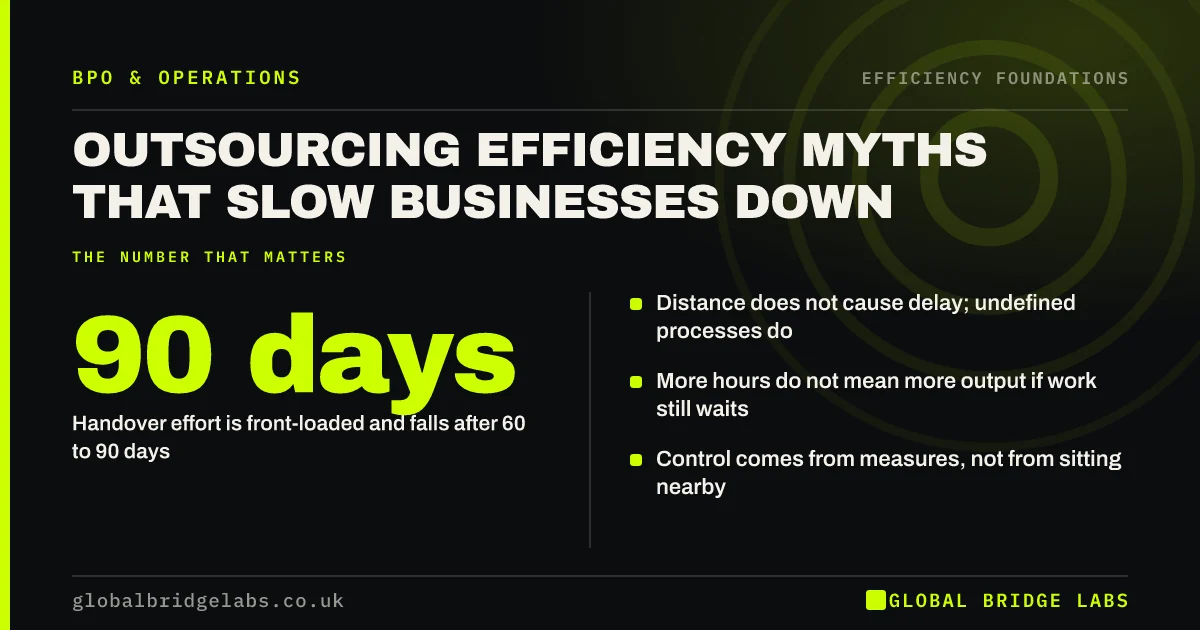
- Distance does not cause delay; undefined processes do.
- More hours do not mean more output if work still waits.
- Handover effort is front-loaded and falls after 60 to 90 days.
- Control comes from measures, not from sitting nearby.
Heard a concern about outsourcing you want tested? Message us on WhatsApp.
Chat on WhatsApp →Myth: offshore teams are always slower
Offshore teams are not slower by nature. Sri Lanka is four and a half to five and a half hours ahead of the UK depending on the season, so teams can work UK business hours or start before the UK day begins. Speed depends on whether the team works the queue continuously and has the authority to finish tasks without waiting for approval.
Myth: more hours means more output
Adding hours to a process where work waits on approvals or information adds little output. Little's law shows that lead time grows with work in progress, so piling more work into a blocked process makes it slower. Remove the blockage first, then add capacity if the queue still grows.
Myth: handing over takes longer than doing it yourself
It does at first. Writing a process down and answering questions in the first weeks takes real time. That effort is front-loaded. Once exceptions are documented, usually within 60 to 90 days, review time drops to a small weekly check, while the routine work no longer interrupts you.
Myth: you lose control when you outsource
You lose control only if nothing is measured. In-house work is often less visible than outsourced work, because nobody reports its turnaround or errors. A weekly scorecard with lead time, volumes and corrections gives more control than walking past someone's desk.
Myth: automation has made outsourcing pointless
Automation handles predictable steps well and exceptions badly. Most small-business processes are a mix. The efficient set-up is usually automation for the routine steps and a trained team for the exceptions and the checks, with people reviewing what the tools produce.
Myth: only big companies gain efficiency from outsourcing
Small firms often gain more, because they cannot afford specialists or spare capacity for each process. A managed team lets a ten-person business buy part of a specialised role. The constraint is volume: below a few hours a week, the handover may not be worth it.
When are the concerns justified?
The concerns are justified when the process changes weekly, when work needs face-to-face contact, or when the provider is chosen on rate with no service levels. In those cases outsourcing can make things slower. The answer is to fix the process and the brief first, or keep the work in-house.
What does this look like in practice?
A pattern we see: an owner's first outsourcing attempt failed because tasks were sent by email with no written process, so every item came back with questions. The second attempt, with a one-page work instruction and one named contact, worked within a month. The provider was not the problem the first time.
Myth-busting checklist
Check these before you decide outsourcing will slow you down.
- Is the process written down?
- Can the team finish tasks without your approval?
- Are working hours aligned with your customers?
- Will turnaround be reported weekly?
- Is there a 60 to 90 day settling-in plan?
Next step
Tell us the concern that has stopped you outsourcing so far. We will give you a straight answer on whether it applies to your process.
Message us on WhatsApp with your concern, or book a 30-minute consultation.
Chat on WhatsApp →Sources and further reading
- Multitasking: switching costs · American Psychological Association
- Contracts and liabilities between controllers and processors · Information Commissioner's Office
Frequently asked questions
Is outsourcing slower than doing work in-house?
Not necessarily. Outsourced work is slower when the process is undefined or every decision waits for the client. A documented process run by a team that works the queue all day, in UK-aligned hours, is often faster than in-house work that fits around other jobs.
Does outsourcing reduce quality?
It can if quality is never defined or checked. Agree acceptance criteria, a right-first-time target and weekly sampling of real work. With those in place, quality is often more consistent than in-house, because one written method replaces several informal ones.
How long before an outsourced team is efficient?
Expect the first improvement in turnaround within a few weeks and steady performance within 60 to 90 days, as exceptions are documented and questions fall. A pilot of one process over that period is the most reliable way to judge.
Written by

Global Bridge Labs (GBL) is a UK–Sri Lanka partner for social media, websites and BPO. Everything here comes from client delivery, not theory.


