
On this page
- 01Key takeaways
- 02What does reducing operational costs mean?
- 03Why are operating costs so hard to cut in-house?
- 04How does BPO reduce operational costs?
- 05How much of the saving is the hourly rate?
- 06How does BPO cut paid idle time and rework?
- 07What does the saving look like in numbers?
- 08Which operating costs can BPO reduce?
- 09What will BPO not fix?
- 10How do you keep quality and compliance in place?
- 11How do you measure whether costs really fell?
- 12What does this look like in practice?
- 13Operational cost reduction checklist
- 14Next step
- 15Sources and further reading
- 16Frequently asked questions
Key takeaways
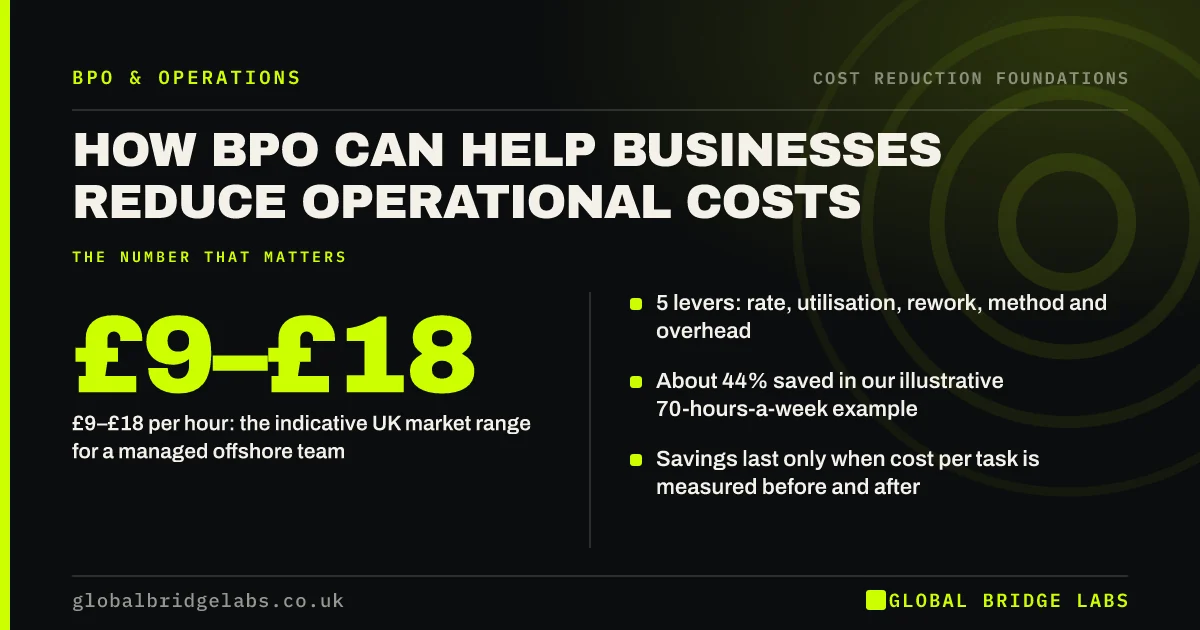
How BPO reduces operational costs comes down to five levers, and the hourly rate is only the first. A managed team also removes paid idle time, cuts rework, standardises the method and carries the supervision and tools you would otherwise fund. In our illustrative example, a 12-person firm lowers the cost of 70 hours of weekly routine work by about 44%.
- 5 levers: rate, utilisation, rework, method and overhead.
- £9–£18 per hour: the indicative UK market range for a managed offshore team.
- About 44% saved in our illustrative 70-hours-a-week example.
- Savings last only when cost per task is measured before and after.
Want to see which of the five levers apply to your costs? Message us on WhatsApp with your team size and your three biggest routine tasks.
Chat on WhatsApp →What does reducing operational costs mean?
Reducing operational costs means lowering what a business spends to deliver the same output to the same standard. Operational costs are the day-to-day costs of running the business: wages, software, premises, customer service and administration. A real reduction lowers the cost of each task, order or customer, and it is still there a year later.
Business process outsourcing (BPO) is the practice of handing a defined, repeatable process to an outside team that runs it for you as a managed service. It is one route to lower operating cost, alongside better processes and automation, and it usually works best when combined with both.
Why are operating costs so hard to cut in-house?
Operating costs are hard to cut in-house because most of them are people, and people come in whole units. A small business cannot employ 0.6 of an administrator, share a team leader with another firm, or stop paying for quiet weeks. The cost stays fixed while the workload moves, so the cost per task rises whenever volume dips.
The employment cost is also larger than the salary. At the 2026/27 National Living Wage of £12.71 an hour, an employee costs about £16.27 per worked hour once employer National Insurance, the minimum pension contribution and 28 days of paid holiday are counted. A £30,000 administrator costs about £19.81 per worked hour, or roughly £34,500 a year, before recruitment, equipment and management time.
Then there is the cost nobody sees in the accounts: the same task done three different ways, errors corrected later, and senior people doing routine work because nobody else is free.
How does BPO reduce operational costs?
BPO reduces operational costs by changing five things at once: the rate paid per hour, the share of paid hours that are productive, the amount of work done twice, the method used to do it, and the overhead carried around it. We call these the five cost levers. Most firms look only at the first and miss the other four.
Each lever can be measured before and after, which is what separates a real saving from a hopeful one.
- Rate: a lower cost per productive hour for the same skill.
- Utilisation: you pay for hours used, not for hours available.
- Rework: documented steps and quality checks mean fewer errors to fix.
- Method: one standard way of working replaces several informal ones.
- Overhead: supervision, cover, recruitment and tools sit in the provider's price.
How much of the saving is the hourly rate?
The hourly rate is the most visible lever and usually the largest when in-house staff are fully used. As indicative market ranges, a managed offshore team costs UK businesses £9–£18 per hour and an onshore provider £20–£35 per hour. Neither is a GBL price. Against a loaded in-house cost of £16.27 to £19.81 per worked hour, the offshore rate gap is real but not dramatic.
That is why the rate should never be the whole case. A low rate attached to slow, error-prone work produces a higher cost per task than the team it replaced. The right comparison is cost per completed task at the same quality.
How does BPO cut paid idle time and rework?
BPO cuts idle time because you buy hours or output to match the workload, and it cuts rework because the process has to be written down before anyone else can run it. An in-house role sized for the busiest week is under-used in the others. A managed team is sized to the average and flexed for peaks.
Rework falls for a plain reason. Handing over a process forces the business to define the steps, the standard and the exceptions. Once those exist, errors become visible and countable, and a provider's quality checks catch them before the customer does.
- Size capacity to average volume and flex for peaks.
- Write the steps down once and train everyone to the same version.
- Sample completed work every week and count the errors.
- Fix the cause of repeat contacts, not just the contact.
What does the saving look like in numbers?
In an illustrative 12-person services firm, about 70 hours a week of inbox handling, booking, invoicing and data entry is spread across employees at a loaded £19.81 per worked hour. That is 3,640 hours and about £72,100 a year. Once the work is documented, the same output takes about 60 hours a week from a managed team.
At an indicative £12 an hour, 60 hours a week costs £37,440 a year. Add three hours a week of in-house review at £19.81, about £3,090, and the new cost is roughly £40,500. The saving is about £31,600 a year, or 44%. Around four-fifths of the gross saving comes from the rate and the rest from the better method.
These are example figures to show the mechanism, not a quote or a benchmark. Where in-house staff are under-used or senior people do the work, utilisation and overhead matter more than the rate.
- Before: 70 hours a week in-house, about £72,100 a year.
- After: 60 managed hours a week, about £37,440 a year.
- In-house review: 3 hours a week, about £3,090 a year.
- Net saving: about £31,600 a year, or 44%.
- How much can a small business save by outsourcing?
- In-house vs outsourcing: which model is more cost-effective?
- Cost baseline: measure today's cost before you change it
Want this sum rebuilt with your own hours and salaries? Send them on WhatsApp and we will discuss your requirements.
Chat on WhatsApp →Which operating costs can BPO reduce?
BPO reduces the cost of work that is repeatable, rule-based, measurable and can be done remotely with system access. In UK small and medium-sized businesses that usually means customer email, calls and chat, order and booking administration, invoicing and payment chasing, data entry, CRM upkeep and routine reporting.
It has little effect on rent, stock, energy, professional fees or the cost of the people who deliver your core service. Those need a different lever.
- Customer service: replies, calls, chat and order queries.
- Back office: data entry, bookings, documents and CRM records.
- Finance admin: invoicing, payment chasing and invoice matching.
- Sector work: returns, job paperwork, patient admin and reservations.
What will BPO not fix?
BPO will not fix a process nobody can describe, a volume too small to justify handover, or costs caused by the offer itself. If customers contact you because the product, the website or the invoice is confusing, outsourcing those contacts makes them cheaper but does not make them go away.
It can also create new costs: your review time, setup, tool access and the effort of changing how people work. A business that prices only the provider's invoice will overstate its saving.
- Undocumented work that changes every week.
- Tasks under a few hours a week in total.
- Roles that are your product, your sales or your client relationship.
- Costs driven by complexity you could remove instead.
How do you keep quality and compliance in place?
Quality holds when four things exist: a written process, a named internal owner, a short weekly scorecard and sampling of real work. Under UK GDPR your business remains the controller of personal data handled by a provider, so you need a written processor contract, and a transfer to a country without UK adequacy regulations needs a safeguard such as the International Data Transfer Agreement (IDTA).
If existing employees' work moves to a provider, the Transfer of Undertakings (Protection of Employment) regulations, known as TUPE, may apply. Take advice before any role changes. Handing over new or overflow volume, with nobody's job transferring, is the simpler case.
How do you measure whether costs really fell?
Measure cost per task before the change and again 90 days after, using the same definition both times. Count the hours and the loaded rate of everyone who touched the work before, then the provider's invoice plus your own review time after. Track errors and turnaround alongside, because a saving that lowers quality is a cost moved elsewhere.
Separate one-off gains from the saving that repeats every year, and report only the second as a run rate.
What does this look like in practice?
A pattern we see in UK firms with 10 to 25 staff: the owner believes admin costs one salary, because one person holds the job title. A two-week time log shows the work is spread across five people, including two senior ones, and totals nearly double the hours expected. Once it is written down and moved to a managed team, the senior hours come back first.
Across our client work, back-office cost per task has fallen by 42% once the process was written down and run by a managed team, and owners have got 31 hours a week back.
Operational cost reduction checklist
Work through these steps before you ask anyone for a quote.
- List your ten most time-consuming routine tasks.
- Log who does each one and for how long over two weeks.
- Work out today's cost per task at loaded rates.
- Score each process on the five cost levers.
- Write down the highest-scoring process step by step.
- Remove steps that add nothing before handing anything over.
- Pilot one process for 60 to 90 days with a weekly scorecard.
- Compare cost per task, errors and turnaround with the baseline.
Next step
Send us your team size, your three most time-consuming routine tasks and roughly how many hours a week each takes. In a 30-minute call we will score them on the five levers with you, say plainly which should stay in-house, and outline what a managed team would look like for the rest.
Message us on WhatsApp for an operational cost review, or book a 30-minute consultation.
Chat on WhatsApp →Sources and further reading
- National Minimum Wage and National Living Wage rates · GOV.UK
- Rates and thresholds for employers 2026 to 2027 · HM Revenue & Customs
- Workplace pensions: what you, your employer and the government pay · GOV.UK
- Holiday entitlement · GOV.UK
- Contracts and liabilities between controllers and processors · Information Commissioner's Office
- Business transfers, takeovers and TUPE · GOV.UK
Frequently asked questions
How does BPO reduce operational costs?
BPO reduces operational costs by lowering the rate paid per productive hour, removing paid idle time, cutting rework through documented processes and quality checks, standardising how the work is done, and absorbing supervision, cover and tools into one price. The saving shows up as a lower cost per completed task.
How much can BPO reduce operating costs?
It depends on who does the work today and how busy they are. In our illustrative example of 70 hours a week of routine work, the cost fell by about 44% after review time. Savings are smaller on fully used low-paid roles and larger where senior or under-used staff do the work.
Which business processes are cheapest to outsource?
High-volume, rule-based processes that can be done remotely give the clearest saving: customer email and chat, order and booking administration, data entry, invoicing and payment chasing. They are easy to document and measure, so cost per task can be compared before and after.
Is BPO only worthwhile for large companies?
No. Small businesses often gain more, because they cannot share supervisors, cover or tools across a large team. A managed team lets a 10-person firm buy part of a role and a share of a team leader, which it could never employ directly. Very small volumes may not justify the handover.
What is the biggest risk when using BPO to cut costs?
The biggest risk is choosing on hourly rate alone. A cheap rate with slow or inaccurate work raises the cost per task and can lose customers. Protect the saving by agreeing a written scope, measuring cost per task and errors weekly, and keeping notice terms short.
Written by

Global Bridge Labs (GBL) is a UK–Sri Lanka partner for social media, websites and BPO. Everything here comes from client delivery, not theory.


