
On this page
- 01Key takeaways
- 02What is the difference between the two?
- 03Why does resolution matter more?
- 04How do you improve response time?
- 05How do you improve resolution time?
- 06What does it look like in numbers?
- 07When should response time come first?
- 08What does this look like in practice?
- 09Response and resolution checklist
- 10Next step
- 11Sources and further reading
- 12Frequently asked questions
Key takeaways
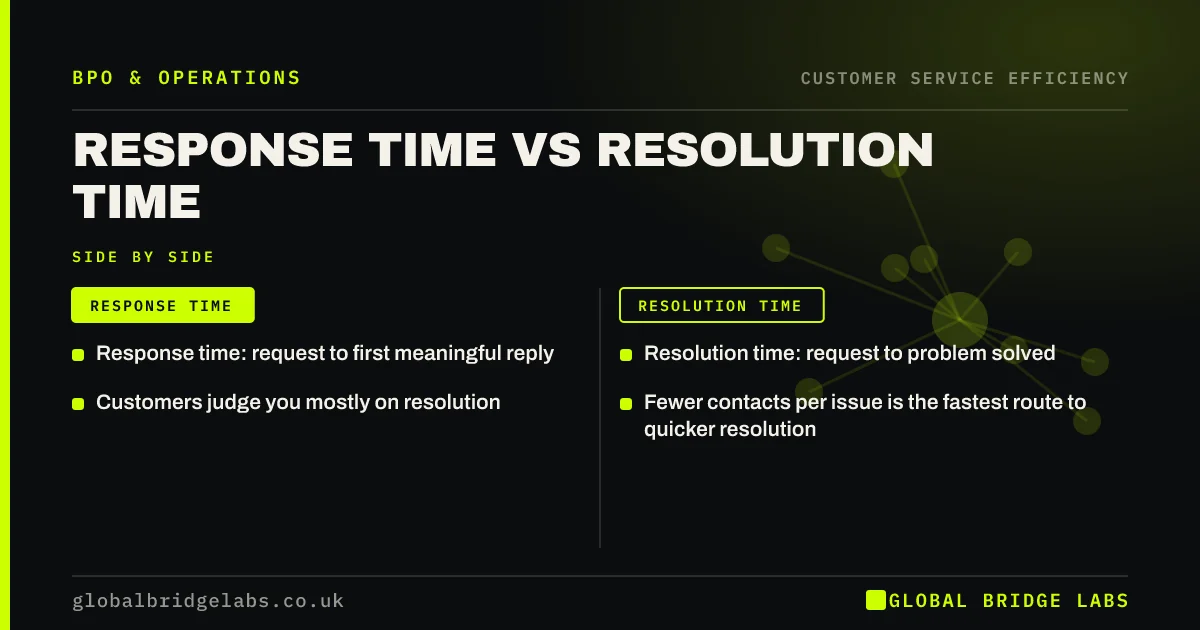
Response time is how long a customer waits for the first reply. Resolution time is how long until their problem is actually solved. Customers care most about resolution. A fast first reply that says nothing useful can look good on a report and still frustrate. Improve response time first if replies are slow, then focus on resolving in fewer contacts.
- Response time: request to first meaningful reply.
- Resolution time: request to problem solved.
- Customers judge you mostly on resolution.
- Fewer contacts per issue is the fastest route to quicker resolution.
Want to see where your response and resolution times sit? Message us on WhatsApp.
Chat on WhatsApp →What is the difference between the two?
First response time runs from when the customer contacts you to the first reply from a person. Resolution time runs to the point the issue is closed and the customer has what they need. The gap between them is the back and forth: questions, waiting on other teams and follow-ups.
Why does resolution matter more?
Resolution matters more because it ends the customer's effort. Research summarised by Dixon, Freeman and Toman in the Harvard Business Review in 2010 found that reducing customer effort, such as repeat contacts and transfers, did more for loyalty than exceeding expectations. Each extra contact before resolution adds effort.
How do you improve response time?
Improve response time by staffing to arrival peaks, triaging quickly and answering routine queries from templates. An automated acknowledgement can set expectations but does not count as a response. A managed team working UK hours can hold first response to a few hours without pulling senior people into the inbox.
How do you improve resolution time?
Improve resolution time by giving first-line staff the information and authority to solve common issues in one reply. Ask for all missing details at once, set clear limits for refunds and replacements, and make the second team's turnaround visible. Most delay in resolution is waiting for someone else.
- Ask for all missing details in the first reply.
- Give first line clear authority limits.
- Set turnaround targets for internal handoffs.
- Track contacts per resolved issue.
What does it look like in numbers?
In an illustrative team, first response is four hours but resolution averages three days and 3.2 contacts per issue. Giving first line authority to replace damaged items under £50 and a template that asks for photos up front brings resolution to about one day and 1.6 contacts. Response time barely changed; resolution halved. Example figures.
- Customer service workflow: from first message to closed
- After-call work: the hidden half of every customer contact
Want to find where your resolution time goes? Send us a few ticket histories on WhatsApp.
Chat on WhatsApp →When should response time come first?
Response time should come first when customers wait more than a working day for any reply, because silence creates repeat contacts and complaints. Fix that, then turn to resolution. For urgent issues, both matter from the start.
What does this look like in practice?
A pattern we see: a business celebrates a one-hour first response, while customers still complain. Reading the tickets shows the first reply asks a question, then waits days for another team. Tracking resolution time and contacts per issue shows the real problem.
Response and resolution checklist
Use these measures and fixes.
- Measure first response and resolution separately.
- Track contacts per resolved issue.
- Ask for all details in one reply.
- Set first-line authority limits.
- Set targets for internal handoffs.
Next step
Send us your current response and resolution times, even rough ones. We will help you see which to work on first and what would change both.
Message us on WhatsApp to review your service times, or book a 30-minute consultation.
Chat on WhatsApp →Sources and further reading
- Stop trying to delight your customers (Dixon, Freeman and Toman, 2010) · Harvard Business Review
- UK Customer Satisfaction Index · Institute of Customer Service
Frequently asked questions
What is the difference between response time and resolution time?
Response time is how long the customer waits for the first reply from a person. Resolution time is how long until their issue is solved and closed. A fast response with a slow resolution still leaves the customer waiting.
Which matters more to customers?
Resolution usually matters more, because it ends their effort. Repeated contacts and transfers frustrate customers more than a slightly slower first reply. Very slow first responses are the exception, as silence quickly creates complaints.
How do you reduce resolution time?
Give first-line staff the information and authority to solve common issues in one reply, ask for all missing details up front, set targets for internal handoffs and track contacts per issue. Most resolution delay is waiting on someone else, not the reply itself.
Written by

Global Bridge Labs (GBL) is a UK–Sri Lanka partner for social media, websites and BPO. Everything here comes from client delivery, not theory.


