
On this page
- 01Key takeaways
- 02What is turnaround time?
- 03How do you set turnaround targets?
- 04How should turnaround be measured?
- 05What does a good agreement look like?
- 06Why does turnaround slip?
- 07When should you not chase faster turnaround?
- 08What does this look like in practice?
- 09Turnaround checklist
- 10Next step
- 11Sources and further reading
- 12Frequently asked questions
Key takeaways
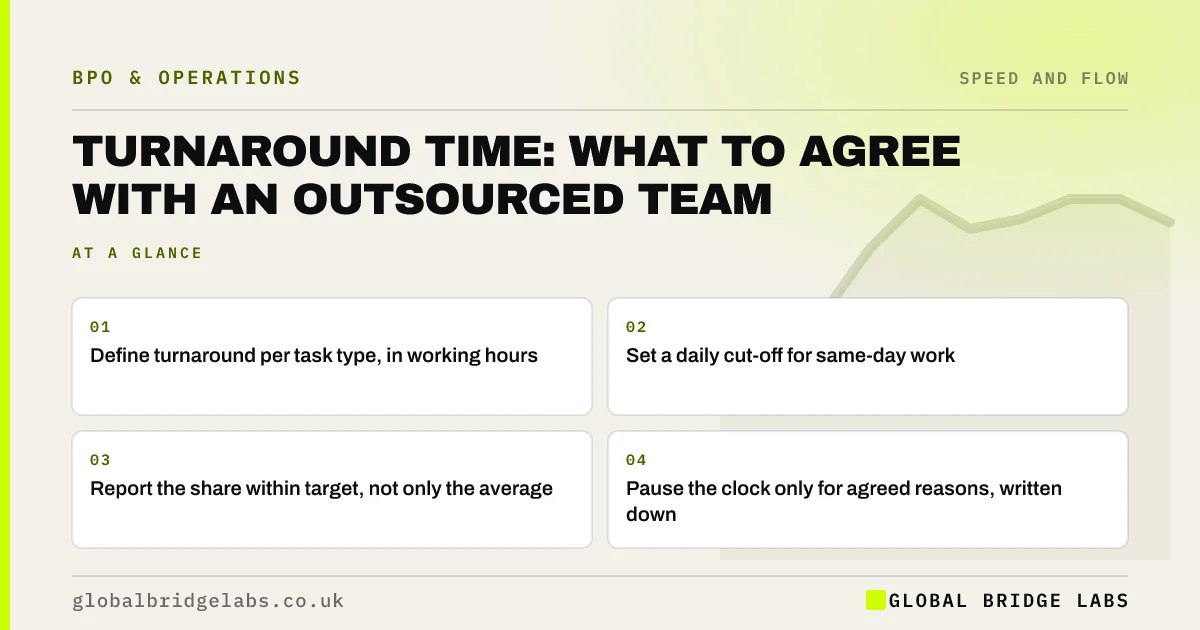
Turnaround time in outsourcing is the time from a task reaching the provider to it being completed to the agreed standard. Set it per task type, in working hours, with a cut-off time for same-day work. Measure the share of items within target each week, not just the average, because a good average can hide a long tail of late work.
- Define turnaround per task type, in working hours.
- Set a daily cut-off for same-day work.
- Report the share within target, not only the average.
- Pause the clock only for agreed reasons, written down.
Want help setting turnaround targets for a process? Message us on WhatsApp.
Chat on WhatsApp →What is turnaround time?
Turnaround time is the elapsed time between a task being handed to a team and the finished result being returned. In outsourcing it is usually measured in working hours from receipt to completion. It sits inside the customer's lead time, so a fast turnaround only helps if work reaches the provider promptly too.
How do you set turnaround targets?
Set targets from what the customer or the next step needs, then check they are achievable against volumes. A supplier invoice might be four working hours, a customer email reply two hours, a new account setup one working day. Different types need different targets. One blanket target is either too slow for urgent work or impossible for complex work.
- Urgent or customer-facing: hours, with a same-day cut-off.
- Routine processing: same or next working day.
- Complex or multi-step: a set number of working days.
- Exceptions: a separate target once a decision is received.
How should turnaround be measured?
Measure the percentage of items completed within target each week, plus the age of anything still open past target. Averages hide problems: 90 items in one hour and 10 in three days averages under a day but leaves ten customers waiting. Agree when the clock pauses, for example while waiting on your decision, and log every pause.
What does a good agreement look like?
In an illustrative agreement, invoices received by 2pm UK time are processed the same working day, with a target of 95% within that window; customer emails get a first reply within two working hours at 90%; anything needing your decision is flagged within one hour. Example targets to show the format, not a recommendation for every business.
- Service level in call answering: what 80/20 really means
- Escalation paths for outsourced teams: fast, not chaotic
Want your own turnaround targets drafted? Send us your task types on WhatsApp.
Chat on WhatsApp →Why does turnaround slip?
Turnaround slips for four common reasons: volumes rise without capacity changing, items arrive incomplete, exceptions wait for your decision, or the provider's team is shared across too many clients. The weekly report should show which. Each has a different fix, from flexing hours to tightening the intake form.
When should you not chase faster turnaround?
Do not chase faster turnaround when the next step cannot use it, for example if invoices are only paid weekly anyway, or when speed would cut checks that protect accuracy. Faster is only better if the customer or the next step benefits.
What does this look like in practice?
A pattern we see: an agreement promises next-day turnaround on average, and the weekly report looks fine. Customers still complain. Switching to the share within target reveals a group of complex items taking a week. A separate target for those items fixes the complaints.
Turnaround checklist
Agree these before the work starts.
- List task types and set a target for each.
- Agree working hours and a same-day cut-off.
- Define when the clock starts, pauses and stops.
- Report share within target weekly.
- Review targets after 90 days.
Next step
Send us the tasks you plan to outsource. We will suggest turnaround targets and a simple way to report them each week.
Message us on WhatsApp to set your targets, or book a 30-minute consultation.
Chat on WhatsApp →Sources and further reading
- The Sourcing and Consultancy Playbooks · Cabinet Office
- Contracts and liabilities between controllers and processors · Information Commissioner's Office
Frequently asked questions
What is a typical turnaround time for outsourced admin?
For routine admin such as data entry or invoice processing, same working day for items received before an agreed cut-off is common. Customer emails are often answered within a few working hours. Complex tasks need their own target in working days.
How do you measure turnaround time?
Record when each item reaches the team and when it is completed to standard, in working hours. Report the percentage of items within target each week and the age of any overdue items. Log any agreed pauses, such as waiting for your decision.
What happens if an outsourced team misses turnaround targets?
First, find the cause from the weekly report: rising volume, incomplete inputs, waiting on your decisions or provider capacity. Agree a fix and a date. Service credits can be written into the contract, but a clear cause and fix usually matter more.
Written by

Global Bridge Labs (GBL) is a UK–Sri Lanka partner for social media, websites and BPO. Everything here comes from client delivery, not theory.


