On this page
- 01Key takeaways
- 02What is work sampling?
- 03How do you run a study?
- 04Which categories should you use?
- 05What does a study show?
- 06How do you use the results?
- 07When is work sampling not suitable?
- 08What does this look like in practice?
- 09Work sampling checklist
- 10Next step
- 11Sources and further reading
- 12Frequently asked questions
Key takeaways
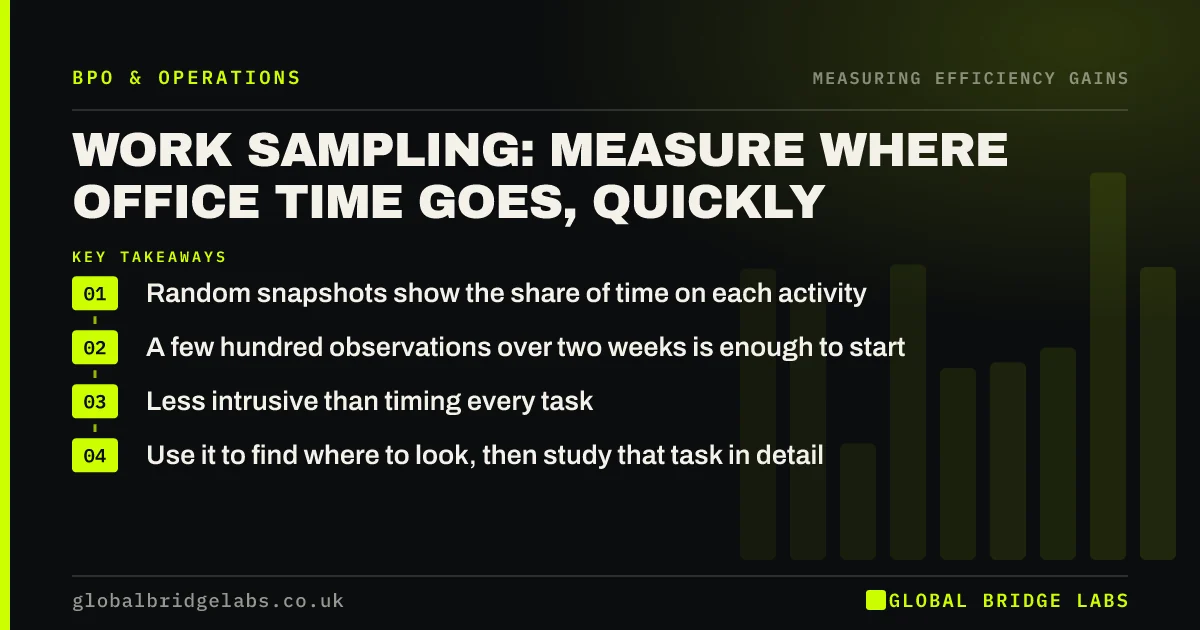
Work sampling measures where time goes by recording what people are doing at random moments, instead of timing everything. With a few hundred snapshots across two weeks, the share of each activity becomes clear: core work, admin, searching, waiting, interruptions. It is quicker and less intrusive than a full time study and good for spotting where to improve first.
- Random snapshots show the share of time on each activity.
- A few hundred observations over two weeks is enough to start.
- Less intrusive than timing every task.
- Use it to find where to look, then study that task in detail.
Want help setting up a work sampling study? Message us on WhatsApp.
Chat on WhatsApp →What is work sampling?
Work sampling, also called activity sampling, is a statistical method for estimating how time is spent. At random moments, you record which activity each person is doing. The share of observations in each category estimates the share of time. The method is credited to L. H. C. Tippett, who developed it in the British textile industry in the 1930s.
How do you run a study?
Choose five to eight activity categories. Set random prompts, for example a phone reminder at random times, and at each prompt people note what they were doing. Run it for two weeks. Count the observations in each category and divide by the total.
- 1. Define 5 to 8 activity categories.
- 2. Set random prompts through the day.
- 3. Record the activity at each prompt.
- 4. Run for about two weeks.
- 5. Calculate the share for each category.
Which categories should you use?
Use categories that separate valuable work from the rest. A common set for office teams is core work, routine admin, customer contact, searching for information, waiting, meetings, interruptions and other. Keep them few and clear so recording is quick and consistent.
What does a study show?
In an illustrative study of a five-person team over two weeks, 400 observations show 38% core work, 22% routine admin, 14% searching for information, 9% waiting for others, 10% meetings and 7% other. Searching and waiting together are nearly a quarter of the time, which points straight at filing and approvals. Example figures only.
- File naming conventions for small business teams
- Approval bottlenecks: when sign-off holds up the work
Want your study results interpreted? Send us the category counts on WhatsApp.
Chat on WhatsApp →How do you use the results?
Use the largest non-core categories as your shortlist. Routine admin may be a candidate for a managed team. Searching points to filing and a knowledge base. Waiting points to approvals and handoffs. Then study the specific tasks in more detail before changing them.
When is work sampling not suitable?
It is not suitable for one-off tasks, very small teams where a simple time log is easier, or when people are uneasy about being observed. Explain that it measures the process, not individuals, and share the results with the team.
What does this look like in practice?
A pattern we see: a team believes it is overloaded with customer work. Work sampling shows a large share of time goes on internal admin and searching. Moving routine admin to a managed team frees more time than hiring would have.
Work sampling checklist
Set these up before you start.
- Explain the purpose to the team.
- Agree 5 to 8 categories.
- Set random prompts.
- Run for two weeks.
- Share results and next steps.
Next step
Tell us about the team whose time you want to understand. We will help you set categories and read the results.
Message us on WhatsApp about work sampling, or book a 30-minute consultation.
Chat on WhatsApp →Sources and further reading
- Labour productivity · Office for National Statistics
- Multitasking: switching costs · American Psychological Association
Frequently asked questions
What is work sampling?
Work sampling is a method for estimating how time is spent by recording what people are doing at random moments. The share of observations in each activity estimates the share of time. It was developed by L. H. C. Tippett in the British textile industry in the 1930s.
How many observations do you need?
A few hundred observations across a team over about two weeks gives a useful picture for spotting where time goes. More observations give more precise estimates. For a first look, the broad shares matter more than exact percentages.
Is work sampling better than a time log?
It is less effort for the people involved and less prone to the gaps of logging every task. A time log gives more detail per task. Use work sampling to find where to look, then a time log or time study for the specific tasks.
Written by

Global Bridge Labs (GBL) is a UK–Sri Lanka partner for social media, websites and BPO. Everything here comes from client delivery, not theory.