
On this page
- 01Key takeaways
- 02How quickly should you send a quote?
- 03Why does quote speed affect win rates?
- 04Where does quote time really go?
- 05How do you speed up the quoting process?
- 06What should you measure?
- 07When is a slower quote the right choice?
- 08What does this look like in practice?
- 09Quote turnaround checklist
- 10Next step
- 11Sources and further reading
- 12Frequently asked questions
Key takeaways
Send a quote the same or next working day for routine work, and confirm a date for anything that needs a survey or detailed pricing. Buyers often ask several firms at once, so the first clear quote has an advantage. Most quote delays are waiting, not pricing: the preparation is quick, but it waits for the one person who can do it.
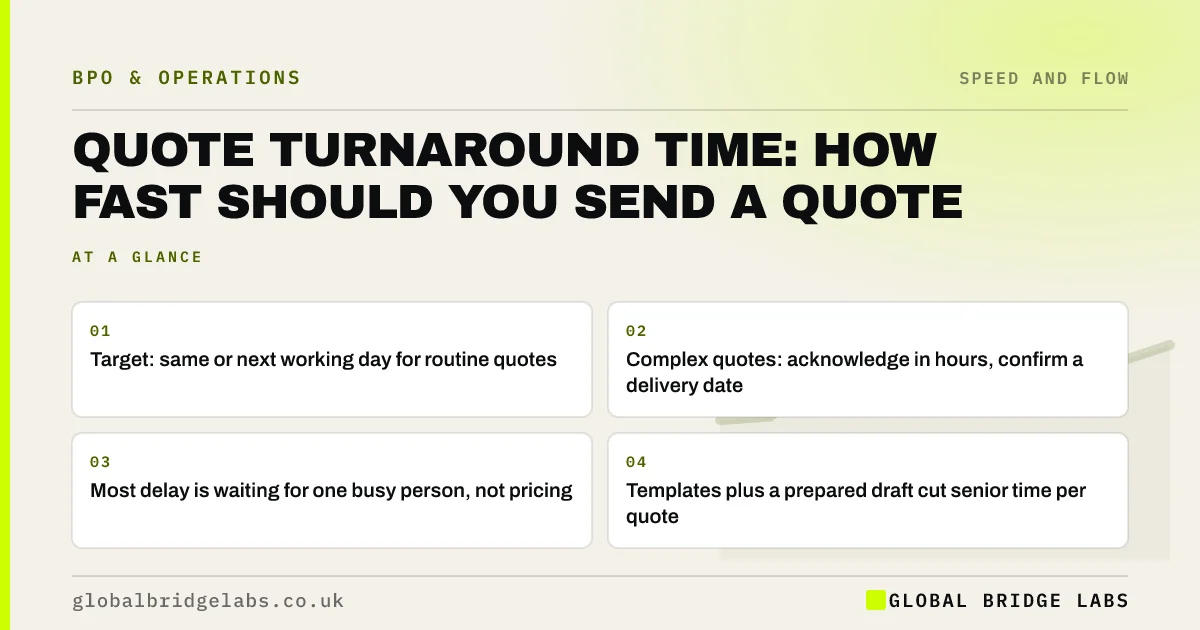
- Target: same or next working day for routine quotes.
- Complex quotes: acknowledge in hours, confirm a delivery date.
- Most delay is waiting for one busy person, not pricing.
- Templates plus a prepared draft cut senior time per quote.
Want to see how fast your quotes could go out? Message us on WhatsApp with your current process.
Chat on WhatsApp →How quickly should you send a quote?
For routine work with standard pricing, aim for the same working day, or the next if the request arrives late. For work that needs a site visit or custom pricing, acknowledge the request within a few hours and give a date for the quote. What buyers dislike most is silence, so the acknowledgement matters as much as the quote.
Why does quote speed affect win rates?
Quote speed affects win rates because buyers comparing firms tend to engage with the first credible response, and a slow quote signals slow delivery. The quote also catches the buyer while the need is fresh. A week later, they may have decided, delayed or forgotten the detail of what they asked for.
Where does quote time really go?
Measure it and most of the time is waiting. In an illustrative example, a quote takes 45 minutes of work but goes out on day four: one day waiting for the enquiry to be logged, two days waiting for the owner, and half a day for a missing detail from the customer. The pricing itself is a small share. Example figures only.
- Logging the enquiry and gathering details.
- Waiting for the person who prices the work.
- Chasing missing information from the customer.
- Formatting, checking and sending.
How do you speed up the quoting process?
Speed it up by splitting the work. A support team logs the enquiry, asks for missing details using a set list, and prepares a draft from templates and price lists. The senior person reviews and adjusts price and scope, which takes minutes instead of an hour. The same split works in-house or with a managed team.
- 1. Use an enquiry form that captures what pricing needs.
- 2. Ask for missing details within an hour, from a set list.
- 3. Draft the quote from templates and price lists.
- 4. Senior review in a fixed daily slot.
- 5. Send, then follow up after two working days.
- Sales support outsourcing: more selling time for your team
- Lead qualification process: spend sales time on real buyers
- Instant quote calculators: do they win more enquiries?
Want this quoting split designed around your business? Send us your steps on WhatsApp.
Chat on WhatsApp →What should you measure?
Measure the share of quotes sent within target, the average lead time from enquiry to quote, and the win rate by quote speed. Even a rough split, such as quotes sent within one day against those sent later, shows whether speed matters in your market.
When is a slower quote the right choice?
A slower quote is right when speed would mean guessing at scope, for example on large projects where a site visit avoids a costly underquote. In that case, a fast acknowledgement and a firm date protect the sale while the quote is done properly.
What does this look like in practice?
A pattern we see in trades and professional services: the owner prices every quote personally, in the evening, so quotes go out in batches twice a week. Moving the drafting to a support team and keeping a 30-minute daily review slot gets most quotes out the next day.
Quote turnaround checklist
Check your quoting process against these.
- Do you know your current enquiry-to-quote time?
- Does your form capture what pricing needs?
- Is there a template for each common job?
- Is there a fixed daily review slot?
- Is every quote followed up?
Next step
Send us your current quoting steps and how long each takes. We will show you which could be prepared for you and what turnaround that would make possible.
Message us on WhatsApp about your quoting, or book a 30-minute consultation.
Chat on WhatsApp →Sources and further reading
- UK Customer Satisfaction Index · Institute of Customer Service
- Consumer Contracts (Information, Cancellation and Additional Charges) Regulations 2013 · legislation.gov.uk
Frequently asked questions
How long should it take to send a quote?
For routine work, aim to send the quote the same or next working day. For complex work, acknowledge the request within a few hours and confirm when the quote will arrive. The preparation itself is usually under an hour; most delay is waiting.
How do you speed up quotes without losing accuracy?
Capture the right details at enquiry, use templates and price lists, and have a support person prepare a draft for a short senior review. Accuracy improves because the same checks are applied every time, and senior time per quote falls.
Should you follow up a quote?
Yes. Follow up after about two working days with a short message offering to answer questions. Many quotes are not declined, just not decided. A follow-up keeps you in the conversation and tells you whether to adjust or close the opportunity.
Written by

Global Bridge Labs (GBL) is a UK–Sri Lanka partner for social media, websites and BPO. Everything here comes from client delivery, not theory.


