
On this page
- 01Key takeaways
- 02Why do small website changes take so long?
- 03What turnaround should you expect?
- 04What should a change request include?
- 05What does a better process change?
- 06How do you keep quality and safety?
- 07When is a formal process unnecessary?
- 08What does this look like in practice?
- 09Change request checklist
- 10Next step
- 11Sources and further reading
- 12Frequently asked questions
Key takeaways
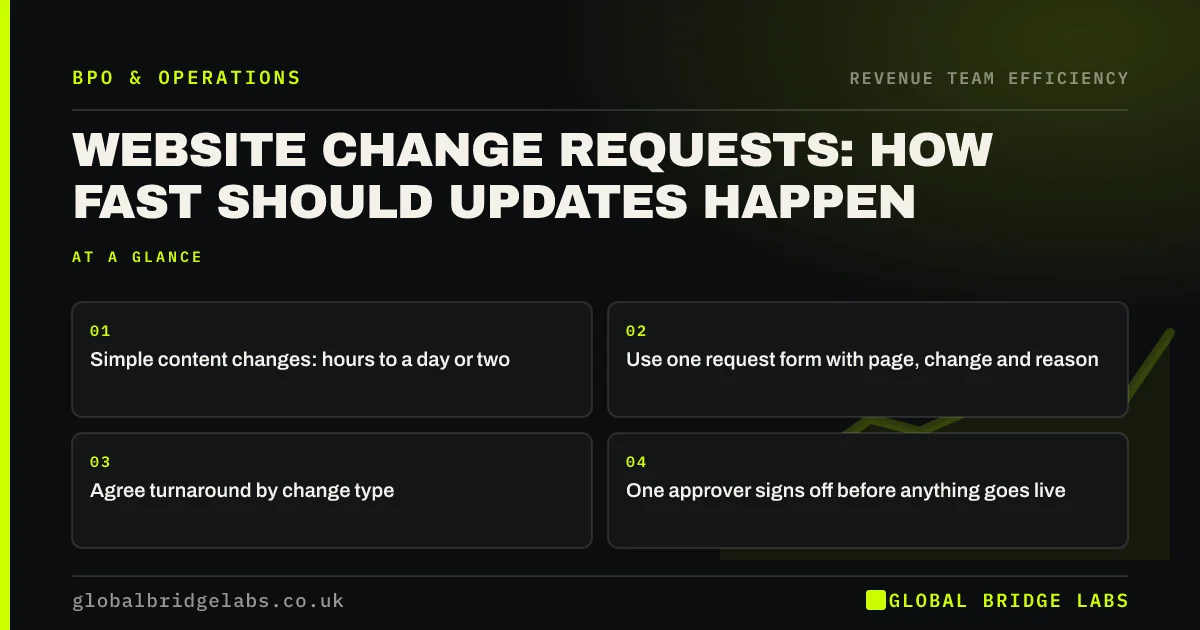
A website change request process sets how updates are asked for, prioritised and completed. Simple content changes, such as text, prices or opening hours, should usually take hours to a day or two, not weeks. Most delay comes from vague requests and unclear ownership. A short request form, agreed turnaround by change type and one approver keep updates moving.
- Simple content changes: hours to a day or two.
- Use one request form with page, change and reason.
- Agree turnaround by change type.
- One approver signs off before anything goes live.
Want a change request process for your website? Message us on WhatsApp.
Chat on WhatsApp →Why do small website changes take so long?
Small changes take long because requests arrive by email or phone without the detail needed, the developer queues them behind larger work, and nobody is sure who approves the result. A one-line change can sit for weeks. Out-of-date prices, team members or opening hours then cost enquiries.
What turnaround should you expect?
Agree turnaround by type of change. These are typical expectations, not fixed rules, and depend on your agreement with whoever maintains the site.
- Urgent fixes, such as a broken form: same day.
- Content edits, prices, hours, staff: one to two working days.
- New page from supplied content: a few working days.
- New features or layouts: scoped and quoted separately.
What should a change request include?
A good request names the page, says exactly what should change, supplies the new text or images, explains why and gives a deadline. A screenshot with the area marked helps. The more complete the request, the faster and more accurately it is done.
What does a better process change?
In an illustrative business, website changes are emailed to a freelancer and take an average of nine working days, mostly waiting for clarification. A request form, agreed turnaround by type and a weekly check of open requests bring simple edits down to about two days. Example figures only.
- Work queue management: stop jobs waiting in the back office
- Work ageing report: find the jobs that have been waiting
Want to see where your website requests get stuck? Send us a few recent ones on WhatsApp.
Chat on WhatsApp →How do you keep quality and safety?
Keep quality by having one approver check changes before or soon after they go live, and keep safety with named log-ins, multi-factor authentication and regular backups. Check that new content is accessible, for example that images have alt text and links make sense out of context.
When is a formal process unnecessary?
If you edit the website yourself through an easy content system and change it rarely, a formal process is unnecessary. It helps once several people request changes, or once changes go through a developer or agency.
What does this look like in practice?
A pattern we see: a business's website shows last year's prices for months because the change request is in someone's inbox. A simple form and a weekly review of open requests ends the problem.
Change request checklist
Set these up for your website.
- One request form.
- Turnaround agreed by change type.
- One named approver.
- Weekly review of open requests.
- Named log-ins and backups.
Next step
Tell us how website changes are requested and made today. We will suggest a simple process and realistic turnaround times.
Message us on WhatsApp about website updates, or book a 30-minute consultation.
Chat on WhatsApp →Sources and further reading
- Easy checks: a first review of web accessibility · W3C Web Accessibility Initiative
- Small Business Guide: cyber security · National Cyber Security Centre
Frequently asked questions
How long should website changes take?
Simple content changes such as text, prices or opening hours should usually take hours to a day or two. Urgent fixes like a broken form should be same day. New pages take a few days, and new features need scoping. Agree turnaround by change type with whoever maintains the site.
What should a website change request include?
The page, exactly what should change, the new text or images, the reason and the deadline. A screenshot with the area marked helps. Complete requests are done faster and more accurately than vague ones.
Who should approve website changes?
One named person who understands the business and the brand. Having a single approver avoids conflicting feedback and stops changes waiting for several people. They can check changes before they go live or soon after for low-risk edits.
Written by

Global Bridge Labs (GBL) is a UK–Sri Lanka partner for social media, websites and BPO. Everything here comes from client delivery, not theory.


