
On this page
- 01Key takeaways
- 02What is throughput?
- 03How do you measure it?
- 04What limits throughput?
- 05What does raising it look like?
- 06How does outsourcing affect throughput?
- 07When is throughput the wrong focus?
- 08What does this look like in practice?
- 09Throughput checklist
- 10Next step
- 11Sources and further reading
- 12Frequently asked questions
Key takeaways
Throughput is the amount of finished work a process delivers in a period, such as invoices processed or tickets resolved per week. It counts only completed items, not work started. It matters because it, together with the amount of work in progress, sets how long customers wait. Raise it by removing the bottleneck, rework and waiting, before adding people.
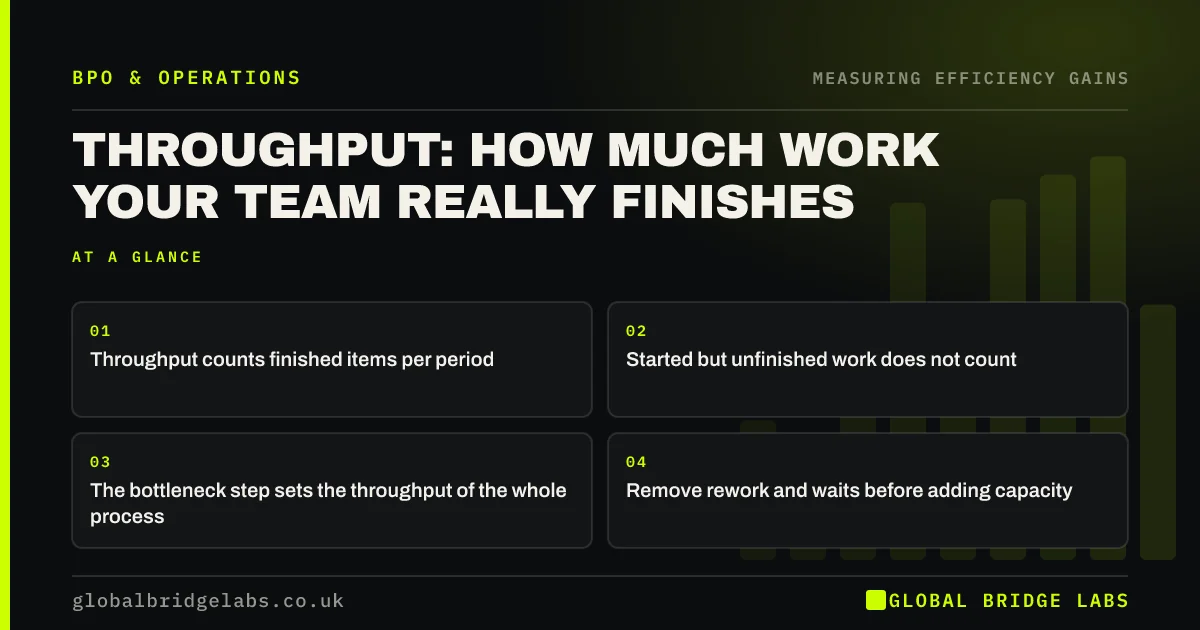
- Throughput counts finished items per period.
- Started but unfinished work does not count.
- The bottleneck step sets the throughput of the whole process.
- Remove rework and waits before adding capacity.
Want to measure throughput for one of your processes? Message us on WhatsApp.
Chat on WhatsApp →What is throughput?
Throughput is the rate at which a process completes items to the required standard. It is measured as a count per period, such as 250 orders dispatched a day. In Little's law, average lead time equals work in progress divided by throughput, so throughput directly affects how long customers wait.
How do you measure it?
Count items that reached done in each week, using your acceptance criteria. Track it by process, and alongside arrivals. If arrivals are higher than throughput week after week, a backlog is growing. Exclude items that were reopened or corrected, or count them separately.
What limits throughput?
Throughput is limited by the slowest step, the bottleneck. Improving any other step does not raise output, because work just queues at the bottleneck. Rework also cuts throughput, since corrected items use capacity twice. So does work waiting for information or approval.
- The bottleneck step or person.
- Rework that uses capacity twice.
- Waiting for information or approvals.
- Too much work started at once.
What does raising it look like?
In an illustrative process, three people complete about 200 customer onboarding packs a week, but the director's sign-off handles only about 150. Throughput is 150, and a backlog grows. Delegating sign-off for standard cases under written limits lifts throughput to 200 with no extra staff. Example figures only.
- Right first time rate: the quality number that cuts cost
- Takt time for service teams: pace work to demand
Want help finding the step that limits your throughput? Send us the process on WhatsApp.
Chat on WhatsApp →How does outsourcing affect throughput?
Outsourcing raises throughput when the provider takes on the bottleneck step or the routine work around it, and works it every day. It does not help if the bottleneck stays in-house, such as an approval only the owner can give. Find the bottleneck first, then decide what to hand over.
When is throughput the wrong focus?
Throughput is the wrong focus when work is low volume and high value, such as complex advice, where quality and outcome matter more than count. It also misleads if it rewards closing items before they are really resolved.
What does this look like in practice?
A pattern we see: a business adds a person to a busy team and output barely moves, because the limit was a sign-off step elsewhere. Measuring throughput step by step shows where the real constraint is.
Throughput checklist
Use these to measure and raise it.
- Count finished items weekly.
- Compare with arrivals.
- Find the slowest step.
- Remove rework and waits there.
- Add capacity only at the bottleneck.
Next step
Send us weekly arrivals and completions for one process. We will help you find what limits throughput and what would raise it.
Message us on WhatsApp about throughput, or book a 30-minute consultation.
Chat on WhatsApp →Sources and further reading
- Labour productivity · Office for National Statistics
- Multitasking: switching costs · American Psychological Association
Frequently asked questions
What is throughput in a business process?
Throughput is the number of items a process completes to the required standard in a set period, such as orders dispatched per day or invoices processed per week. It counts only finished work, not work started.
How do you increase throughput?
Find the slowest step, the bottleneck, and improve that first, because no other change raises output. Remove rework, waiting for information and unnecessary approvals there. Add capacity only at the bottleneck, once those are fixed.
What is the difference between throughput and productivity?
Throughput is total output per period for a process. Productivity is output per unit of input, such as items per hour worked. A process can raise throughput by adding people without raising productivity, or raise productivity by removing waste.
Written by

Global Bridge Labs (GBL) is a UK–Sri Lanka partner for social media, websites and BPO. Everything here comes from client delivery, not theory.


