
On this page
- 01Key takeaways
- 02What does focusing on your core business mean?
- 03Why does routine work crowd out core work?
- 04How does outsourcing create focus?
- 05What is the gain in numbers?
- 06How do you protect the time you get back?
- 07When does focus not improve after outsourcing?
- 08What does this look like in practice?
- 09Focus checklist
- 10Next step
- 11Sources and further reading
- 12Frequently asked questions
Key takeaways
Outsourcing to focus on your core business works when it moves the interruptions as well as the tasks. Core work is what customers pay you for and what sets you apart: selling, delivering, advising and improving the offer. Handing over routine work only creates focus if the freed hours are planned and protected, otherwise they fill with new low-value work.
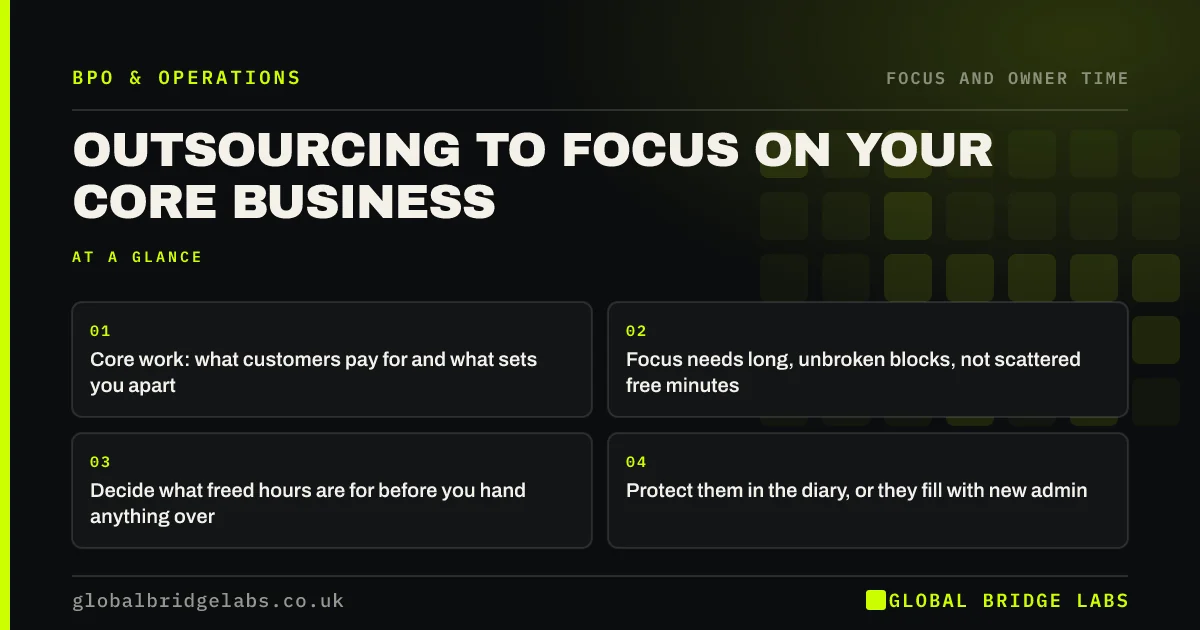
- Core work: what customers pay for and what sets you apart.
- Focus needs long, unbroken blocks, not scattered free minutes.
- Decide what freed hours are for before you hand anything over.
- Protect them in the diary, or they fill with new admin.
Want to see how much of your week is core work today? Message us on WhatsApp.
Chat on WhatsApp →What does focusing on your core business mean?
Focusing on your core business means spending most senior time on the activities that earn revenue and build competitive advantage, and as little as possible on routine work that any competent team could do. For a law firm that is legal advice and client relationships. For a trades firm it is quoting, doing and supervising jobs. Everything else supports that.
Why does routine work crowd out core work?
Routine work crowds out core work because it is urgent and small. A supplier query, a booking change or a missing document takes five minutes and feels easier to do than to delegate. Across a week, those pieces fill the gaps where focused work would happen, and the American Psychological Association notes that switching between tasks can cost as much as 40% of productive time.
How does outsourcing create focus?
Outsourcing creates focus by removing whole categories of interruption. When customer email, scheduling, invoicing and data entry go to a team with its own queue, the questions that used to arrive all day arrive once, as a short list of decisions. Senior people then get long blocks for core work instead of the scraps between interruptions.
- Routine requests go to a team queue, not to senior inboxes.
- Decisions are batched into one daily list.
- Senior diaries get fixed blocks for core work.
- Weekly reports replace checking in all day.
What is the gain in numbers?
In an illustrative firm, a director spends 12 hours a week on routine work in about 40 separate pieces. Handing it to a managed team returns about 10 hours after a short daily review. If 6 of those hours go on winning or delivering work valued at £80 an hour, that is about £480 a week of extra capacity. Example figures to show the scale, not a benchmark.
Want this sum run for your own week? Send us your rough diary on WhatsApp.
Chat on WhatsApp →How do you protect the time you get back?
Protect the time by deciding its use before the handover and blocking it in the diary. Name two or three core activities, such as business development calls, client reviews or improving the offer, and give each a fixed weekly slot. Review after a month whether the hours went where planned.
When does focus not improve after outsourcing?
Focus does not improve when the owner keeps checking every item, when the team must ask before finishing anything, or when the freed time is absorbed by more meetings. It also fails if the work handed over was not the real source of interruption. Measure interruptions before and after, not just hours.
What does this look like in practice?
A pattern we see: an owner hands over admin and still feels busy a month later. A diary review shows the freed time was taken by internal meetings and checking the provider's work. Booking two protected half-days a week for sales and setting a single daily review slot makes the gain visible.
Across our client work, owners have got 31 hours a week back once routine work was documented and run by a managed team.
Focus checklist
Work through these before and after handing work over.
- List your core activities in one sentence each.
- Log interruptions for one week.
- Group them by type and pick the largest.
- Hand that type over with a written process.
- Block the freed hours for named core work.
- Review the diary after four weeks.
Next step
Send us a rough list of what interrupts you each day. We will tell you which interruptions a managed team could absorb and how to protect the time that comes back.
Message us on WhatsApp to plan your focus time, or book a 30-minute consultation.
Chat on WhatsApp →Sources and further reading
- Multitasking: switching costs · American Psychological Association
- Work-related stress and how to manage it · Health and Safety Executive
Frequently asked questions
How does outsourcing help a business focus on its core?
Outsourcing moves routine tasks and the interruptions they cause to a team with its own queue. Senior people then get long, unbroken blocks for selling, delivering and improving the offer. The gain only lasts if the freed hours are planned and protected in the diary.
What counts as core business activity?
Core activity is the work customers pay you for and the work that sets you apart from competitors: delivering your service, winning clients, managing key relationships and improving the offer. Routine processing, scheduling and data handling support the core but rarely differentiate it.
What should I do with the time saved by outsourcing?
Decide before the handover. Pick two or three core activities, such as business development or client reviews, and block fixed weekly slots for them. Review after a month whether the time went where planned, and adjust if it was absorbed by meetings or checking.
Written by

Global Bridge Labs (GBL) is a UK–Sri Lanka partner for social media, websites and BPO. Everything here comes from client delivery, not theory.


