
On this page
- 01Key takeaways
- 02What is an internal knowledge base?
- 03Why does it matter for outsourced teams?
- 04What should it include?
- 05How do you build it quickly?
- 06What does it change in numbers?
- 07When does a knowledge base fail?
- 08What does this look like in practice?
- 09Knowledge base checklist
- 10Next step
- 11Sources and further reading
- 12Frequently asked questions
Key takeaways
An internal knowledge base is one searchable place for the answers your team needs: processes, rules, templates and product facts. For an outsourced team it is the difference between asking you and finding the answer in seconds. Build it from real questions, keep each article short, give each an owner, and update it every time a new question is answered.
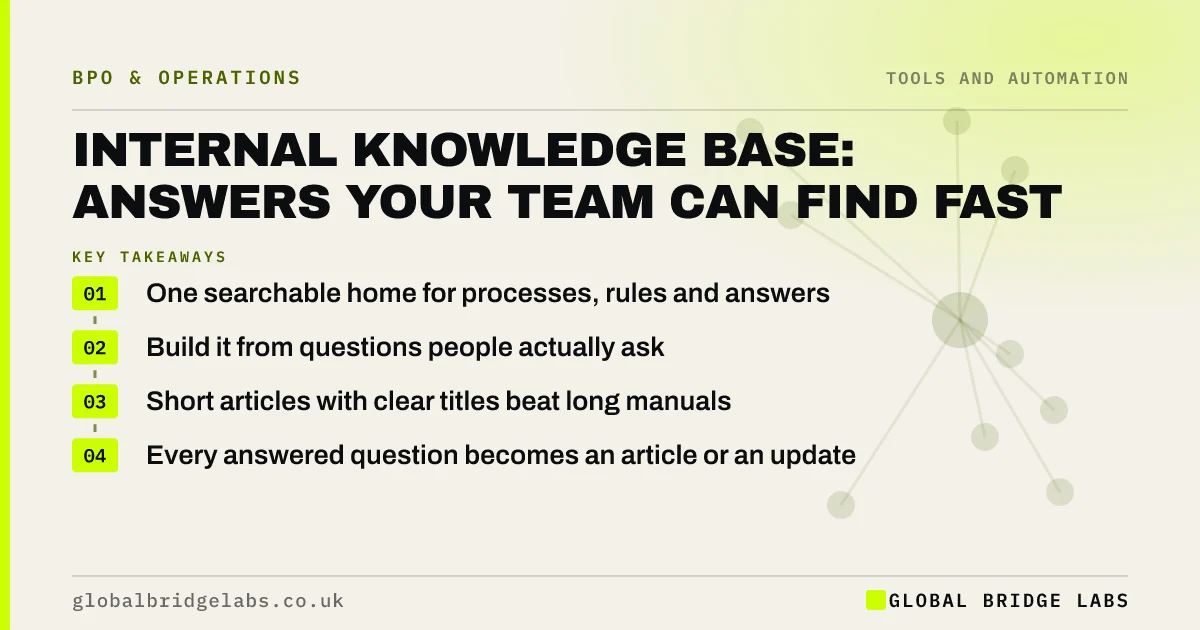
- One searchable home for processes, rules and answers.
- Build it from questions people actually ask.
- Short articles with clear titles beat long manuals.
- Every answered question becomes an article or an update.
Want help starting a knowledge base? Message us on WhatsApp.
Chat on WhatsApp →What is an internal knowledge base?
An internal knowledge base is a collection of short, searchable articles that answer the questions staff and partners have while working. It might hold SOPs, work instructions, policy rules, product details, templates and frequently asked questions. It is for your team, unlike a customer help centre.
Why does it matter for outsourced teams?
It matters because every question an outsourced team cannot answer itself becomes a wait for you. A good knowledge base answers most routine questions instantly. It also keeps knowledge in the business when individuals leave, on either side.
What should it include?
Start with what people ask most, not with everything you know. Typical early articles are the core SOPs, rules and limits, product or service facts, standard replies and contact lists.
- Process SOPs and work instructions.
- Rules, limits and approval thresholds.
- Product, service and pricing facts.
- Standard replies and templates.
- Who to contact for what.
How do you build it quickly?
Collect a month of questions from staff and the provider. Group them, and write one short article per group, titled as the question people ask. Link related articles. Within a few weeks, most new questions will already have an answer, and the rest show you what to add next.
- 1. Log every question for a month.
- 2. Group them by topic.
- 3. Write one short article per group.
- 4. Title each as the question people ask.
- 5. Add an article for every new question.
- The 80/20 rule in business: find the work that matters
- File naming conventions for small business teams
Want your common questions turned into an article list? Send them on WhatsApp.
Chat on WhatsApp →What does it change in numbers?
In an illustrative handover, the outsourced team sends about 25 questions a week in the first month. A knowledge base built from those questions cuts it to about five a week by month three, mostly genuine exceptions. Each avoided question saves a wait for the team and an interruption for you. Example figures only.
When does a knowledge base fail?
It fails when nobody updates it, so answers go stale and people stop trusting it. It also fails when it is hard to search or full of long documents. Give each article an owner and a review date, keep articles short and remove anything out of date.
What does this look like in practice?
A pattern we see: knowledge lives in old email threads and one long-serving employee's head. When that person is on holiday, work slows down. A short, searchable knowledge base built over a few weeks removes the dependency.
Knowledge base checklist
Set these up as you build it.
- Built from real questions.
- Articles titled as questions.
- One owner per article.
- Review dates set.
- Every new answer added.
Next step
Send us the questions your team or provider asks most often. We will help you plan a short knowledge base around them.
Message us on WhatsApp about a knowledge base, or book a 30-minute consultation.
Chat on WhatsApp →Sources and further reading
- The Sourcing and Consultancy Playbooks · Cabinet Office
- Lawful basis for processing personal data · Information Commissioner's Office
Frequently asked questions
What is an internal knowledge base?
An internal knowledge base is a searchable collection of short articles that answer the questions your staff and partners have while working, such as processes, rules, product facts and templates. It is for your team rather than for customers.
How do you build a knowledge base quickly?
Log every question your team and provider ask for a month, group them, and write one short article per group, titled as the question. Add an article each time a new question is answered. Within weeks most routine questions will be covered.
How do you keep a knowledge base up to date?
Give every article an owner and a review date, update articles whenever a process changes, and remove anything out of date. Encourage the team to flag gaps. A smaller, accurate knowledge base is more useful than a large one people do not trust.
Written by

Global Bridge Labs (GBL) is a UK–Sri Lanka partner for social media, websites and BPO. Everything here comes from client delivery, not theory.


