
On this page
- 01Key takeaways
- 02Which KPIs show efficiency?
- 03Why measure before the handover?
- 04How should KPIs be reported?
- 05What does a KPI set look like?
- 06Which KPIs mislead?
- 07When are fewer KPIs better?
- 08What does this look like in practice?
- 09Efficiency KPI checklist
- 10Next step
- 11Sources and further reading
- 12Frequently asked questions
Key takeaways
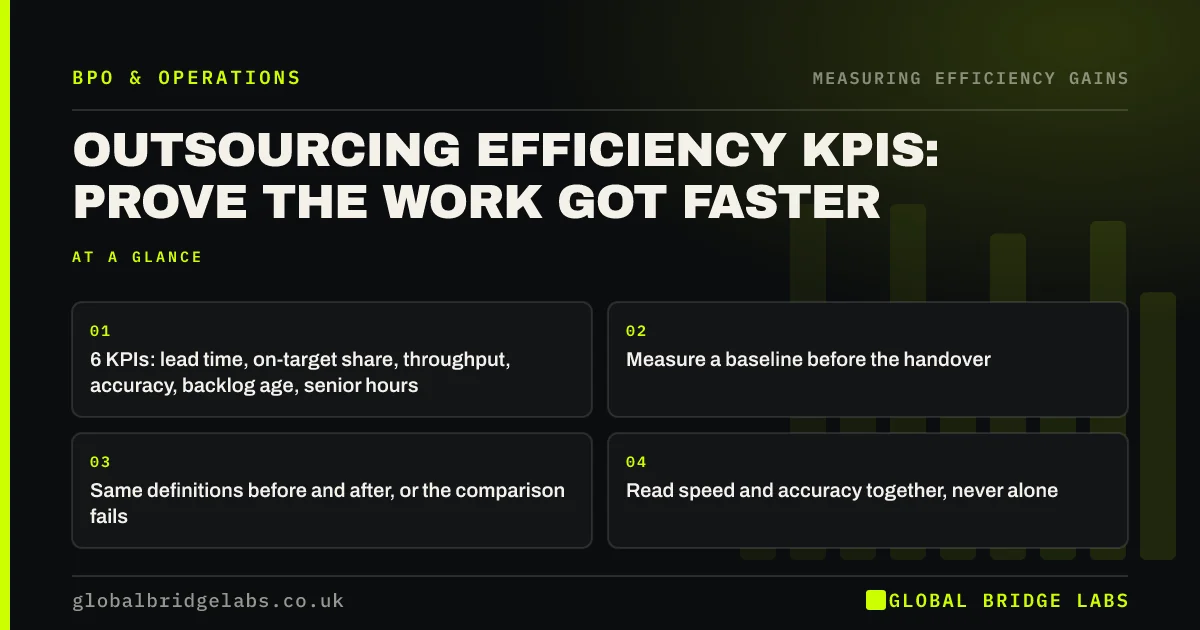
Outsourcing efficiency KPIs show whether outsourced work is faster, more accurate and less disruptive than before. Six cover most processes: lead time, share within turnaround target, throughput, right-first-time rate, backlog age and senior hours spent on the process. Measure them before the handover, then weekly, using the same definitions both times.
- 6 KPIs: lead time, on-target share, throughput, accuracy, backlog age, senior hours.
- Measure a baseline before the handover.
- Same definitions before and after, or the comparison fails.
- Read speed and accuracy together, never alone.
Want a KPI set drafted for your outsourced process? Message us on WhatsApp.
Chat on WhatsApp →Which KPIs show efficiency?
Efficiency KPIs measure flow, quality and the effect on your own team. Cost KPIs are separate and matter too, but these six show whether the work itself improved.
- Lead time: request received to result delivered.
- On-target share: percentage completed within turnaround target.
- Throughput: items completed per week.
- Right-first-time rate: items with no correction.
- Backlog age: how long the oldest open item has waited.
- Senior hours: your team's time spent on the process.
Why measure before the handover?
Without a baseline, you cannot show improvement, and any problem after the handover gets blamed on the provider. Two weeks of measurement before the change is usually enough. Record how you measured, so the same method can be used afterwards.
How should KPIs be reported?
Report them weekly in a short table or dashboard, with 8 to 12 weeks of trend. Add a line explaining any big movement. Agree the definitions in writing so in-house and provider figures match. A monthly summary and a quarterly review sit on top of the weekly figures.
What does a KPI set look like?
In an illustrative invoice-processing handover, the baseline shows a lead time of six working days, 40% within a two-day target, 300 invoices a week, 88% right first time, oldest item 15 days and 9 senior hours a week. After 90 days: two days, 92% on target, 300 a week, 97%, oldest item 3 days and 2 senior hours. Example figures only.
- Purchase-to-pay process: faster, cleaner supplier payments
- How to measure the time outsourcing saves you
Want a baseline set up before your handover? Send us the process on WhatsApp.
Chat on WhatsApp →Which KPIs mislead?
Average handling time alone can push speed at the cost of quality. Hours billed show effort, not output. A single monthly average hides peaks and long tails. Always pair a speed measure with an accuracy measure, and look at the share within target, not just the average.
When are fewer KPIs better?
For a small, stable process, three KPIs may be enough: on-target share, right-first-time rate and backlog age. Adding more creates reporting work without adding insight. Expand only when a question cannot be answered from the numbers you have.
What does this look like in practice?
A pattern we see: a provider reports hours worked and tickets closed, and the client cannot tell if things improved. Agreeing six efficiency KPIs with a baseline makes the weekly conversation about results instead of activity.
Efficiency KPI checklist
Agree these before the handover.
- Choose the KPIs and define each.
- Measure a two-week baseline.
- Report weekly with trend.
- Pair speed with accuracy.
- Review at 30, 60 and 90 days.
Next step
Tell us which process you plan to outsource. We will help you choose the KPIs, define them and set a baseline you can trust.
Message us on WhatsApp about efficiency KPIs, or book a 30-minute consultation.
Chat on WhatsApp →Sources and further reading
- Labour productivity · Office for National Statistics
- The Sourcing and Consultancy Playbooks · Cabinet Office
Frequently asked questions
What KPIs should you use for an outsourced process?
For efficiency, use lead time, the share completed within the turnaround target, throughput, right-first-time rate, backlog age and the senior hours your own team spends on the process. Track cost per task separately. Measure all of them before the handover as a baseline.
How do you prove outsourcing improved efficiency?
Compare the same KPIs, measured the same way, before the handover and 90 days after. Show the trend in between. A shorter lead time with the same or better accuracy, and fewer senior hours on the process, is clear evidence.
How often should outsourcing KPIs be reviewed?
Review them weekly in a short report, monthly as a summary and quarterly in a longer review with the provider. Weekly review catches problems early; quarterly review is where improvements and targets are agreed.
Written by

Global Bridge Labs (GBL) is a UK–Sri Lanka partner for social media, websites and BPO. Everything here comes from client delivery, not theory.


