On this page
- 01Key takeaways
- 02What does scaling without hiring mean?
- 03Why does hiring slow small businesses down?
- 04How does outsourcing add capacity without headcount?
- 05Which work can be scaled through a partner?
- 06What does it cost compared with hiring?
- 07How fast can outsourced capacity start?
- 08What stays in-house when you scale this way?
- 09How do you keep quality and control?
- 10What about data protection and UK law?
- 11When is hiring the better way to scale?
- 12What does this look like in practice?
- 13Scale without hiring checklist
- 14Next step
- 15Sources and further reading
- 16Frequently asked questions
Key takeaways
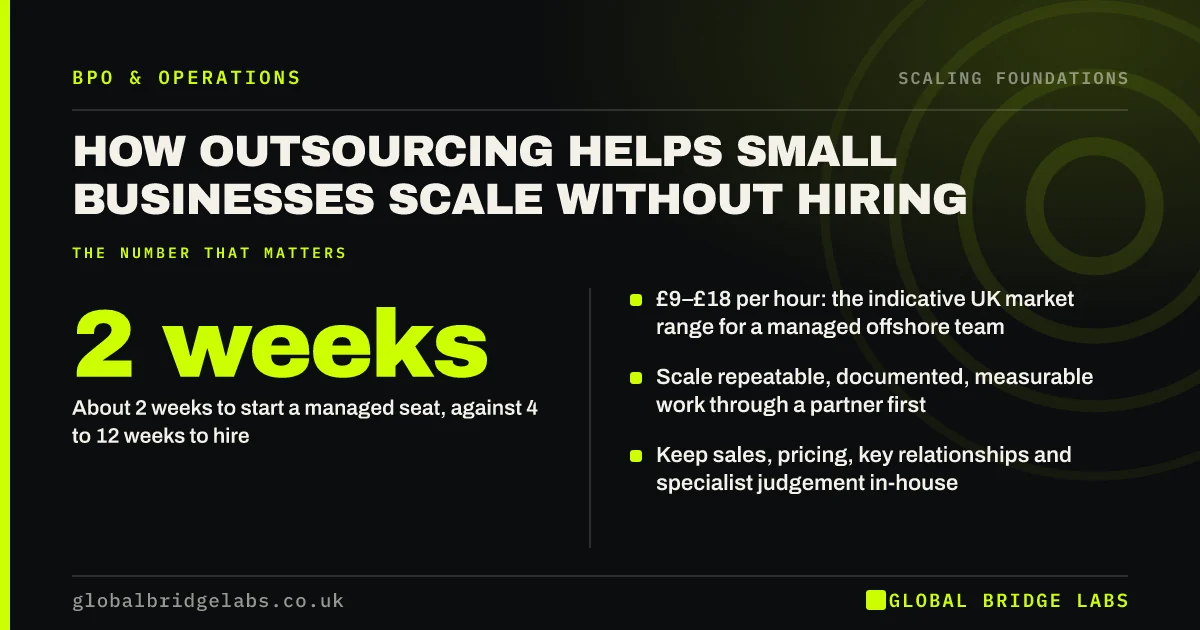
To scale a business without hiring, keep a small in-house team on the work customers pay for and buy the repeatable volume around it as managed capacity. Outsourcing helps because it starts in about two weeks, flexes monthly, includes cover and supervision, and costs UK small businesses an indicative £9–£18 per hour offshore.
- About 2 weeks to start a managed seat, against 4 to 12 weeks to hire.
- £9–£18 per hour: the indicative UK market range for a managed offshore team.
- Scale repeatable, documented, measurable work through a partner first.
- Keep sales, pricing, key relationships and specialist judgement in-house.
Want to see which of your work could scale without a hire? Message us on WhatsApp with your team size and what is stretching.
Chat on WhatsApp →What does scaling without hiring mean?
Scaling without hiring means increasing the volume of work a business can handle without adding employees to its own payroll. The extra capacity comes from a managed outside team, better processes and software. The business grows its output and revenue while its internal headcount, and the fixed cost and management load that come with it, stay roughly the same.
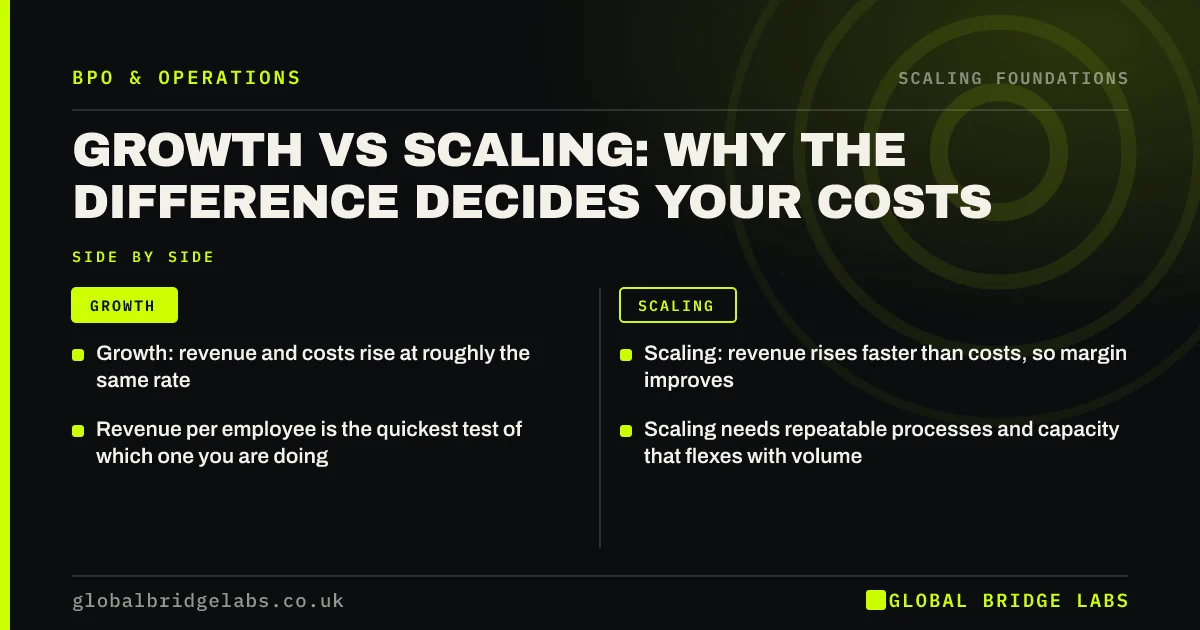
It is not the same as refusing to hire. Most firms that scale this way still recruit, but they recruit for the few roles that make them different and buy the rest as a service. Growth and scaling are also different things, and the difference decides how costs behave as you get bigger.
Why does hiring slow small businesses down?
Hiring slows a small business because every new employee is a fixed cost, a management commitment and a delay. Recruiting and training commonly take 4 to 12 weeks, so capacity arrives after the demand that justified it. Once hired, the cost continues whether the work does or not, and each person adds to what the owner has to manage.
The numbers are larger than the salary. At the 2026/27 National Living Wage of £12.71 an hour, an employee costs about £16.27 per worked hour once employer National Insurance, the minimum pension contribution and 28 days of paid holiday are counted. A £30,000 administrator costs about £19.81 per worked hour, or roughly £34,500 a year, before recruitment, equipment and management time.
The Department for Business and Trade counted 5.7 million private sector businesses in the UK in 2025, and the vast majority employ fewer than ten people. In a team that size, one hire is a 10% or greater jump in fixed cost.
How does outsourcing add capacity without headcount?
Outsourcing adds capacity without headcount by supplying trained people, supervision and cover as a monthly service instead of an employment contract. The provider recruits, manages and replaces the team. You define the work, the standard and the volume, and you pay for the hours or output you use.
Five mechanisms do the work. Each one removes a constraint that hiring leaves in place.
- Speed: a managed seat can start in about two weeks, so capacity arrives with demand.
- Elasticity: hours rise and fall monthly, so cost follows volume.
- Cover: holiday, sickness and leavers are the provider's problem to fill.
- Skills: you get specialists for part of a week without funding a whole role.
- Management: team leaders and quality checks are included, so the owner manages outcomes.
Which work can be scaled through a partner?
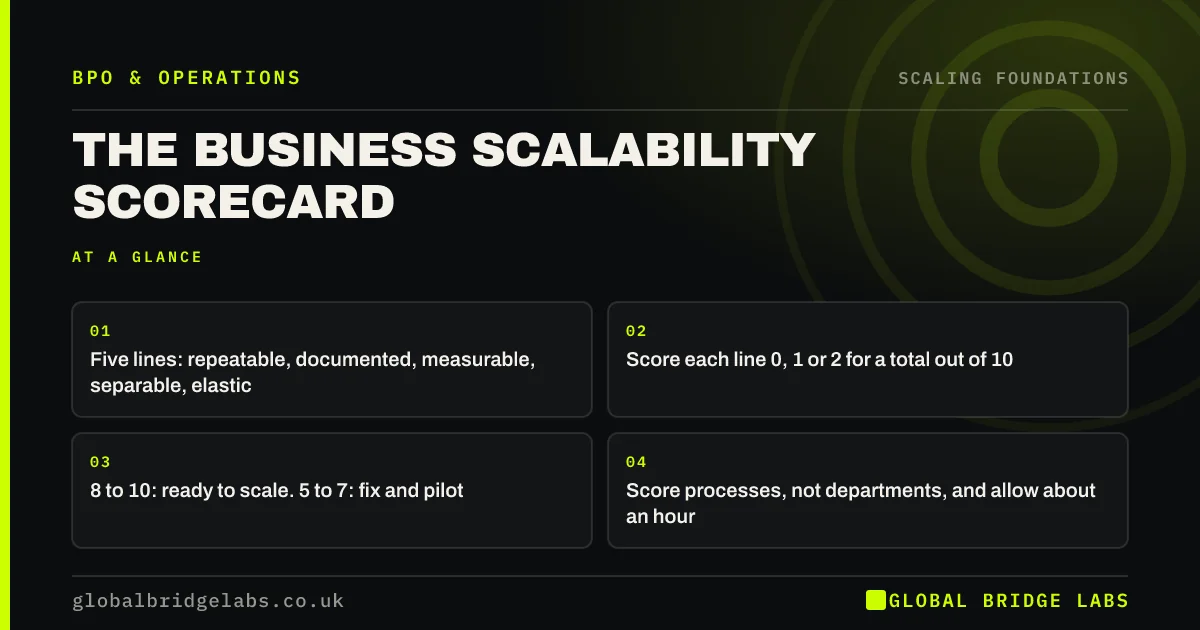
Work scales through a partner when it is repeatable, written down, measurable, separable from your premises and variable in volume. The GBL Scalability Scorecard scores a process 0 to 2 on each of those five lines. A total of 8 to 10 is ready to scale through a partner, 5 to 7 needs its weakest line fixed and a pilot, and 4 or below should be stabilised in-house first.
In UK small businesses the work that scores highest is usually customer email, calls and chat, order and booking administration, invoicing and credit control, data entry and CRM upkeep, and the production side of marketing and websites.
- Repeatable: the same steps are followed most of the time.
- Documented: someone new could follow the written process.
- Measurable: volume, turnaround and errors can be counted.
- Separable: it can be done remotely with system access.
- Elastic: volume rises and falls, so flexible capacity pays.
What does it cost compared with hiring?
Scaling through a partner usually costs less per productive hour than hiring, and the cost can be reduced when volume falls. As indicative market ranges, a managed offshore team costs UK businesses £9–£18 per hour and an onshore provider £20–£35 per hour. Neither is a GBL price; the right figure depends on the work, hours and language needs.
Take an illustrative 10-person services firm that needs about 60 more hours a week of admin and customer contact. Hiring two full-time administrators at £30,000 costs about £68,900 a year at the loaded rate, fixed, with recruitment on top and a wait of one to three months. Buying 60 hours a week at an indicative £12 an hour is £3,120 a month, about £37,400 a year, adjustable monthly and with cover included.
These are example figures, not a quote. The comparison only holds when the outsourced work is done to the same standard, so price your review time and the setup effort too.
- Hire-led: about £68,900 a year for two £30,000 roles, fixed.
- Partner-led: about £37,400 a year for 60 hours a week at £12, variable.
- Hire-led start: 4 to 12 weeks. Partner-led start: about 2 weeks.
- What scaling a business costs: hire-led vs partner-led
- BPO cost per hour in the UK
- In-house vs outsourcing: which model is more cost-effective?
Want this comparison rebuilt with your own hours and salaries? Send them on WhatsApp and we will discuss your requirements.
Chat on WhatsApp →How fast can outsourced capacity start?
A managed seat on a documented process can usually start in about two weeks: a few days to agree scope and access, a week of training and shadowing, then supervised live work. Undocumented or changing processes take longer, because the first job is writing down how the work is done.
The practical lesson is to prepare before the growth arrives. A business that documents its three highest-volume processes and forecasts demand six to eight weeks ahead can add capacity almost as soon as it needs it.
What stays in-house when you scale this way?
Keep in-house the work that customers choose you for and the decisions that set direction. That normally means sales conversations, pricing, key client relationships, product or service design, specialist judgement and final sign-off. The in-house team gets smaller in share but more senior in focus: it sets standards, handles exceptions and owns outcomes.
The role of your existing people changes, and that needs saying out loud. Staff who were doing routine volume become reviewers, trainers and owners of a process, which is usually a better job.
How do you keep quality and control?
Control comes from four things: a written process, a named internal owner, a small scorecard reviewed weekly, and sampling of real work. With those in place, an outsourced team is often more measured than the in-house team it supports, because nobody was counting before.
Add seats one or two at a time into a process that is already running well. Most quality problems during growth come from adding people faster than the process can absorb them, which is true of employees and outsourced teams alike.
What about data protection and UK law?
Under UK GDPR your business remains the controller and stays responsible for personal data handled by a provider. You need a written contract with the processor, and a transfer to a country without UK adequacy regulations needs a safeguard such as the International Data Transfer Agreement (IDTA). The Information Commissioner's Office (ICO) publishes guidance on both.
If work moves from employees to a provider, the Transfer of Undertakings (Protection of Employment) regulations, known as TUPE, may apply. Scaling by adding outside capacity for new volume, with no one's job transferring, is the simpler case.
When is hiring the better way to scale?
Hiring is the better way to scale when the bottleneck is the work customers pay for, when a role would be fully used every week, when the work needs years of built-up judgement, or when someone must be on site. It is also right when volume is tiny, because handover and review would cost more than the hours saved.
Outsourcing does not fix a broken process, a weak offer or a shortage of leads. If the constraint is demand, more capacity of any kind only adds cost. Find the real bottleneck first.
- The role is your product, your sales or your client relationship.
- The work fills a full-time role with little idle time.
- Physical presence is required.
- The process changes every week and nobody has written it down.
What does this look like in practice?
A pattern we see in UK service businesses with 8 to 15 staff: enquiries rise, the owner starts answering email at night, and the plan is to hire an administrator. By the time the role is advertised, filled and trained, a quarter has passed and the owner has stopped selling. Moving the inbox, bookings and invoicing to a managed team first, then hiring only for the role that proved permanent, keeps growth moving.
Across our client work, back-office cost per task has fallen by 42% once the process was written down and run by a managed team, and owners have got 31 hours a week back.
Scale without hiring checklist
Work through these steps before you advertise the next role.
- Find the bottleneck: is it demand, delivery or admin?
- List the processes behind it and their weekly hours.
- Score each process on the five scorecard lines.
- Write down the highest-scoring process step by step.
- Price the hire fully and get a quote for the same scope.
- Pilot one process for 60 to 90 days with a weekly scorecard.
- Name one internal owner for the relationship.
- Hire only for the roles that stay core and fully used.
Next step
Send us your team size, the work that is stretching and roughly how many hours a week it takes. In a 30-minute call we will score it with you, say plainly what should stay in-house, and outline what a managed team would look like for the rest.
Message us on WhatsApp for a scale-without-hiring review, or book a 30-minute consultation.
Chat on WhatsApp →Sources and further reading
- Business population estimates for the UK and regions 2025 · Department for Business and Trade
- National Minimum Wage and National Living Wage rates · GOV.UK
- Rates and thresholds for employers 2026 to 2027 · HM Revenue & Customs
- Holiday entitlement · GOV.UK
- Contracts and liabilities between controllers and processors · Information Commissioner's Office
Frequently asked questions
Can a small business scale without hiring more staff?
Yes, for work that is repeatable and can be done remotely. A small business can add capacity through a managed outsourced team, better processes and software while keeping its own headcount steady. Roles that are core to the product, need on-site presence or would be fully used every week are still better hired.
How does outsourcing help a business grow?
Outsourcing helps a business grow by adding trained capacity quickly, turning a fixed staffing cost into a variable one, and freeing the owner and senior staff from routine work. Capacity can start in about two weeks and change monthly, so the business can take on more customers without waiting for recruitment.
Is outsourcing cheaper than hiring an employee in the UK?
Often, for routine work. A UK employee on the National Living Wage costs about £16.27 per worked hour in 2026/27 once employer costs and holiday are included. Indicative market rates for a managed offshore team are £9–£18 per hour with supervision and cover included. Compare like for like on a written scope.
What should a small business outsource first when scaling?
Start with the highest-volume process that follows clear rules and grows directly with customer numbers. For most UK small businesses that is customer email and calls, order or booking administration, or invoicing and payment chasing. Document it, pilot it for 60 to 90 days, then add the next process.
What are the risks of scaling through outsourcing?
The main risks are handing over an undocumented process, losing knowledge of how the work is done, weak quality checks and over-reliance on one provider. Each has a control: write the process down, keep an internal owner, review a weekly scorecard, and keep notice terms short with your documentation in your own hands.
Written by

Global Bridge Labs (GBL) is a UK–Sri Lanka partner for social media, websites and BPO. Everything here comes from client delivery, not theory.