
On this page
- 01Key takeaways
- 02How much do meetings really cost?
- 03Which meetings should you cut?
- 04How do you replace status meetings?
- 05How do you audit your meetings?
- 06Do outsourced teams add more meetings?
- 07When are more meetings the right answer?
- 08What does this look like in practice?
- 09Meeting checklist
- 10Next step
- 11Sources and further reading
- 12Frequently asked questions
Key takeaways
Too many meetings cost a small business twice: the hours in the room and the broken focus either side. Most status meetings can be replaced by a short written report, and most others can be shorter with fewer people. Audit a fortnight of meetings, cut or shorten the ones without a decision, and protect focus blocks.
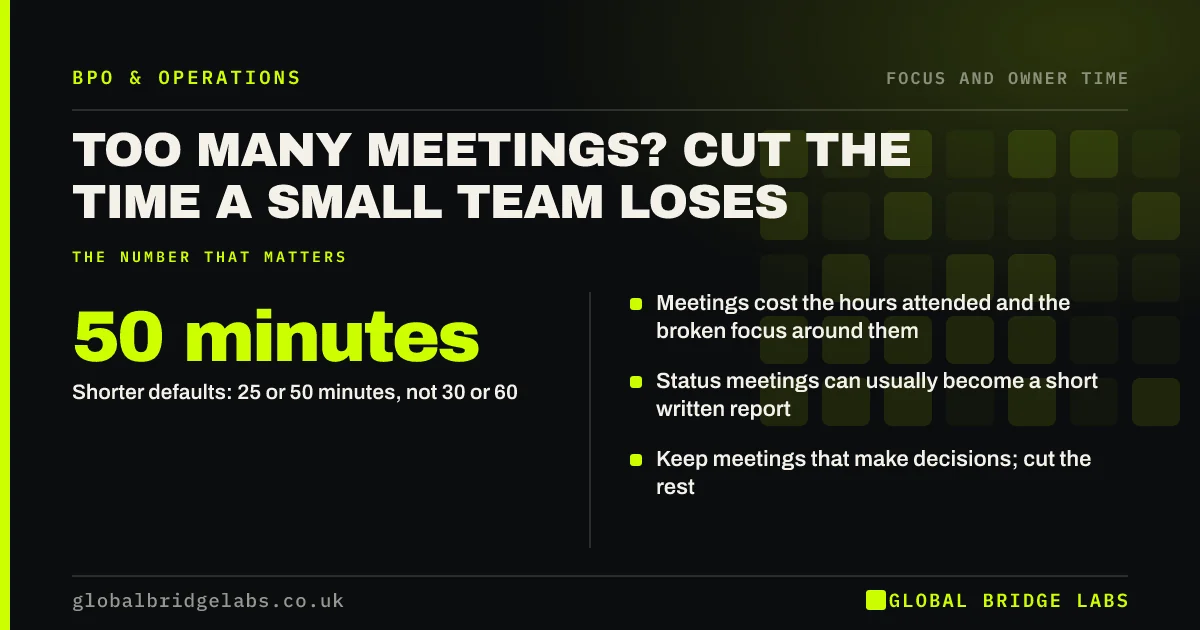
- Meetings cost the hours attended and the broken focus around them.
- Status meetings can usually become a short written report.
- Keep meetings that make decisions; cut the rest.
- Shorter defaults: 25 or 50 minutes, not 30 or 60.
Want help working out which meetings to cut? Message us on WhatsApp.
Chat on WhatsApp →How much do meetings really cost?
A meeting's cost is the hourly cost of everyone in it multiplied by its length, plus the lost focus around it. In an illustrative firm, a weekly one-hour status meeting with six people at a loaded £30 an hour costs £180 a week, about £9,000 a year, before counting the half hour of disrupted work either side. Example figures only.
Which meetings should you cut?
Cut meetings that share information rather than make decisions, meetings with no agenda, and recurring meetings whose original purpose has gone. Shorten those that remain and invite only people who will decide or contribute. Everyone else can read the notes.
- Cut: status updates that could be a written report.
- Cut: recurring meetings with no recent decisions.
- Shorten: default to 25 or 50 minutes.
- Slim: only people who decide or contribute.
How do you replace status meetings?
Replace status meetings with a short written update or a dashboard that shows volumes, turnaround and issues. People read it in two minutes when it suits them. Keep one short weekly meeting for decisions and problems the report raises. Outsourced teams usually report this way already, which is a model for in-house teams too.
How do you audit your meetings?
Export two weeks of your diary. For each meeting, note its purpose, length, attendees and whether a decision was made. Calculate the total hours across the team. Then decide for each: keep, shorten, make written or stop. Repeat the audit each quarter.
- 1. Export two weeks of meetings.
- 2. Note purpose, length, attendees and decisions.
- 3. Total the hours across everyone.
- 4. Mark each keep, shorten, written or stop.
Want a second view on your meeting audit? Send us the summary on WhatsApp.
Chat on WhatsApp →Do outsourced teams add more meetings?
They should not. A well-run arrangement uses a weekly report, a daily decision list and a short weekly review, with a longer quarterly review. If you find yourself in daily calls with a provider after the first month, the process or the reporting needs fixing.
When are more meetings the right answer?
More meetings are right when a team is new, when a problem needs several people to solve together, or when a written update keeps being misunderstood. A short daily stand-up during a busy launch can save time overall. Set an end date so it does not become permanent.
What does this look like in practice?
A pattern we see: a growing team adds a meeting for every new problem and never removes one. An audit shows several hours a week per person in meetings that share information. Replacing them with a short written update returns time without anyone feeling less informed.
Meeting checklist
Apply these to every recurring meeting.
- Does it make decisions?
- Could a written update replace it?
- Is everyone invited needed?
- Can it be 25 or 50 minutes?
- Does it have an agenda and an owner?
Next step
Send us your list of recurring meetings. We will help you decide which to keep, shorten or replace with reporting.
Message us on WhatsApp to review your meetings, or book a 30-minute consultation.
Chat on WhatsApp →Sources and further reading
- Multitasking: switching costs · American Psychological Association
- Employee earnings in the UK (Annual Survey of Hours and Earnings) · Office for National Statistics
Frequently asked questions
How many meetings is too many?
There is no fixed number. A warning sign is when people cannot find a block of two or three hours for focused work in a week, or when meetings mostly share information rather than make decisions. Audit two weeks and judge by purpose, not count.
How do you calculate the cost of a meeting?
Multiply each attendee's loaded hourly cost by the meeting length and add them up. Add some allowance for disrupted focus before and after. A one-hour meeting of six people at £30 an hour costs £180, before the lost focus time.
What can replace status meetings?
A short written update or a dashboard showing volumes, turnaround and issues, read when it suits each person. Keep one short weekly meeting for decisions on the problems the update raises. This saves time and leaves a written record.
Written by

Global Bridge Labs (GBL) is a UK–Sri Lanka partner for social media, websites and BPO. Everything here comes from client delivery, not theory.


