
On this page
- 01Key takeaways
- 02What is lead routing?
- 03Why does routing matter?
- 04How do you set routing rules?
- 05What does better routing change?
- 06Where does a person need to be involved?
- 07When is routing unnecessary?
- 08What does this look like in practice?
- 09Lead routing checklist
- 10Next step
- 11Sources and further reading
- 12Frequently asked questions
Key takeaways
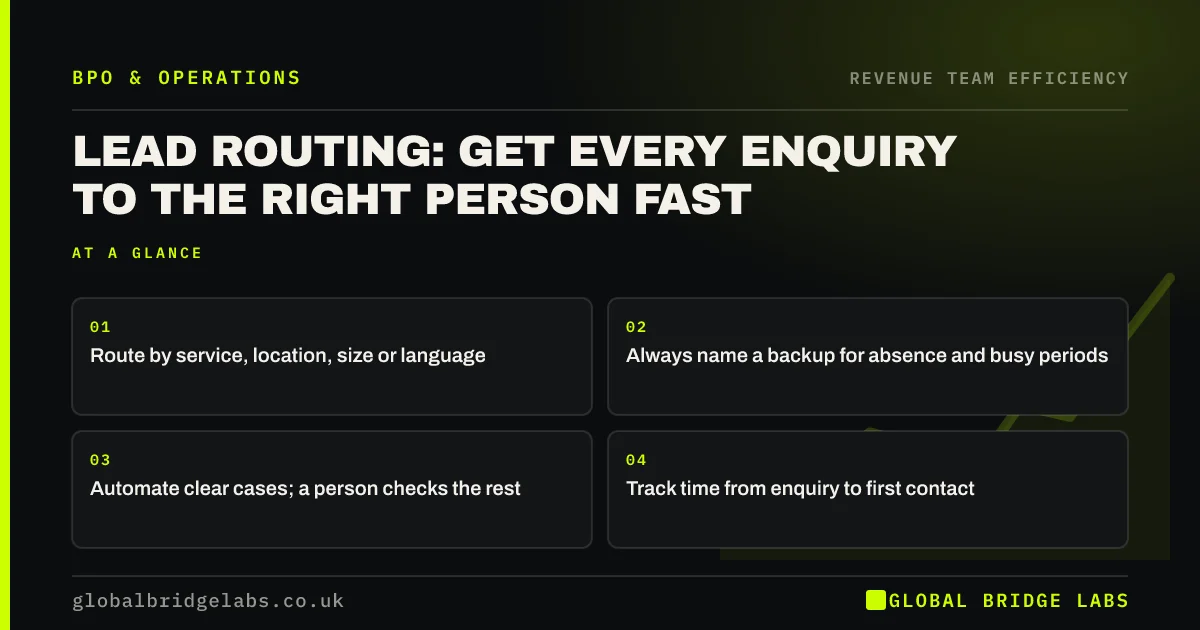
Lead routing is the set of rules that sends each new enquiry to the right person, fast. Route by service, location, size or language, with a named backup for when the first person is busy or away. Combine automatic rules for clear cases with a person checking unclear ones, and track time from enquiry to first contact.
- Route by service, location, size or language.
- Always name a backup for absence and busy periods.
- Automate clear cases; a person checks the rest.
- Track time from enquiry to first contact.
Want lead routing rules for your enquiries? Message us on WhatsApp.
Chat on WhatsApp →What is lead routing?
Lead routing is assigning each incoming enquiry to an owner according to set rules, so it is followed up quickly by someone able to help. In a small business it might be as simple as sending commercial enquiries to one person and residential to another, with a backup for each.
Why does routing matter?
Routing matters because leads cool quickly. An enquiry sitting in a shared inbox until someone notices it may be contacted hours or days late, by which time the buyer has spoken to a competitor. Clear routing removes that wait and stops two people chasing the same lead.
How do you set routing rules?
Start with the factor that most changes who should respond, usually service type or location. Write each rule as if this, then that person, with a backup. Add an out-of-hours rule. Keep the rules few enough that anyone can understand them.
- 1. Choose the main routing factor.
- 2. Name an owner and a backup for each route.
- 3. Add an out-of-hours rule.
- 4. Set a target time to first contact.
- 5. Review unrouted leads weekly.
What does better routing change?
In an illustrative firm, web enquiries land in info@ and are picked up when someone checks, an average of five working hours later. Routing rules in the CRM, plus a support team checking unclear leads every hour, bring first contact to under one hour for most enquiries. Example figures only.
Want to see how fast your leads are contacted today? Send us a week of timestamps on WhatsApp.
Chat on WhatsApp →Where does a person need to be involved?
A person needs to check enquiries that do not match a rule, enquiries with missing details and anything that looks like an existing customer. A support team can do this quickly and add context before the lead reaches a salesperson, such as previous orders or the page they came from.
When is routing unnecessary?
Routing is unnecessary when one person handles all enquiries and is reliably available. It becomes necessary once two or more people sell, enquiries arrive out of hours, or the owner is often unavailable.
What does this look like in practice?
A pattern we see: two salespeople both reply to the same enquiry, while another sits unanswered because each thought the other had it. Simple routing rules and a visible owner on every lead end both problems.
Lead routing checklist
Set these up for your enquiries.
- One entry point for all enquiries.
- Written routing rules with backups.
- An out-of-hours rule.
- Target time to first contact.
- Weekly review of unrouted leads.
Next step
Tell us how enquiries reach you and who follows them up. We will suggest routing rules and where a support team could check unclear leads.
Message us on WhatsApp about lead routing, or book a 30-minute consultation.
Chat on WhatsApp →Sources and further reading
- Electronic and telephone marketing under PECR · Information Commissioner's Office
- Direct marketing and privacy and electronic communications · Information Commissioner's Office
Frequently asked questions
What is lead routing?
Lead routing is assigning each new enquiry to the right person according to set rules, such as service type, location or size, so it is followed up quickly. It prevents leads waiting in a shared inbox and stops two people chasing the same one.
How fast should you respond to a new lead?
As quickly as you reasonably can, ideally within an hour in business hours. Buyers often contact several businesses, and the first useful reply has an advantage. Measure your own time to first contact and set a target you can meet every day.
Can lead routing be automated?
Clear cases can be routed automatically by your CRM or form tool using rules such as service or postcode. Keep a person checking leads that do not match a rule, have missing details or might be existing customers.
Written by

Global Bridge Labs (GBL) is a UK–Sri Lanka partner for social media, websites and BPO. Everything here comes from client delivery, not theory.


