
On this page
- 01Key takeaways
- 02What is process cycle efficiency?
- 03How do you calculate it?
- 04What is a good score?
- 05What does improving it look like in numbers?
- 06How do you raise process cycle efficiency?
- 07When is a low score fine?
- 08What does this look like in practice?
- 09Process cycle efficiency checklist
- 10Next step
- 11Sources and further reading
- 12Frequently asked questions
Key takeaways
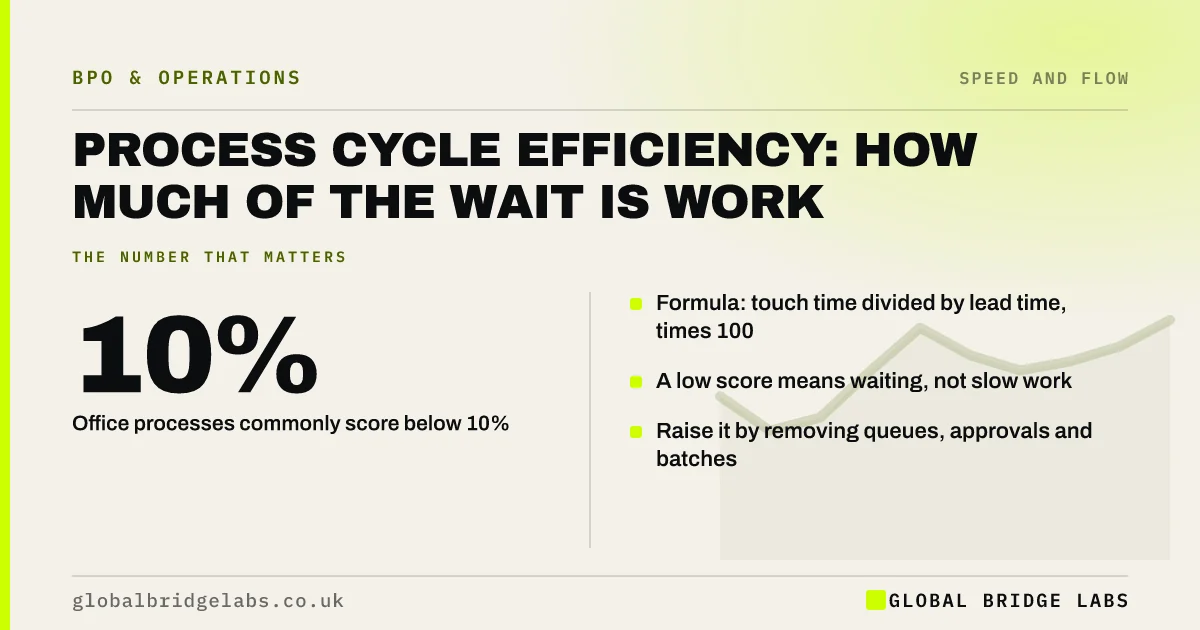
Process cycle efficiency (PCE) is touch time divided by lead time, shown as a percentage. It tells you how much of the customer's wait is spent actually working on their request. Office processes commonly score below 10%, because most of the time is waiting. Raising PCE means removing waits, not asking people to work faster.
- Formula: touch time divided by lead time, times 100.
- Office processes commonly score below 10%.
- A low score means waiting, not slow work.
- Raise it by removing queues, approvals and batches.
Want your process cycle efficiency worked out? Message us on WhatsApp with one process.
Chat on WhatsApp →What is process cycle efficiency?
Process cycle efficiency is the share of total lead time spent on value-adding work. Lean practitioners also call it flow efficiency. If a request takes 40 minutes of work and the customer waits two working days of 7.5 hours, PCE is 40 minutes out of 900, or about 4%. The other 96% is the request waiting.
How do you calculate it?
Measure touch time and lead time for ten items in the same units, usually working minutes. Divide average touch time by average lead time and multiply by 100. Count only the work that moves the item forward. Rework, chasing and searching for information are not value-adding, even though someone is busy.
- 1. Choose one process with a clear start and end.
- 2. Time the active work on ten items.
- 3. Measure lead time for the same items.
- 4. Divide touch time by lead time.
What is a good score?
There is no fixed good score, but the trend matters. A process at 3% that moves to 15% has cut most of its waiting. Above about 25% in office work, the remaining gains usually come from making the work itself simpler. Compare your process with itself over time, not with other businesses.
What does improving it look like in numbers?
In an illustrative example, supplier invoice approval has 12 minutes of touch time and a lead time of six working days, a PCE of under 1%. Replacing a weekly approval meeting with a daily approval list and a named deputy cuts lead time to one day, raising PCE to about 3%. Example figures. The gain came from removing waiting, not from faster work.
- Approval bottlenecks: when sign-off holds up the work
- Purchase-to-pay process: faster, cleaner supplier payments
Want to see which waits matter most in your process? Send us the steps on WhatsApp.
Chat on WhatsApp →How do you raise process cycle efficiency?
Raise PCE by removing the waits between steps. Give the queue a daily owner, limit work in progress, release batches daily, delegate low-risk approvals and collect all the information needed at the start. Outsourcing helps when a dedicated team can work the queue continuously instead of fitting it around other jobs.
When is a low score fine?
A low score is fine when waiting is built in and costs nothing, such as a cooling-off period or a scheduled review. It is also less important for internal work nobody waits for. Focus on processes where the customer or a senior person is waiting on the result.
What does this look like in practice?
A pattern we see: a team asked to speed up a process tries to work faster and gains a few minutes. Calculating PCE shows the work is a tiny share of the wait. Moving the queue to a team that works it daily delivers a far larger gain with no change to the work itself.
Process cycle efficiency checklist
Work through these for your slowest process.
- Measure touch time and lead time in the same units.
- Calculate PCE for ten items.
- List every wait longer than an hour.
- Remove or shorten the longest wait.
- Recalculate after four weeks.
Next step
Send us one process with rough touch and lead times. We will calculate PCE with you and suggest where to remove waiting first.
Message us on WhatsApp to calculate your PCE, or book a 30-minute consultation.
Chat on WhatsApp →Sources and further reading
- Labour productivity · Office for National Statistics
- Designing services that deliver (Shostack, 1984) · Harvard Business Review
Frequently asked questions
What is the formula for process cycle efficiency?
Process cycle efficiency equals value-adding touch time divided by total lead time, multiplied by 100. If an item takes 30 minutes of real work and the customer waits 10 working hours, PCE is 30 out of 600 minutes, or 5%.
Why is process cycle efficiency so low in offices?
Because most of the lead time is waiting: requests sit in inboxes, wait for approvals, or wait for a weekly batch. People are busy, but on other things. The work itself is often quick, so even small queues produce a low score.
Is flow efficiency the same as process cycle efficiency?
Yes, the two terms are used for the same idea: the share of lead time spent on value-adding work. Some teams measure it in calendar time and some in working time, so state which you use and keep it consistent.
Written by

Global Bridge Labs (GBL) is a UK–Sri Lanka partner for social media, websites and BPO. Everything here comes from client delivery, not theory.


