On this page
- 01Key takeaways
- 02What is a bottleneck in a business?
- 03How do you find the bottleneck?
- 04What causes bottlenecks in small businesses?
- 05How do you fix a bottleneck without hiring?
- 06What happens after you fix it?
- 07When is the bottleneck outside operations?
- 08What does this look like in practice?
- 09Bottleneck checklist
- 10Next step
- 11Sources and further reading
- 12Frequently asked questions
Key takeaways
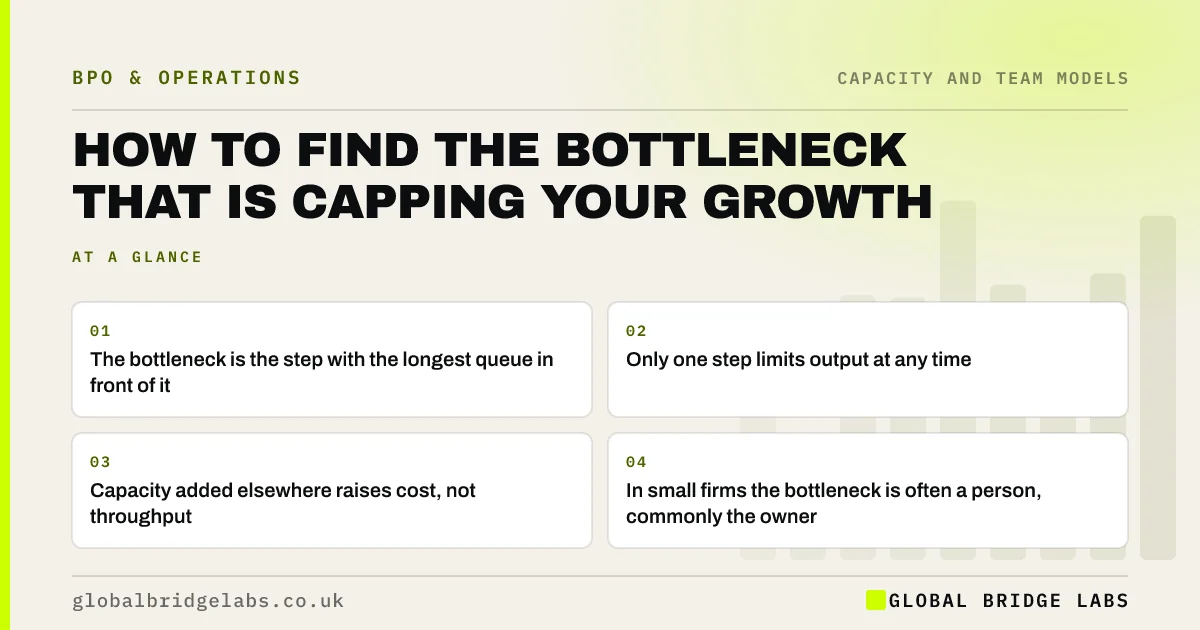
To find bottlenecks in a business, follow one piece of work from enquiry to payment and look for where it waits longest. The step with the biggest queue in front of it sets the pace for everything else. Adding capacity anywhere other than that step increases cost without increasing output.
- The bottleneck is the step with the longest queue in front of it.
- Only one step limits output at any time.
- Capacity added elsewhere raises cost, not throughput.
- In small firms the bottleneck is often a person, commonly the owner.
Want help tracing where your work is waiting? Message us on WhatsApp with your process steps.
Chat on WhatsApp →What is a bottleneck in a business?
A bottleneck is the step in a process with the least capacity relative to the demand placed on it. Because work cannot pass through faster than its slowest step, the bottleneck determines how much the whole business can deliver. Everything before it builds a queue, and everything after it waits.
How do you find the bottleneck?
Find the bottleneck by measuring waiting time, not working time. Take ten recent jobs and record when each step started and finished. The step where work sat untouched for longest is the constraint. A quicker check is to ask where the piles are: unanswered emails, unsent quotes, unapproved drafts or unraised invoices.
- 1. List the steps from enquiry to cash.
- 2. Time ten recent jobs through each step.
- 3. Separate working time from waiting time.
- 4. Find the step with the longest wait.
- 5. Ask why that step is short of capacity.
What causes bottlenecks in small businesses?
Most bottlenecks in small businesses have one of four causes: a single person who must approve or do the step, a skill only one or two people have, a system that forces manual work, or a policy such as batching invoices monthly. The owner's inbox is the most common example of the first.
- Approval: everything waits for one person.
- Skill: only one person can do it.
- System: re-keying, spreadsheets, no integration.
- Policy: batching, cut-offs, sign-off rules.
How do you fix a bottleneck without hiring?
Fix a bottleneck in this order: stop wasting its time, move work away from it, then add capacity to it. Take routine tasks off the constrained person, simplify approvals, and hand the repeatable part of the step to a managed team. Hire only if the remaining work is specialist and fills a role.
- Protect: remove interruptions and non-essential tasks.
- Offload: move the routine share of the step elsewhere.
- Simplify: cut approvals for low-risk cases.
- Add: bring in trained capacity for what remains.
- Overflow outsourcing: hand off only work above your limit
- Cross-training a small team: more cover without hiring
Found the step but not the fix? Describe it on WhatsApp and we will suggest options.
Chat on WhatsApp →What happens after you fix it?
The bottleneck moves. Once the slowest step is relieved, another becomes the constraint, often the next one downstream. That is normal and a sign of progress. Repeat the exercise each quarter, and expect the constraint to move from admin to delivery to sales as the business grows.
When is the bottleneck outside operations?
Sometimes the constraint is not capacity at all. If there are no queues anywhere and the team has spare time, the limit is demand, pricing or the offer. Adding operational capacity then is wasted money. Check lead flow and conversion before concluding that the business needs more hands.
What does this look like in practice?
A pattern we see in UK trades and service firms: the owner believes the limit is engineers, and plans to recruit two. Timing ten jobs shows quotes waiting four days for the owner to price them, and a third of enquiries going elsewhere in the meantime. The constraint was quoting, and the fix was a pricing guide and someone to prepare drafts.
Bottleneck checklist
Repeat this every quarter.
- Map the steps from enquiry to payment.
- Record waiting time at each step for ten jobs.
- Identify the longest wait and its cause.
- List tasks the constrained person could stop doing.
- Decide what part of the step is routine.
- Move the routine part and measure again.
- Look for the next constraint.
Next step
Tell us your steps from enquiry to payment and where you think work waits. We will help you confirm the constraint and the cheapest way to relieve it.
Message us on WhatsApp for a bottleneck review, or book a 30-minute consultation.
Chat on WhatsApp →Sources and further reading
- Labour productivity · Office for National Statistics
- Multitasking: switching costs · American Psychological Association
Frequently asked questions
How do you identify a bottleneck in a process?
Identify a bottleneck by finding where work waits longest. Track several recent jobs through each step, noting start and finish times, and separate time spent working from time spent waiting. The step with the largest queue or longest wait before it is the bottleneck that limits overall output.
What is an example of a bottleneck in a small business?
A common example is the owner approving every quote. Enquiries arrive and site visits happen on time, but quotes wait days for one person to price them, so jobs are lost. Other examples are one person who can run payroll, or invoices raised only at month end.
Why does fixing one bottleneck create another?
Because a process always has a slowest step. When you add capacity to the current constraint, work flows faster until it meets the next slowest step, which becomes the new limit. This is expected. Each fix raises total output, and the exercise is repeated on the new constraint.
Should I hire to fix a bottleneck?
Only after cheaper fixes. First remove non-essential work from the constrained step, simplify approvals and move routine tasks to other people or a managed team. If what remains is specialist work that fills a role, hire. Hiring before checking often adds cost at a step that was not the constraint.
Written by

Global Bridge Labs (GBL) is a UK–Sri Lanka partner for social media, websites and BPO. Everything here comes from client delivery, not theory.