
On this page
- 01Key takeaways
- 02What is the difference between productivity and efficiency?
- 03Can a team be productive but inefficient?
- 04How do you measure each?
- 05Which should you improve first?
- 06How does outsourcing affect both?
- 07When does the distinction not matter?
- 08What does this look like in practice?
- 09Productivity and efficiency checklist
- 10Next step
- 11Sources and further reading
- 12Frequently asked questions
Key takeaways
Productivity is output per unit of input, such as orders per hour. Efficiency is how little of that input is wasted. A team can raise productivity by working harder while staying inefficient, because work still waits and loops back. Improving efficiency usually raises productivity too, and it lasts longer than effort alone.
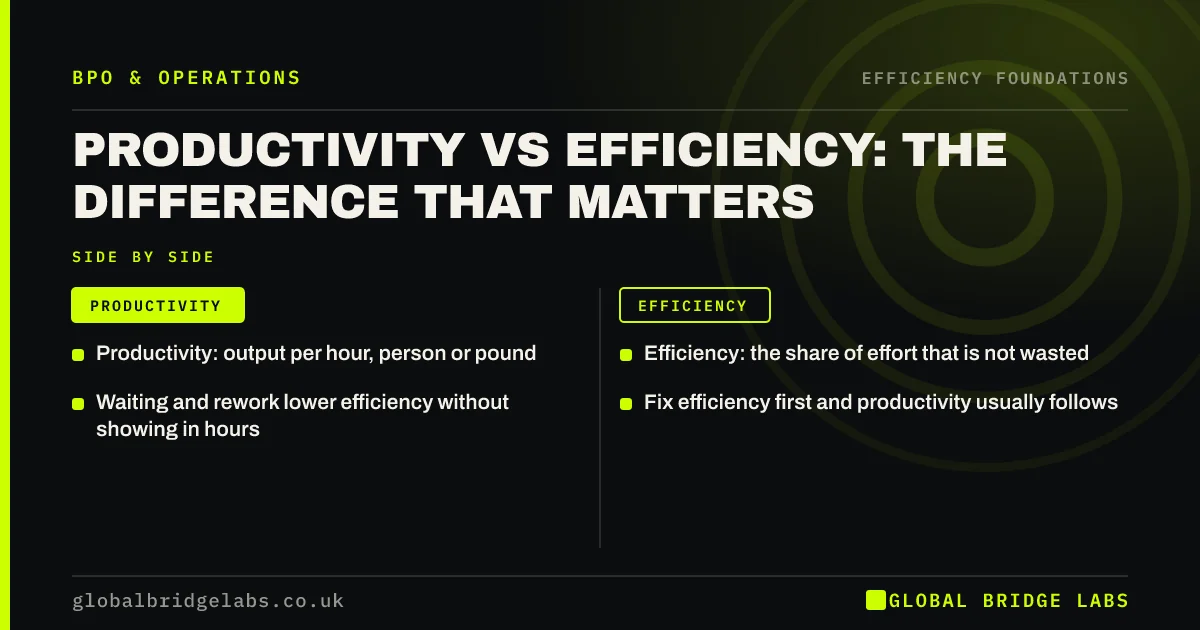
- Productivity: output per hour, person or pound.
- Efficiency: the share of effort that is not wasted.
- Waiting and rework lower efficiency without showing in hours.
- Fix efficiency first and productivity usually follows.
Want to see which of your numbers to track? Message us on WhatsApp with the process you care about.
Chat on WhatsApp →What is the difference between productivity and efficiency?
Productivity is a ratio of output to input, such as invoices processed per hour worked. Efficiency compares the input used with the minimum needed, so it shows waste. The Office for National Statistics measures UK labour productivity as output per hour worked. A small business needs both views: how much gets done, and how much effort was spent on things that did not need doing.
Can a team be productive but inefficient?
Yes. A team can process many items per hour while a third of them come back for correction, or while customers wait days because work sits between steps. Hours look well used, so the waste stays hidden. The signs are long lead times, frequent rework and people waiting for approvals or information.
How do you measure each?
Measure productivity as completed output divided by hours, for one process at a time. Measure efficiency with process cycle efficiency (touch time divided by lead time) and right-first-time rate. Track them together. If productivity rises and right-first-time falls, the team is working faster and creating rework.
- Productivity: completed items per hour worked.
- Process cycle efficiency: touch time divided by lead time.
- Right-first-time rate: items with no correction.
- Read them as a set, never one alone.
Which should you improve first?
Improve efficiency first. Pushing productivity through effort raises stress and errors, and the gain fades. Removing waits, duplicate entry and corrections raises output without extra effort. In an illustrative team, cutting corrections from one item in five to one in twenty frees about 15% of hours with nobody working faster.
- Checklists that reduce errors in routine business work
- Double data entry: what rekeying costs and how to stop it
Want to work out what your corrections cost in hours? Send us the numbers on WhatsApp.
Chat on WhatsApp →How does outsourcing affect both?
Outsourcing a documented process usually lifts both. A dedicated team works one queue all day, which raises output per hour, and a written method with quality checks cuts waste. Comparing an outsourced team with an in-house one is only fair when both are measured on the same definitions.
When does the distinction not matter?
For very small processes, a few hours a week with few errors, the distinction is academic. Measure lead time and move on. Spend the effort on high-volume work, where small percentage gains add up to whole days each month.
What does this look like in practice?
A pattern we see: an owner asks why output has not risen after hiring. Hours rose, but so did handovers, approvals and corrections, so efficiency fell and productivity barely moved. Writing the process down and giving one team clear ownership usually helps more than the extra person did.
Productivity and efficiency checklist
Use these checks before you add hours to a process.
- Count completed items and hours for two weeks.
- Measure lead time and touch time for ten items.
- Count corrections and their causes.
- Remove the most common cause first.
- Measure both again after a month.
Next step
Send us one process and the numbers you already have. We will help you read productivity and efficiency side by side and say what to change first.
Message us on WhatsApp to review a process, or book a 30-minute consultation.
Chat on WhatsApp →Sources and further reading
- Labour productivity · Office for National Statistics
- Multitasking: switching costs · American Psychological Association
Frequently asked questions
Is productivity the same as efficiency?
No. Productivity measures how much output you get per hour or per person. Efficiency measures how much of the effort was wasted on waiting, rework or duplication. They usually move together, but a team can raise productivity by working harder while staying inefficient.
How do you increase productivity without working longer?
Remove the waste first: waits between steps, duplicate data entry, unnecessary approvals and errors that come back for correction. Each removed minute is output gained without extra hours. Handing routine work to a dedicated team also lifts productivity because people switch tasks less.
What is a good productivity measure for a small business?
Use completed output per hour for one process at a time, such as orders packed or invoices raised per hour. Revenue per employee is useful for the whole business, but it moves slowly and hides which process is the problem.
Written by

Global Bridge Labs (GBL) is a UK–Sri Lanka partner for social media, websites and BPO. Everything here comes from client delivery, not theory.


