
On this page
- 01Key takeaways
- 02What is service level?
- 03How is it calculated?
- 04What does 80/20 hide?
- 05What target should a small business choose?
- 06How do you hit the target consistently?
- 07When is service level the wrong focus?
- 08What does this look like in practice?
- 09Service level checklist
- 10Next step
- 11Sources and further reading
- 12Frequently asked questions
Key takeaways
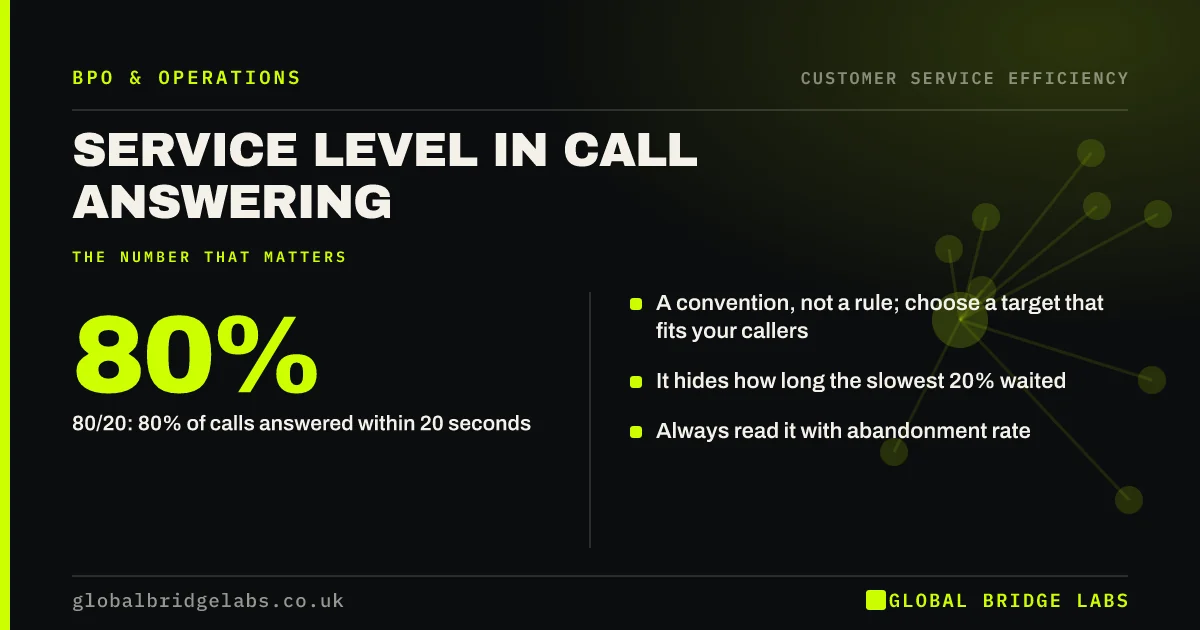
Service level 80/20 means 80% of calls are answered within 20 seconds. It is a common contact centre convention, not a regulation. It is a useful target for staffing, but it says nothing about the 20% of calls that wait longer, or whether callers got an answer. Pair it with abandonment rate and resolution measures.
- 80/20: 80% of calls answered within 20 seconds.
- A convention, not a rule; choose a target that fits your callers.
- It hides how long the slowest 20% waited.
- Always read it with abandonment rate.
Want help choosing a call answering target? Message us on WhatsApp.
Chat on WhatsApp →What is service level?
Service level is the share of calls answered within a set time, written as a percentage and a number of seconds. 80/20 is the most quoted, and 90/30 or 70/30 are also common. It measures speed of answer, not quality, and is mainly used to set staffing for each half hour of the day.
How is it calculated?
Divide the calls answered within the threshold by the calls offered, then multiply by 100. Decide how to treat calls abandoned very early, often within five seconds, because many centres exclude them. Write the formula down so it stays the same each month and matches what a provider reports.
- Calls answered within threshold, divided by calls offered.
- Decide whether to exclude very short abandons.
- Report each half hour, not just the daily total.
- Use the same definition for in-house and provider reports.
What does 80/20 hide?
It hides the tail. If 80% of calls are answered in 20 seconds, the other 20% might wait 30 seconds or ten minutes. It also hides time of day, because a good daily figure can include a poor Monday morning. And it says nothing about whether the caller's problem was solved.
What target should a small business choose?
Choose a target based on what your callers expect and what a missed call costs. A trades business taking urgent call-outs may want most calls answered in a few rings, because callers ring the next firm. A professional firm may accept a slightly slower answer if callers reach someone knowledgeable. In an illustrative case, moving from 70/30 to 80/20 might need one extra agent at peak hours. Example only.
- Call answering and admin for trades and construction firms
- Outsourced call answering for UK businesses
Want to know what a higher target would take for you? Send us your call volumes on WhatsApp.
Chat on WhatsApp →How do you hit the target consistently?
Staff each half hour to its own forecast, keep after-call work short so agents return to the phones, and use overflow cover for peaks. Watch the half-hour figures every week, not just the monthly average. A provider should report by interval so you can see where the target is missed.
When is service level the wrong focus?
Service level is the wrong focus when calls are few and long, such as complex advice lines, or when most contacts come by email. There, resolution and response time matter more. Also beware of a provider meeting 80/20 by answering quickly and transferring, which helps the number and annoys callers.
What does this look like in practice?
A pattern we see: a monthly report shows 82/20 and the owner is satisfied, while reviews mention long waits. The half-hour data shows lunchtime falls to below 50% every day. Shifting breaks and adding lunchtime cover fixes the reviews without changing the monthly headline much.
Service level checklist
Agree these before you set a target.
- Choose a target that suits your callers.
- Write the calculation down.
- Report by half hour.
- Pair it with abandonment rate.
- Check resolution as well as speed.
Next step
Tell us how many calls you take, when, and how quickly you answer today. We will help you set a realistic target and the cover it would need.
Message us on WhatsApp about call answering, or book a 30-minute consultation.
Chat on WhatsApp →Sources and further reading
- UK Customer Satisfaction Index · Institute of Customer Service
- Telephone marketing under PECR · Information Commissioner's Office
Frequently asked questions
What does an 80/20 service level mean?
It means 80% of calls are answered within 20 seconds. It is a widely used contact centre convention for planning staffing. It does not show how long the remaining 20% waited or whether their issue was resolved.
How do you calculate service level?
Divide the number of calls answered within your threshold by the number of calls offered, and multiply by 100. Decide in advance whether to exclude calls abandoned within a few seconds, and keep the same definition in every report.
Is 80/20 a good target for a small business?
It is a reasonable starting point, but not a rule. Pick a target based on what callers expect and what a missed call costs you. Urgent services may need faster answers; complex advice lines may accept slower answers from more knowledgeable staff.
Written by

Global Bridge Labs (GBL) is a UK–Sri Lanka partner for social media, websites and BPO. Everything here comes from client delivery, not theory.


