On this page
- 01Key takeaways
- 02What is a post-implementation review?
- 03When should you hold it?
- 04What should the review cover?
- 05What does a review look like?
- 06What should you decide at the end?
- 07When does a review go wrong?
- 08What does this look like in practice?
- 09Review checklist
- 10Next step
- 11Sources and further reading
- 12Frequently asked questions
Key takeaways
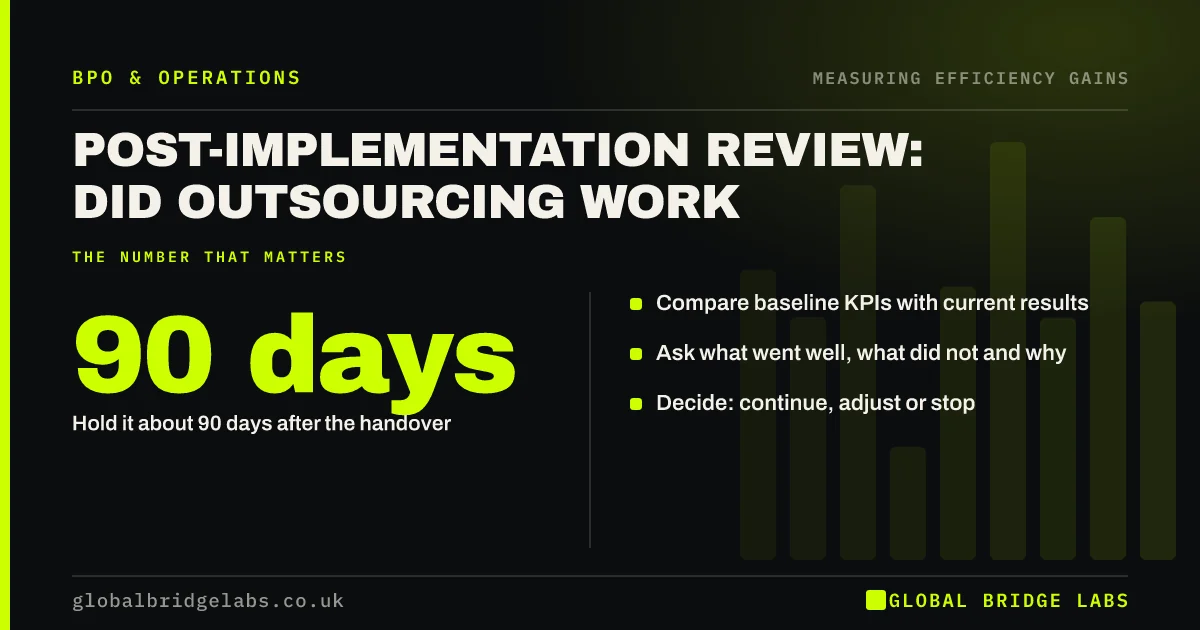
A post-implementation review checks whether an outsourcing change delivered what the business case promised. Hold it about 90 days after the handover settles. Compare the baseline with current KPIs, list what went well and what did not, and make one of three decisions: continue as is, adjust, or stop. Keep it short, factual and written.
- Hold it about 90 days after the handover.
- Compare baseline KPIs with current results.
- Ask what went well, what did not and why.
- Decide: continue, adjust or stop.
Want a review template for your outsourced process? Message us on WhatsApp.
Chat on WhatsApp →What is a post-implementation review?
A post-implementation review is a structured look back at a change once it has bedded in, to see whether it achieved its aims and what was learned. The UK government's Green Book guidance on appraisal and evaluation treats evaluation after implementation as part of good decision-making. For a small business it can be a one-page document and a one-hour meeting.
When should you hold it?
Hold it about 90 days after the handover, once the learning period is over. Earlier, the numbers still reflect settling in. Later, problems may have become habits. Book the date when the handover starts, so it happens.
What should the review cover?
Cover results against the baseline, cost against the business case, the experience of staff and customers, and what was learned. Keep each to a few lines.
- Efficiency KPIs before and after.
- Cost per task before and after.
- Senior hours returned and how they were used.
- Customer and staff feedback.
- What went well, what did not and why.
- Decision and next actions.
What does a review look like?
In an illustrative review of an outsourced customer inbox: first response fell from a day to three hours, resolution from four days to two, right first time rose from 85% to 95%, and the owner's time on the inbox fell from eight hours a week to one. Refund decisions still waited too long. Decision: continue, and delegate refunds under £50. Example figures.
- Response time vs resolution time: which one to improve
- Approval bottlenecks: when sign-off holds up the work
Want help preparing your 90-day review? Send us your before and after figures on WhatsApp.
Chat on WhatsApp →What should you decide at the end?
Decide one of three things. Continue, if results meet the case. Adjust, if results are mixed and the causes are fixable, with named actions and dates. Stop, if the process or the fit is wrong and cannot be fixed. Record the decision and the reasons.
When does a review go wrong?
Reviews go wrong when there was no baseline, so opinions replace numbers, or when they turn into blame. Keep the focus on the process and the decision. If there was no baseline, use the review to set one for the next quarter.
What does this look like in practice?
A pattern we see: an outsourced process runs for a year without a formal review, and nobody can say whether it worked. A 90-day review with the original baseline would have shown the gains and the one fix needed far earlier.
Review checklist
Prepare these before the meeting.
- Baseline and current KPIs.
- Cost per task before and after.
- Senior hours returned.
- Customer and staff feedback.
- A proposed decision.
Next step
Tell us what you outsourced and when. We will help you prepare a short review and reach a clear decision.
Message us on WhatsApp about your review, or book a 30-minute consultation.
Chat on WhatsApp →Sources and further reading
- The Green Book: appraisal and evaluation in central government · HM Treasury
- The Sourcing and Consultancy Playbooks · Cabinet Office
Frequently asked questions
What is a post-implementation review?
It is a structured look back at a change once it has bedded in, to check whether it achieved its aims and what was learned. For outsourcing, it compares baseline and current KPIs and cost, gathers feedback and ends with a clear decision.
When should you review an outsourcing arrangement?
Hold the first formal review about 90 days after the handover, once the learning period has passed. After that, review quarterly. Book the first review when the handover starts so it is not forgotten.
What if there was no baseline before outsourcing?
Use the review to set one. Record the current KPIs carefully, agree definitions with the provider and compare against them next quarter. Use staff estimates of the old performance with caution, and note them as estimates.
Written by

Global Bridge Labs (GBL) is a UK–Sri Lanka partner for social media, websites and BPO. Everything here comes from client delivery, not theory.