On this page
- 01Key takeaways
- 02What is business efficiency?
- 03How is business efficiency different from productivity?
- 04How do you measure efficiency in a small business?
- 05What are examples of business efficiency?
- 06What drags efficiency down?
- 07What does improving efficiency look like in numbers?
- 08When is chasing efficiency the wrong move?
- 09What does this look like in practice?
- 10Business efficiency checklist
- 11Next step
- 12Sources and further reading
- 13Frequently asked questions
Key takeaways
Business efficiency is how much useful output a business gets from the time, money and effort it puts in. An efficient firm delivers the same quote, order or reply with fewer hours, less waiting and fewer corrections. It is measured with a few plain numbers, such as lead time and right-first-time rate, rather than a single score.
- Efficiency means more useful output per hour, pound and handover.
- Waiting time is usually the largest source of inefficiency in office work.
- 4 measures cover most firms: lead time, touch time, accuracy and backlog.
- Busy is not efficient: a full diary can hide work that loops back.
Not sure where your business loses time? Message us on WhatsApp with the three tasks that feel slowest.
Chat on WhatsApp →What is business efficiency?
Business efficiency is the ratio of useful output to the resources used to produce it: staff hours, money, materials and management attention. A more efficient business produces the same result with fewer of those, or a better result with the same. The word useful matters. Work that is redone, chased or never used is effort with no output.
Efficiency is narrower than performance. It does not tell you whether you are doing the right things, only whether you are doing things well. That second question is effectiveness, and a business needs both.
How is business efficiency different from productivity?
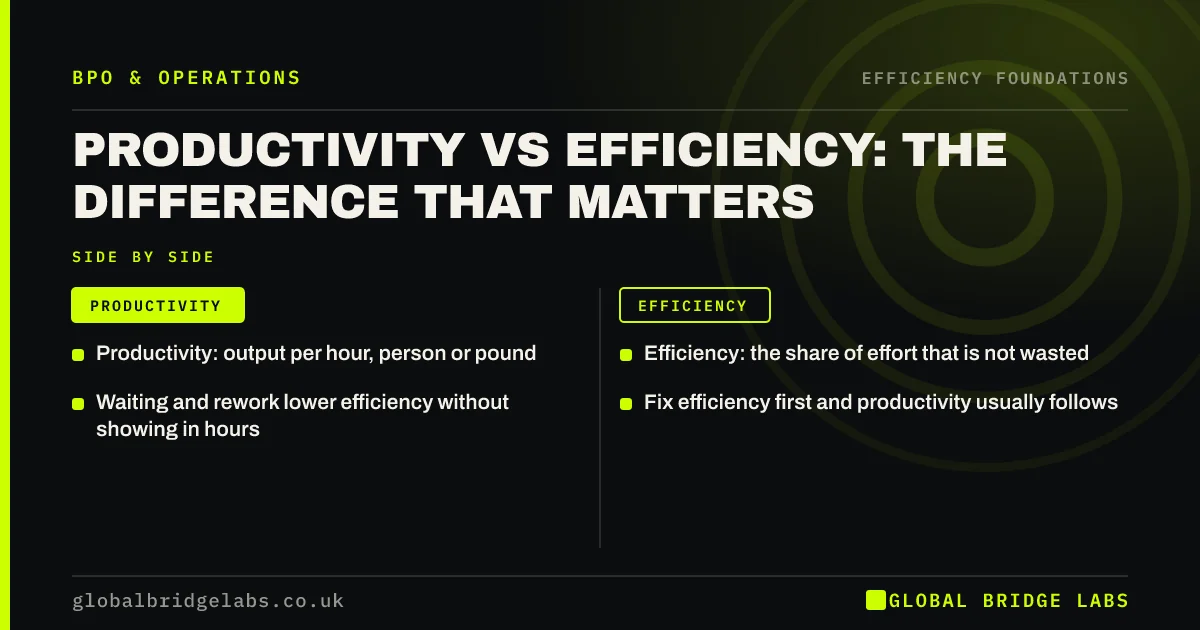
Productivity measures output per unit of input, such as orders shipped per hour worked. Efficiency asks how much of the input was wasted getting there. The Office for National Statistics reports national productivity as output per hour worked. Inside a small business, two teams can have the same productivity while one has twice the rework, which makes it less efficient.
How do you measure efficiency in a small business?
Measure efficiency process by process with four numbers: lead time (how long the customer waits from request to result), touch time (how long the work itself takes), right-first-time rate (the share completed without correction) and backlog age (how long the oldest item has waited). Together they show where time is lost.
- Lead time: request received to result delivered.
- Touch time: minutes of actual work on the item.
- Right-first-time rate: items completed with no correction.
- Backlog age: how long the oldest open item has waited.
What are examples of business efficiency?
Examples of business efficiency are concrete and countable: sending quotes the same day instead of in three days, answering customer email in hours instead of days, invoicing on completion instead of at month-end, and setting up a supplier once without three rounds of corrections. Each one removes waiting or rework rather than asking people to work faster.
What drags efficiency down?
Efficiency drops when work waits, loops back or lands on the wrong person. In small businesses the usual causes are undocumented methods, approvals that depend on one busy person, constant interruptions and data typed into more than one system. None of these shows up in the accounts, which is why they persist.
- Waiting: work sits in an inbox until someone is free.
- Rework: errors found late and fixed twice.
- Interruptions: senior people pulled into routine tasks.
- Duplication: the same data keyed into two or three places.
What does improving efficiency look like in numbers?
In an illustrative firm, an invoice takes 20 minutes of work but goes out eight working days after a job closes, because it waits for the owner to check it. Moving the check to a simple daily list and a named person brings lead time down to one day with no extra effort. The work did not get faster. It stopped waiting. These are example figures, not a benchmark.
- Work queue management: stop jobs waiting in the back office
- Little's law: why more work in progress slows delivery
Want help finding where your own work waits? Send us one process on WhatsApp and we will discuss it with you.
Chat on WhatsApp →When is chasing efficiency the wrong move?
Chasing efficiency is the wrong move when the process itself should not exist, or when speed would damage what customers value. A bespoke service with long client conversations is not inefficient, it is the product. Fix effectiveness first: stop work nobody needs, then make the remaining work flow well.
What does this look like in practice?
A pattern we see in owner-led UK businesses: everyone feels busy, so the business is assumed to be stretched. Measuring lead and touch time for one week usually shows modest workloads with long waits between steps. The efficiency gain comes from shortening the waits, often by giving one team clear ownership of the queue.
Business efficiency checklist
Use these checks on any routine process.
- Name the output and who receives it.
- Measure lead time and touch time for ten items.
- Count how many needed correcting.
- Find the longest wait and who it waits for.
- Remove one approval or duplicate entry.
- Measure again after four weeks.
Next step
Send us the one process that frustrates customers most. We will help you measure where its time goes and say plainly whether a process change, a tool or a managed team would help most.
Message us on WhatsApp to talk through your efficiency, or book a 30-minute consultation.
Chat on WhatsApp →Sources and further reading
- Labour productivity · Office for National Statistics
- Multitasking: switching costs · American Psychological Association
Frequently asked questions
What is a simple definition of business efficiency?
Business efficiency is getting more useful output from the same time, money and effort. An efficient business delivers its quotes, orders, invoices and replies with fewer hours, less waiting and fewer corrections than a less efficient one doing the same work.
How can I tell if my business is inefficient?
Look for long waits between steps, work that is often corrected, customers chasing for updates and senior people doing routine tasks. Measure lead time and touch time for ten recent items in one process. If the work takes minutes but the customer waits days, the process is inefficient.
Is efficiency the same as cutting costs?
No. Efficiency often lowers costs, but its main effect is usually speed and accuracy: customers wait less and fewer items are redone. Cutting costs without improving the process can make a business less efficient, for example by removing the person who kept a queue moving.
Written by

Global Bridge Labs (GBL) is a UK–Sri Lanka partner for social media, websites and BPO. Everything here comes from client delivery, not theory.